

How Long Do BIAB Nails Last? My Honest 2–4 Week Timeline (2026)
Let me save you the scroll: BIAB nails last two to four weeks, and three weeks is the sweet spot. That is the honest answer, and it is also the answer that nobody on the internet seems willing to give you straight, because every salon, every brand and every influencer quotes a different number — two weeks, three weeks, five weeks — and they are all technically right about someone. I have worn BIAB for two years now, through three salons, one disastrous at-home attempt, and more infills than I can count, and this is the timeline I actually live by. If you want the short version: book your infill at three weeks, expect two if your nails grow fast or your hands live in water, and never stretch it past four weeks just because the set still looks fine. Still attached does not mean still fine, and that distinction is the whole point of this article.
BIAB — Builder In A Bottle — is a brush-on builder gel that adds strength to the natural nail, thicker than gel polish and gentler than acrylic, and the reason it lasts longer than regular gel is structural: a trained technician builds a subtle apex, the slightly raised strip down the centre of the nail, which lets the set resist everyday bending instead of just chipping at the tip. That apex is also the reason the timeline matters so much, because as your natural nail grows, the apex moves further from the cuticle, the weight of the nail shifts toward the tip, and the structure that was protecting you starts working against you. If you are new to BIAB entirely, my BIAB guide explains what it is and whether it is worth it, and my honest verdict on whether BIAB is good for your nails is the article to read before you book. This one is about the clock: how long it lasts, what shortens it, what lengthens it, and when to infill.
In This Article
- My Verdict: Three Weeks Is the Sweet Spot
- My Week-by-Week Wear Diary
- What Actually Decides How Long BIAB Lasts
- BIAB vs Gel Polish vs Acrylic: How the Timelines Compare
- Infill or Removal? When to Book What
- The Cost Math: What BIAB Actually Costs Over Six Months
- Mistakes to Avoid (I Made Them All)
- Frequently Asked Questions
My Verdict: Three Weeks Is the Sweet Spot
Here is why I say three weeks, when the internet says everything from two to five. Two weeks is what you get with fast-growing nails, or a set applied over nails that were not prepped properly, or hands that live in water — and two weeks is not a failure, it is just the short end of normal. Four weeks is what you get with slow-growing nails, thorough prep, daily cuticle oil, and a bit of luck — and four weeks is the point where I start getting nervous, because the regrowth line has moved well past the reinforced part of the nail, which raises the chance of snags and breaks at that weaker point. Five weeks is what some people claim online, and I believe them, but being able to keep a set on for five weeks does not mean you should: the structure has moved so far from the cuticle that the nail is carrying weight in the wrong place, and the risk is not that it looks bad, it is that it breaks — and a break at the stress point hurts, and it takes the natural nail with it.
Three weeks is the point where everything is still true: the set still looks fresh, the apex is still roughly where it should be, the regrowth gap is small enough that nobody notices it, and the infill is a quick appointment rather than a rescue mission. Every nail tech I have asked has said the same thing in different words: two to three weeks for most clients, three to four for slow growers, never past four without a fill. So my timeline is not a guess, it is the consensus, confirmed by my own hands over two years. If your nails grow fast, book at two and a half weeks. If they grow slowly and you oil daily, you can push to four. But three is the default, and the default is the default for a reason.
One more thing the verdict depends on: what kind of BIAB you have. Used as a strengthening overlay over natural nails — the most common application — most people get four weeks of wear before the grown-out base becomes noticeable, and with proper prep and slow-growing nails some people stretch to five. Used as an extension with nail forms or tips, expect three to four weeks, because the extension carries more weight and more leverage. And if you are doing BIAB at home, expect the salon timeline only after your third or fourth set — my first at-home set lasted eleven days, and I am not embarrassed to say so, because the prep is a skill and skills take practice. My at-home BIAB guide is honest about that learning curve.
My Week-by-Week Wear Diary
I kept a diary on my last full BIAB cycle, because I wanted to know what actually happens, week by week, instead of relying on memory. Here it is, unedited in its honesty. Week one: perfect. The set looks like it did in the salon — glossy, smooth, no regrowth visible, no lifting, no chips. I forget I have nails on, which is the highest compliment a manicure can get. I am typing, cooking, opening cans with my knuckles like a responsible adult. Cuticle oil every night, gloves for the washing-up, and the set does not notice any of it.
Week two: still excellent, with one change — a hairline of regrowth at the cuticle, maybe a millimetre, visible only if I look for it. The apex is still in the right place. The shine is still there. This is the week where BIAB earns its reputation, because a gel polish set would already be showing wear at the tips and a regular manicure would be chipped. Nothing has chipped. Nothing has lifted. I start to feel smug, which is always a mistake. Week three: the regrowth gap is now two to three millimetres, visible in photos and noticeable to me, though strangers would not see it. The set still feels solid, the apex has shifted slightly toward the tip but not enough to matter, and this is the week I book the infill — because the set still looks good, the appointment is routine, and I am in control of the timing instead of the timing controlling me.
Week four, the one time I stretched it: the regrowth gap is four millimetres, the apex is visibly too far forward, and the nails feel top-heavy — I catch one on a drawer and it does not break, but it bends in a way that makes my stomach drop. The set still looks fine from across a room, and that is the trap: it looks fine, so I tell myself it is fine, but the structure is wrong now, and the risk is a break at the stress point, which is the most painful kind. I got the infill that week and the tech told me I was lucky. I have not stretched past three and a half weeks since, and I do not plan to. The diary taught me that the timeline is not about looks — it is about structure, and structure is invisible until it fails.
Fino Tip: Photograph your set on day one and again at week two. The comparison shows you your actual regrowth rate, and your actual regrowth rate is the number that decides your infill interval — not the internet’s average, not your friend’s schedule, yours. Mine grows about a millimetre a week, which is why three weeks is my number.
What Actually Decides How Long BIAB Lasts
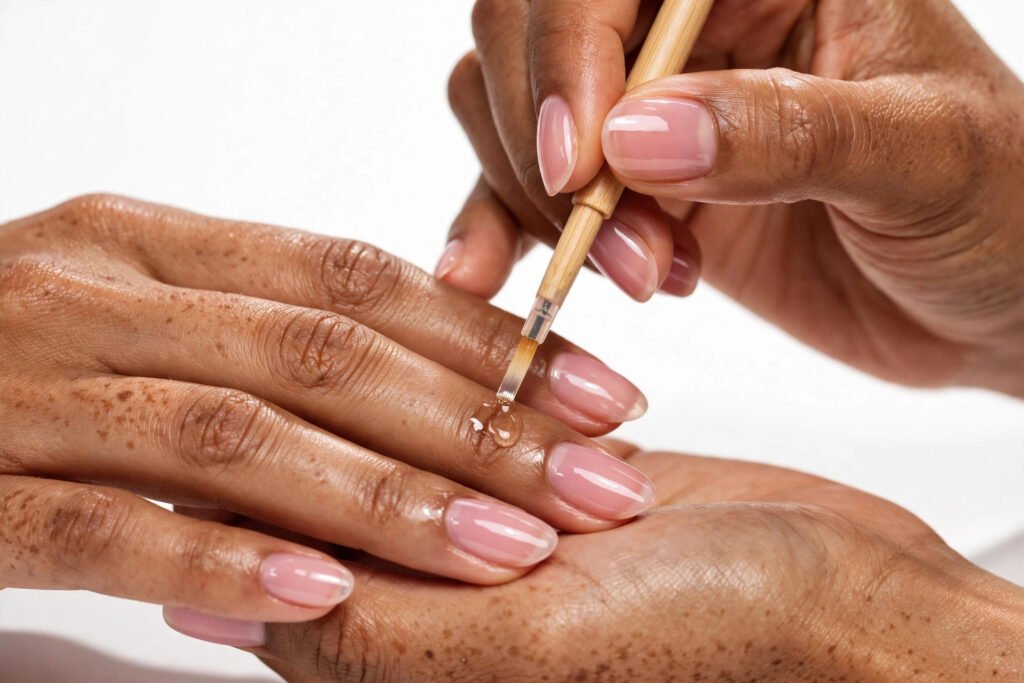
The single biggest factor in how long BIAB lasts is nail prep, and I cannot overstate this. Skipping the dehydrator, or applying gel that touches the cuticle skin, will cause the overlay to lift in days rather than weeks — and lifting in days is a prep failure, not a product failure. Proper prep with a dehydrator and primer gets you four to five weeks. Prep skipped gets you one to two weeks, with lifting likely. Gel flooded onto the cuticle or sidewalls gets you less than two weeks, because the gel cures onto skin instead of nail, and as that skin naturally sheds it takes the edge of the gel with it. If your sets keep failing early, the answer is almost certainly prep, not the brand of BIAB, and a good tech will tell you that honestly.
After prep, the factors are: your nail growth rate (fast growers show regrowth sooner, so they need an infill closer to two weeks), your lifestyle (hands in water, typing all day, gym, gardening, cleaning without gloves — water makes nails swell and contract, and that movement breaks the seal), your aftercare (daily cuticle oil after curing genuinely extends wear, up to five weeks in the best cases, because oil reduces brittleness and keeps the natural nail flexible under the gel), and the condition of your natural nails underneath (thin, peeling, or damaged nails give the gel less to grip, and the set will not last as long until the natural nail recovers). Length matters too: BIAB is not designed for dramatic length, and if you want long extensions, a hard gel gives you more control and more protection.
The factor nobody talks about is the apex, and it is the one that explains the four-week limit better than any other. The apex is the slightly raised strip down the centre of the nail, and it is what lets a BIAB set resist bending. As your nail grows, the apex moves forward with the product, away from the cuticle and toward the tip — and the stress point, where the nail is most likely to break, moves with it. At three weeks the apex is still roughly central. At five weeks it is near the tip, and the base of the nail — the part doing the growing — has no reinforcement at all. That is why the experts say never go past four weeks without a fill, even if the set looks fine: the structure has moved, and the risk is invisible until it is a break.
BIAB vs Gel Polish vs Acrylic: How the Timelines Compare
BIAB and gel polish wear for a similar length of time on paper — two to three weeks for gel polish, two to four for BIAB — but the experience is different in two ways that matter. First, BIAB lasts about a week longer in practice, because the thicker builder gel with its built-in apex resists bending and holds its shape for an extra week or more, where gel polish is a thin colour coat that chips at the tip. Second, and more importantly, BIAB is designed to be infilled instead of fully removed: the bulk of the product stays in place and only the regrowth area at the base is topped up and reshaped, which means less soaking, less filing, and less stress on the natural nail over time. Gel polish needs a full removal and reapplication every cycle.
Acrylic is the longer-lasting option — three to four weeks routinely, and my acrylic longevity guide has the full timeline — but it is harder on the natural nail, it needs infills too, and the removal is harsher. Gel-X sits in the same two-to-three-week window as gel polish, and my Gel-X lasting guide covers how to stretch it. The honest comparison is this: if you want the longest wear with the least damage, BIAB wins on the combination. If you want dramatic length, acrylic or Gel-X wins. If you want the cheapest cycle, gel polish wins, but you pay for it in more frequent appointments. And if you are choosing between BIAB and its closest rivals, my BIAB vs gel polish comparison and my BIAB vs acrylic comparison have the full round-by-round verdicts.
Infill or Removal? When to Book What
The question I get asked most after “how long does it last” is “do I infill or start over”, and the answer is almost always infill. BIAB is designed for it: the tech files down the top layer, fills the regrowth gap at the cuticle with fresh builder gel, reshapes, and you are done in about forty-five minutes — faster than a full set, cheaper than a full set, and kinder to your natural nails, because the bulk of the product never comes off. Book the infill every two to three weeks, or as soon as you see regrowth or lifting at the cuticle, and you can keep the same set going for months, infill after infill, with the natural nail growing stronger underneath.
Removal is the right choice in three situations: when you want a break from BIAB and your natural nails need a rest, when the set has lifted in multiple places and an infill would be building on a compromised foundation, or when you want to change the shape or length significantly. Removal is a soak-off — file the top coat, wrap in acetone-soaked cotton and foil for fifteen to twenty minutes, gently push the softened gel off — and it should never involve prying or peeling, because peeling BIAB off takes layers of your natural nail with it. My BIAB removal guide has the safe method step by step, and the short version is: soak, do not peel, and if it is not coming off, soak longer. If you are deciding between BIAB and Gel-X for your next set, my BIAB vs Gel-X comparison will help, and if you want BIAB on tips specifically, my BIAB on nail tips guide covers whether it works.
The Cost Math: What BIAB Actually Costs Over Six Months
A BIAB manicure costs roughly $50–100 per application depending on your region — bigger cities tend to charge more — and an infill is usually $10–20 less than a full set. Run the math over six months at my three-week interval: that is about eight to nine appointments, roughly $450–750 in total, or $75–125 a month. At a two-week interval, it is thirteen appointments and $650–1,200. At a four-week interval, it is six to seven appointments and $300–600 — but you are paying for that saving in breakage risk, and one bad break costs you a nail, a repair appointment, and weeks of growing it back. The three-week interval is the cheapest option that is also safe, which is the kind of math I like.
The at-home math is different and worth knowing: a BIAB starter kit costs $50–120, and a well-applied home set lasts just as long as a salon one once you have practised — my first set lasted eleven days, my fourth lasted three weeks, and the kit paid for itself by the second set. The hidden cost is time: a full set takes thirty to forty-five minutes once you have practised, and an hour or more the first time. If you value your Saturday mornings, the salon is still the better deal. If you enjoy the ritual, the kit is the bargain of the year. Either way, daily cuticle oil is the cheapest investment in the whole equation — a bottle costs a few dollars and it is the single aftercare habit that measurably extends wear.
Mistakes to Avoid (I Made Them All)
The first mistake is stretching it. I did it once, to four weeks, and I was lucky — the set did not break, but the apex had moved so far forward that the tech told me I was one drawer-catch away from a break at the stress point. Still attached does not mean still fine, and the four-week limit exists for structure, not for looks. The second mistake is the at-home prep shortcut: my first at-home set skipped the dehydrator because I did not own one, and it lifted in eleven days. Buy the dehydrator. It costs less than the BIAB itself and it is the difference between two weeks and four. The third mistake is picking at a lift — the moment you see a hairline gap at the cuticle and start worrying it with your thumbnail, you are tearing the gel off the nail plate and taking keratin with it. Call your tech, or soak it off properly.
The fourth mistake is treating BIAB like it is indestructible. It is stronger than gel polish, not invincible — using your nails as tools, opening cans, scraping labels, and gardening without gloves will break it, and the break will be at the stress point, which is the painful one. The fifth is going past four weeks because the set “still looks good” — it does look good, that is the trap, and the risk is invisible until it is a break. And the sixth is removing it wrong: peeling, prying, or biting it off, which damages the natural nail so badly that the next set will not last either, because damaged nails give the gel nothing to grip. Soak it off, every time, no exceptions.
Frequently Asked Questions
How long do BIAB nails last? BIAB nails last two to four weeks, with three weeks the sweet spot for most people. With good prep and slow-growing nails some people reach four to five weeks, but leaving BIAB much beyond three weeks increases the risk of lifting and breaks, and it is never recommended to go past four weeks without a fill.
How often should I get a BIAB infill? Every two to three weeks, or as soon as you see regrowth or lifting at the cuticle. Fast-growing nails need an infill closer to two weeks; slow-growing nails can stretch to three or four. The infill tops up the regrowth area and reshapes the apex, and it is faster and cheaper than a full set.
Can BIAB last 5 weeks? Some clients achieve around four weeks or more of wear, but that does not mean you should wait that long between maintenance appointments. The longer your natural nail grows, the further the original structure moves away from where it was first applied, and the risk of lifting and breakage rises sharply past four weeks.
How long does BIAB last compared to gel polish? BIAB lasts about a week longer — two to four weeks versus two to three for gel polish — because the thicker builder gel with its built-in apex resists bending. BIAB is also designed to be infilled rather than fully removed, which is kinder to the natural nail over time.
Does BIAB damage your nails? No, if it is applied and removed correctly. Damage comes from poor prep, from peeling or prying it off, or from leaving it too long and breaking at the stress point — not from the product itself. My full verdict on BIAB and nail health goes deeper.
How long does a BIAB manicure take? A full set takes around an hour at the salon, and thirty to forty-five minutes at home once you have practised — your first home set will take an hour or more. An infill takes about forty-five minutes. Each layer cures in thirty to sixty seconds under an LED lamp.
That is the timeline, and here is my honest summary after two years of wearing it: BIAB is the best-wearing manicure I have found for natural nails, and the three-week infill is the habit that makes it work. Book at three weeks, oil daily, wear gloves for the washing-up, and never stretch past four just because it still looks good. Your nails will grow stronger underneath, your appointments will be routine instead of rescues, and you will spend less money than the person stretching to five weeks and paying for the break. If you are still deciding whether BIAB is right for you, start with my BIAB guide — and if you are already wearing it, set the three-week reminder now. Future you will be grateful.


Pingback: BIAB on Short Nails: Does It Work? My Honest Guide