

In This Article
- What dip powder actually is
- Dip vs acrylic: my honest comparison
- Which I’d choose (for real)
- 4 questions I get asked most
Everyone knows the acrylic vs gel debate — I wrote the full breakdown last week. But the question I get asked more than any other lately is about the third option: dip powder. It’s the manicure your friend swears lasts a month, the one with no UV lamp, the one that smells like nothing. I’ve worn dip, acrylic, and gel extensively over the years — sometimes switching seasonally — and I’ve asked working techs what they actually prefer doing. Here’s my honest take on dip vs acrylic: how they compare on wear, cost, health, and which one I’d spend my own money on.
What dip powder actually is
Dip (often called SNS, the biggest brand) is exactly what it sounds like: nail coated in bonding base, dipped into fine colored powder, sealed with activator. No lamp — the activator cures it chemically in seconds. The powder is essentially finely-milled acrylic, same family as traditional acrylic, different application. It goes over natural nails as a long-wearing manicure or over tips as extensions. What I noticed first switching from acrylic: the appointment is faster, there’s no monomer smell at all, and the results are remarkably consistent — which makes sense, since there’s no hand-sculpting variable. My first dip manicure lasted 26 days, and I spent the whole month slightly annoyed at acrylic for taking twice as long.
Dip vs acrylic: my honest comparison
Durability — slight edge to acrylic for extremes
Both are hard acrylic-family products, so both are tough — my dip manicures go 3-4 weeks, same as my acrylic sets did. Where I notice the difference: dip’s powder application creates very even thickness with no weak spots, which is great for everyday wear. But for very long lengths, acrylic wins because a skilled tech builds an apex — extra structure exactly where long nails need it — and dip’s uniform coating can’t reinforce specific points. My rule: natural-nail overlays at normal lengths, it’s a tie. Dramatic extensions, acrylic. The one break I had in two years of dip was a long thumbnail that caught a car door — user error, not product failure.
Best for wear: Dip for natural nails, acrylic for drama.
Appointment experience — dip, comfortably
45-75 minutes for dip versus 1.5-2.5 hours for a full acrylic set, and the dip appointment is dramatically more pleasant: no fumes, no headache, no chemical smell in your hair afterward. I didn’t realize how much I disliked the acrylic smell until I experienced the alternative. If you’re scent-sensitive or pregnant (ask your doctor about any nail service), this alone decides it. Time + comfort is the reason I switched my regular manicures to dip.
Best for your schedule: Dip, no contest. I save roughly an hour per appointment versus acrylic full sets, and over a year of monthly manicures that’s twelve hours of my life back.
Fino Tip: Ask whether the salon uses the dip jar communally or pours powder per client. Hygienic salons pour — shared jars are a sanitation red flag I wish someone had told me about sooner.
Cost — acrylic wins long-term
Real numbers from my area (2026): dip over natural nails $40-65; acrylic full set $45-80, fills $30-50. So dip looks cheaper — until you learn dip can’t really be filled. Most techs soak off the entire dip manicure and redo it fresh every visit, while acrylic gets cheaper fills. Over six months, my acrylic-with-fills routine cost noticeably less than my all-fresh dip routine. Dip over tip extensions ($55-85) costs slightly more than acrylic full sets. If budget is the deciding factor and you want extensions, acrylic’s fill cycle wins. If you want natural-nail manicures and don’t mind full redo pricing, dip’s per-visit cost is fine.
Best for budget: Acrylic with regular fills.
Nail health — technique beats product
Here’s what the marketing won’t tell you: dip powder IS acrylic powder. The “vitamin-enriched, healthier” claims are mostly branding — I believed them until a tech laughed and explained the chemistry. Dip’s genuine advantages: no harsh monomer on your skin, and soak-off is slightly gentler. But both need nail buffing, both need acetone removal, and both are destroyed by picking/peeling — which is the actual #1 damage cause for both systems, not the product. I’ve had healthy nails under both and damaged nails under both; the difference was always the tech’s filing and my removal behavior. Choose a good tech over a “healthier” product, every time.
Best for nails: Whichever one you remove properly. I’ve had healthy nails under both systems and damaged nails under both — the difference was always the tech’s filing and my own removal behavior, never the product name on the jar.
Color and design — acrylic, by a mile
Dip’s real weakness, and the reason I still get acrylic sometimes: pre-mixed powders only. What the salon stocks is what you get — usually 30-80 colors — versus effectively unlimited acrylic options since any gel polish goes over acrylic. Ombre, detailed art, chrome, my cat-eye obsession: all easy over acrylic, all difficult or impossible with dip. I’m a “same elegant nude for weeks” person 80% of the time, so dip’s limitation rarely bothers me — but the 20% of the time I want something fun, I book acrylic. Know which person you are.
Best for variety: Acrylic, easily.
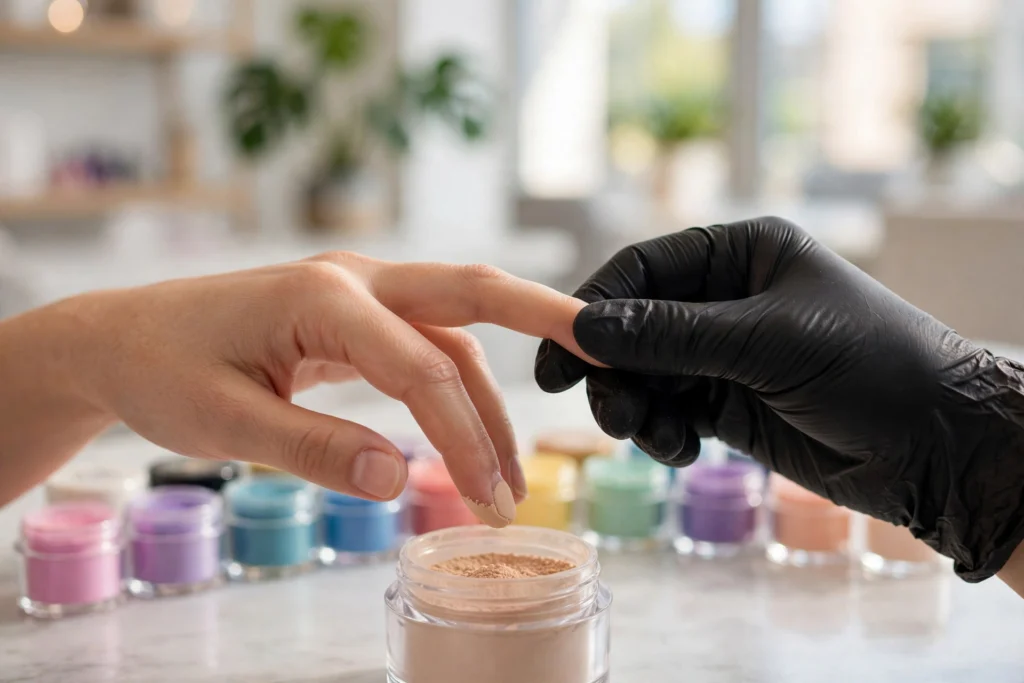
What a dip appointment actually looks like
For anyone who’s never had one, here’s my typical 60 minutes: nails filed and shaped (10 min), cuticles pushed, surfaces lightly buffed and dehydrated (10 min). Then the dip cycle per nail — base coat painted on, finger dipped or powder poured over, tap off excess, repeat for opacity (usually 2-3 dips), then activator painted over everything (20 min for all ten). The activator hardens the powder almost instantly — you’ll hear it, a faint clicking as it cures. Then shaping and buffing smooth (10 min), top coat, done. Compared to acrylic’s sculpting — where you’re watching the tech build tiny beads and shape them freehand for an hour — dip feels almost industrial in its efficiency. I find it relaxing in a different way: less artistry to watch, more steady rhythm. The smell difference hits you in the first five minutes — or rather, the absence of smell does.
Dip powder shades I keep going back to
Since dip limits your palette, the shades you choose matter more. My rotation: a warm nude that matches my skin (my 80% default), deep burgundy for fall, soft white for summer, and one fun shade per season (this fall it’s a burnt terracotta). I pick dips differently than polishes — because you’re wearing it a month, I go safer and more neutral than I would with a 7-day polish. The month-long commitment is also why I test unfamiliar shades as regular polish first. One more thing I learned: dip colors look slightly deeper than the jar suggests once activated and top-coated, so when choosing between two nudes, I take the lighter one.
Which I’d choose (for real)
I choose dip for my regular natural-nail manicures: faster, odorless, consistent, lasts nearly a month. I’d choose acrylic for dramatic length, sculptural shapes, unlimited colors, or the cheapest long-term maintenance. I’d look at builder gel if my nails were fragile — it’s the quiet fourth option techs keep recommending, sitting between dip’s simplicity and acrylic’s versatility. And honestly? I switch. Dip most months, acrylic when I want a statement. There’s no loyalty oath in nail systems.
Switching is easy both directions — soak off completely first, never layer systems. Tell your tech what you’re currently wearing; the prep differs. My actual pattern these days: dip from spring through summer (low maintenance, clean look), acrylic in fall and winter when I want richer colors and the occasional statement set. The systems don’t care about your loyalty, and neither should you.
Dip vs Acrylic — FAQ
Is dip powder actually healthier than acrylic?
Marginally, not dramatically. Same chemical family; dip skips the harsh liquid monomer, which is genuinely gentler. But buffing, acetone, and picking damage apply equally. I trust technique over product claims now.
How long does each last?
Both 3-4 weeks in my experience. The cost difference is in maintenance: dip gets fully redone ($40-65), acrylic gets fills ($30-50). Six months of acrylic-with-fills was cheaper for me.
Can I do dip at home?
Yes — kits are beginner-friendlier than acrylic sculpting, no lamp needed. But salon dip looks better: thinner, smoother, more even. My first home attempt was… chunky. Manage expectations.
Why can’t dip be filled?
The powder-activator chemistry doesn’t blend with grown-out product the way sculpted acrylic does. Most techs do full soak-off and fresh application — which is also why dip takes the same time every visit.
Final Thoughts
Dip vs acrylic was never really a battle for me — they’re different tools, and I use both. Fast, odorless, consistent wear: dip. Drama, color freedom, cheap fills: acrylic. The best choice is the one matching how you actually live. For the other big system debate, see my acrylic vs gel guide — and browse Acrylic & Gel Nails for everything in this lane.



Pingback: Dip Powder vs BIAB: Which Is Better? (2026)
Pingback: Dip Powder vs Press-On Nails: Which Is Better?
Pingback: How Long Do Dip Powder Nails Last? My 3–4 Week Timeline