I have worn both Gel-X and BIAB for months at a time, sometimes back to back, and I still get asked the same question at least once a week: which one is actually better? The honest answer is that neither one wins outright, because they solve different problems. Gel-X gave me instant length and a perfect shape on nails that refused to grow past my fingertips. BIAB gave me my own nails back, stronger and longer than I thought they could ever be, without adding a single extension. If you pick the wrong one for your nail goals, you will be disappointed no matter how good your technician is, so this comparison is the one I wish someone had handed me before I spent money learning the difference the hard way.
Before we go any further, let me clear up the naming confusion, because it trips up almost everyone. BIAB, builder gel, and builder in a bottle all describe the same system: a thick, soak-off gel that is brushed onto your natural nail like a polish but builds real structure and strength as it cures. Some salons say “builder gel” and some say “BIAB” depending on the brand they stock, but when I use either term here, I mean that same brush-on strengthening gel. Gel-X, on the other hand, is a full-cover soft gel tip system: a pre-shaped tip is glued onto your natural nail with gel and cured under a lamp, giving you a full extension in one step. Gel-X versus BIAB is therefore not a battle between two polishes. It is a choice between adding length instantly and strengthening the length you already have, and once you see it that way, the right answer for your nails usually becomes obvious.
I have had Gel-X sets that lasted a full three weeks through cooking, cleaning, and a holiday, and BIAB manicures that carried my natural nails through a growth phase I had given up on. I have also had both go wrong: a Gel-X set that popped off on day four because prep was rushed, and a BIAB set that peeled because I picked at it during a stressful week. Those failures taught me more than the perfect sets did. I will walk you through durability, damage, removal, finish, cost, grow-out, and who each system genuinely suits, so you can walk into your appointment already knowing what to ask for.
In This Article
- What Gel-X Actually Is (And What It Isn’t)
- What BIAB Actually Is
- Durability: Which Lasts Longer on Real Hands?
- Nail Health and Damage: The Question I Get Asked Most
- Removal: The Part Nobody Talks About Enough
- Look and Finish: Shape, Length, and That “Natural Nail” Question
- Cost and Salon Time: What You Actually Pay For
- Grow-Out and Maintenance: Life Between Appointments
- Who Should Pick Which? My Honest Decision Guide
- My Final Verdict
- Mistakes to Avoid
- Frequently Asked Questions
What Gel-X Actually Is (And What It Isn’t)
Gel-X is a soft gel extension system, and the word “soft” matters more than most people realise. Traditional acrylic extensions and hard gel extensions are filed off or soaked off with difficulty, and they sit on the nail like a rigid shell. Gel-X tips are made from a flexible soft gel that soaks off in acetone, which is why removal is gentler than most people expect from an extension system. The technician sizes a pre-formed tip to each of your nails, applies a thin layer of gel to your natural nail and the inside of the tip, presses it on, and cures it under a lamp. There is no sculpting with a brush, no monomer smell, and no long drying window where you cannot touch anything. My first full Gel-X set took under an hour and a half, and I walked out with almond nails that looked like I had grown them myself for six months.
The length and shape you get on day one
The single biggest advantage of Gel-X, and the reason I keep coming back to it before events, is that you get the finished length and shape immediately. If your natural nails break at the same short length every time, no amount of cuticle oil will fix that before a wedding on Saturday. Gel-X lets you choose a shape, almond, coffin, square, stiletto, and a length that suits your hands, and you leave the salon with it already done. I have tried the medium almond tips most often, because they look elegant without getting in the way of typing, and I learned that going dramatically longer than your natural nail bed on the first set is a recipe for lifting at the sides. The tips come in a huge range of sizes, and a good technician will size down rather than force a tip that is slightly too wide, because an over-wide tip puts pressure on your sidewalls and peels away from the cuticle within days.
Fino Tip: If you are trying Gel-X for the first time, ask your technician to show you the tip sizes before they are applied and pick a length one step shorter than the dramatic set you are dreaming of. You can always go longer next time, but a first set that is too long teaches you to hate extensions before you have learned how to live with them.
What BIAB Actually Is
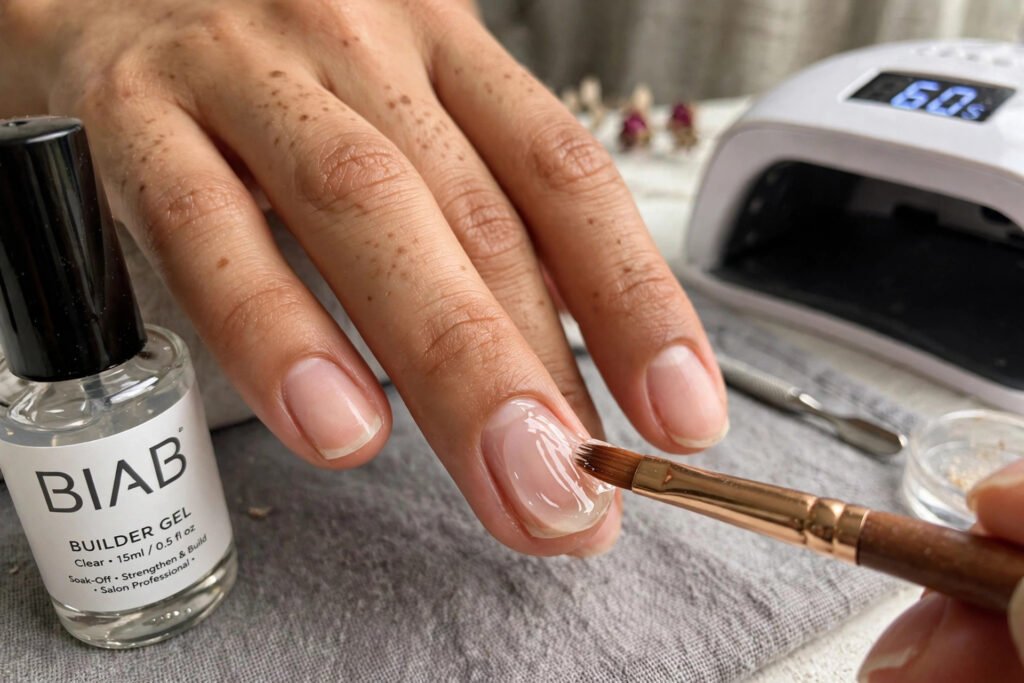
BIAB is not an extension, and that distinction changes everything about who it suits. It is a thick builder gel brushed directly onto your natural nail, usually over a base coat, and cured in layers until it forms a structured, slightly domed layer that protects your nail while it grows. There is no tip glued on, no added length beyond a millimetre or two of free-edge support, and no sculpting form in most appointments. The first time I had BIAB, I honestly wondered whether anything had happened at all, because my nails looked like a very good gel manicure. Then, three weeks later, I realised none of them had snapped at the corners the way they always did, and by the second infill I had visible free edge that was actually mine. That slow, unglamorous progress is the whole point of the system, and it is why people who stick with it become so loyal to it.
Why BIAB works as a growth system
Most natural nails do not fail because they are inherently weak. They fail at the stress points: the corners of the free edge catch, split, and peel, and then you bite or file the whole nail back to match. BIAB works because it builds an apex, a thicker zone near the centre of the nail, that distributes pressure across the nail plate instead of letting it concentrate at the weakest edge. It also seals the free edge in a way that regular gel polish simply does not, so water, soap, and daily knocks do less damage between appointments. I noticed the difference most clearly on my index fingers, which always peeled in layers from the tips inward. Under BIAB, the peeling stopped because the gel layer took the wear instead of my nail plate, and when the gel was soaked off months later, the nail underneath was smoother and longer than it had been in years. If you want the full breakdown of how the system is applied, my builder gel guide walks through the BIAB process step by step, including what to expect at your first appointment.
Best for: Anyone whose goal is growing out their own nails, or keeping medium-length natural nails intact through daily life, rather than getting instant long extensions.
Durability: Which Lasts Longer on Real Hands?
On paper, both systems claim two to four weeks of wear, but in real life the answer depends on what your hands actually do all day. My Gel-X sets have lasted anywhere from ten days to a full four weeks, and the difference was almost never the product. It was my nail prep, my length choice, and whether I spent the week doing things that levered the tips from underneath. Gel-X holds up beautifully when the tips are well fitted and the length is sensible, because the soft gel flexes slightly with your nail instead of cracking like a rigid acrylic can. But a long Gel-X set on someone who opens cans, types aggressively, and gardens without gloves is living on borrowed time. The tip is a separate piece bonded to your nail, so any force that bends it sideways stresses that bond, and once one corner lifts, water gets underneath and the whole tip loosens fast.
How BIAB durability compares week by week
BIAB durability looks different because there is no separate piece to pop off. In my experience, a BIAB manicure lasts a solid three to four weeks on most nails, and the wear shows up as gradual growth at the cuticle and minor wear at the tips rather than sudden lifting. That makes it more forgiving for people who are hard on their hands, because a small chip at the free edge does not mean the whole nail is compromised. I have gone swimming, cooked daily, and cleaned without gloves in BIAB, and while I would never recommend skipping gloves, the manicure survived abuse that would have cost me at least one Gel-X tip. The trade-off is that BIAB will not save a nail that is already splitting badly underneath unless the technician builds enough structure, and a too-thin application peels at the free edge within a week. Thickness is not vanity here; it is the entire mechanism, so if your BIAB feels like a normal gel polish, it probably was applied too thinly to do its job.
Best for: Durability under daily wear goes to BIAB for natural nails, while Gel-X wins for guaranteed length that survives a specific event or holiday window.
Nail Health and Damage: The Question I Get Asked Most
People ask me whether Gel-X or BIAB damages nails, and my honest answer is that neither system damages healthy nails when it is applied and removed properly, but both can damage nails when corners are cut. Damage almost never comes from the gel itself. It comes from over-filing the natural nail plate during prep, from prying or peeling off a set at home instead of soaking it off, and from leaving lifting product on for weeks while moisture and bacteria build underneath. I learned this the painful way when I peeled off a lifting Gel-X tip in a hurry before a trip and took a thin layer of my nail plate with it. That nail stayed weak and bendy for two full growth cycles, and no product could undo a removal mistake that took ten seconds to make. The system gets blamed, but the removal method was the real culprit.
What each system does to your natural nail underneath
Underneath a well-applied set, the two systems treat your nail quite differently. Gel-X covers the entire nail plate with a tip and gel, so your natural nail is protected from daily wear but also sealed away from air and moisture for weeks. That is fine for a few sets in a row, but I personally give my nails a short break between long runs of extensions, because I like to see what is happening underneath. BIAB, by contrast, is a treatment as much as a manicure: it stays bonded to the nail and grows out with it, so your natural nail is being supported the whole time rather than covered by a separate piece. After several months of BIAB, my nails were measurably longer and less prone to peeling, which is the opposite of damage. If your nails are already thin, brittle, or recovering from acrylics, the gentler path is usually BIAB first, and if you want practical recovery steps, my guide on how I strengthened my nails after extensions covers the routine that actually worked for me. Neither system is a miracle cure, but BIAB is the one I recommend when the goal is healthier nails at the end, not just prettier nails for three weeks.
Best for: Nail health and recovery goes to BIAB, especially for thin, peeling, or post-acrylic nails that need support while they grow.
Removal: The Part Nobody Talks About Enough
Removal is where I see the most regret, because people choose a system based on how it looks on day one and never ask how it comes off on day twenty-one. Gel-X removal is a soak-off process: the top layer is filed to break the seal, the nails soak in acetone, and the soft gel tips soften and slide off, usually with gentle pushing from a cuticle stick. It is noticeably quicker and less aggressive than removing acrylics, and I have had full Gel-X removals done in about thirty minutes in-salon. The catch is that you still need the soak, and you still need patience. If you try to peel a softened tip off early because you are bored of soaking, you will take nail layers with it, and that damage is entirely avoidable. I also find that at-home Gel-X removal is doable but messy, because you need to keep acetone on all ten nails at once without flooding your skin.
BIAB removal and the infill question
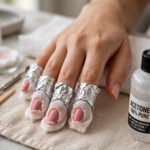
BIAB removal is also a soak-off, but there is an important difference in how most people actually maintain it: you usually do not remove BIAB fully at all. At an infill appointment, the technician files back the grown-out area, rebalances the apex, and applies fresh builder gel over the existing layer, so your nails are never left bare and vulnerable between sets. I love this rhythm because it means my nails are continuously protected, and it cuts down on the repeated full-soak cycle that dries out skin and cuticles. When BIAB is fully removed, it soaks off in acetone like other soft gels, though thicker applications take longer than a thin gel polish removal. If you ever need to take it off at home, my at-home gel removal guide explains the foil-and-acetone method safely, and the same patience rule applies: never force, never pry, and stop if you feel resistance. A removal that takes ten extra minutes is always cheaper than a nail that takes three months to regrow.
Best for: Easy ongoing maintenance goes to BIAB with infills, while Gel-X wins for a clean, complete removal when you want a totally fresh start or a break.
Look and Finish: Shape, Length, and That “Natural Nail” Question
Visually, Gel-X and BIAB can look surprisingly similar in photos, which is why people get confused when they try to choose from Instagram alone. Both can be finished with gel polish, chrome, French tips, nail art, or a simple glossy nude, and both look polished and salon-finished. The difference shows up in person, in the silhouette of the nail. Gel-X gives you a sculpted, uniform shape across all ten nails, because every tip is manufactured to the same curve and length. That uniformity is gorgeous if you want a perfect almond or coffin set, and it hides the fact that your natural nails are different widths and shapes. BIAB follows your natural nail: it enhances the shape you already have, smooths the surface, and adds strength, but it will not turn a short, wide nail bed into a long, narrow stiletto overnight. I have come to love both looks for different reasons, but I reach for Gel-X when I want a dramatic, camera-ready set and BIAB when I want nails that look like mine, only better.
The natural look, the dramatic look, and everything between
There is also a thickness difference that you feel more than you see. A good BIAB application has a visible but natural-looking apex, so the nail looks slightly plumper from the side than a bare nail, but still flexible and realistic. Gel-X tips are thinner and more uniform, so the nail can look sleeker from the side, though very long tips can start to look obviously artificial if the shape does not suit your finger length. I learned to judge this by looking at my hands from the side, not just from above in a photo. From above, almost anything looks good under good lighting. From the side, you can see whether the apex sits in the right place and whether the tip curves naturally or sticks out like a shelf. If you are deciding between systems mainly for a special occasion, Gel-X gives you the widest shape menu on day one. If you want a set you can wear to work, to the gym, and to dinner without thinking about it, BIAB’s natural finish is hard to beat, and it photographs beautifully in a way that does not scream “extensions.”
Best for: Dramatic length and uniform sculpted shapes go to Gel-X, while a natural, “is that your real nail?” finish goes to BIAB.
Cost and Salon Time: What You Actually Pay For
Prices vary wildly by city and salon, so I will talk about the pattern rather than a single number, because the pattern is what helps you budget. Gel-X usually costs more upfront than a BIAB manicure, because you are paying for the tips, the sizing and fitting time, and the skill of applying ten separate pieces evenly. A full Gel-X set with polish typically takes sixty to ninety minutes, and a removal plus a new set can push past two hours. BIAB is usually priced closer to a premium gel manicure, because the product is brushed on rather than fitted piece by piece, and an appointment often takes forty-five to seventy-five minutes. Over time, though, the gap narrows: BIAB infills are quicker and cheaper than a full Gel-X replacement, because the technician is maintaining existing product rather than starting from scratch every time.
Doing the maths over three months
When I compared my own spending over three months, BIAB came out cheaper overall, even though I went to the salon just as often. Each BIAB infill was a maintenance appointment, so I was not paying for a full set, new tips, and a full removal every single visit. With Gel-X, I tended to remove and replace the whole set each time, which meant paying the full-set price again and again, plus a removal fee at some salons. That said, cost should not be the deciding factor if the cheaper system does not meet your goal. Paying less for BIAB when you actually wanted long extensions for a holiday will leave you disappointed, and paying more for Gel-X when you actually wanted to grow your natural nails is money spent on the wrong outcome. Ask your salon for the full-set price, the infill price, and the removal price before you book, because those three numbers together tell you the real cost of living with each system. If you are still weighing extensions in general, my Gel-X versus acrylic comparison breaks down how Gel-X pricing and wear compare to the older extension system many salons still offer.
Fino Tip: Before you book, ask for the full-set price, the infill price, and the removal price in one message. I once assumed removal was included and was surprised at the till, and salons respect clients who ask upfront because it avoids awkwardness later.
Best for: Long-term value and lower maintenance cost goes to BIAB, while Gel-X is worth the higher full-set price when you need instant length for a specific occasion.
Grow-Out and Maintenance: Life Between Appointments
Life between appointments is where a nail system either fits your routine or quietly annoys you for three weeks, and this is where BIAB and Gel-X diverge most in daily experience. BIAB grow-out is gentle and predictable: you see a gap near the cuticle as your nail grows, the apex slowly moves forward, and by week three or four it is time for an infill. There is rarely a dramatic moment where something breaks, and if a small chip appears at the tip, it is usually just the polish layer, not the structure. I found BIAB the easiest system to live with during busy periods, because I could stretch an appointment by a few days without worrying that a nail would suddenly pop off in a meeting. The maintenance habit that matters most is cuticle oil, applied daily, because hydrated nails and skin flex instead of cracking, and it keeps the builder gel looking glossy right up to the infill.
Living with extensions day to day
Gel-X grow-out is also manageable, but it asks more of you. As your natural nail grows, the tip moves forward with it, and the join between your nail and the tip sits further from the cuticle, which can make the set feel slightly heavier and more levered at the free edge. That is normal, but it means long Gel-X sets need more awareness: use the pads of your fingers instead of your nails to open things, wear gloves for cleaning, and do not use your nails as tools, because that is exactly how tips lift from the sides. I also learned to book my next appointment before the three-week mark when I was wearing longer tips, because a set that looks fine at week two can deteriorate quickly in week four once lifting starts. If you love the Gel-X look and want to understand the system in more depth before committing, my complete Gel-X guide covers sizing, shapes, and aftercare in detail, including the habits that kept my sets intact the longest. Whichever system you choose, the unglamorous truth is that daily cuticle oil and gloves for housework do more for longevity than any premium top coat.
Fino Tip: Keep a bottle of cuticle oil by your bed and one in your bag, and use it at least once a day. I resisted this advice for years because it felt fussy, and it is the single habit that extended every manicure I have ever had, regardless of system.
Best for: Low-maintenance, forget-about-it grow-out goes to BIAB, while Gel-X suits people who enjoy the ritual of a fresh full set every few weeks.
Who Should Pick Which? My Honest Decision Guide
If I had to turn this whole comparison into a decision you can make in thirty seconds, it would come down to one question: do you want longer nails now, or stronger natural nails later? If your answer is longer nails now, for an event, a holiday, photos, or simply because you love the look and you are tired of waiting for growth, Gel-X is the honest pick. It delivers the length and shape immediately, it looks uniform and polished, and it soaks off cleanly when you are done. If your answer is stronger natural nails later, because your nails peel, split, or break at the same length every time, BIAB is the honest pick. It protects your nails while they grow, it needs less drama between appointments, and after a few months you may find you no longer need extensions at all, which is a strange and wonderful feeling after years of short nails.
The people in the middle, and my hybrid answer
Many people live in the middle, and I did for a long time: you want some length now, but you also want healthier nails in the long run. For that group, my hybrid answer is the one I actually use myself. Start with BIAB to build strength and length over two to three months, then switch to Gel-X for a special occasion once your natural nails are in better shape underneath, because a healthy nail plate holds any system better. Alternatively, wear Gel-X for a holiday or event, then move to BIAB afterwards to recover and grow, rather than going straight into another full extension set. This rotation respects what each system is good at instead of forcing one system to do a job it was not designed for. There is no prize for loyalty to a single system, and the best technicians will happily talk you through switching, because they would rather keep your nails healthy for years than sell you the same set every month until your nails give up.
Best for: Instant length and event-ready nails goes to Gel-X; growing and protecting your own nails goes to BIAB; and if you want both, rotate them rather than forcing one system to do everything.
My Final Verdict
After wearing both systems for extended periods, my verdict is not a tie for the sake of diplomacy. It is a genuine split, and the split follows your goal, not the products. Gel-X is the better extension system: it is faster than acrylics, it soaks off more gently, it gives you perfect length and shape on day one, and for anyone whose nails will not grow, it is genuinely life-changing in the way only a good manicure can be. BIAB is the better nail-care system: it strengthens what you already have, it grows out gracefully, it costs less to maintain over months, and it leaves you with longer, healthier natural nails at the end of the process. If you forced me to pick one system to wear for the next year with no switching, I would pick BIAB, because I value waking up with strong natural nails more than I value instant length. But if you asked me what to book before a wedding next weekend, I would tell you Gel-X without hesitating, because that is the job it was made for.
The mistake is not choosing the “wrong” system in some absolute sense. It is choosing without knowing which job you are hiring it for, then blaming the product when it does the other job badly. Ask yourself what you want your nails to look like in three months, not just on Saturday, and the answer will usually pick itself. Then find a technician who sizes or builds carefully, never rushes prep or removal, and is honest when your nails need a break. That technician matters more than the brand of gel on the shelf.
Best for: My overall verdict is BIAB for long-term nail health and Gel-X for instant length, so pick based on your three-month goal, not just this weekend.
Mistakes to Avoid
The first mistake I made, and the one I see most often, is peeling or prying off a lifting tip or a peeling edge instead of soaking it off properly. It feels quicker in the moment, and it always costs you layers of your natural nail, which then stay weak for months. If a nail lifts, book a removal or do a proper acetone soak at home, and resist the urge to pick at it while you wait. The second mistake is going too long, too fast with Gel-X, especially on a first set. Very long tips on short natural nails create leverage at the join, so they lift, catch, and break, and then people conclude that extensions do not work for them, when a medium length would have lasted beautifully. The third mistake is treating BIAB like regular gel polish and accepting a thin, flat application with no apex. Without that built-up structure in the centre of the nail, BIAB is just expensive polish, and it will peel at the free edge within days, leaving you convinced the system failed when the application did.
The fourth mistake is skipping cuticle oil and then blaming the product when nails become brittle and polish chips early. Gel systems protect the nail surface, but they do not hydrate the skin and nail around them, and dry cuticles crack, catch, and lift the product from the edges. A daily drop of oil is the cheapest longevity trick in nail care, and skipping it is like buying good skincare and never drinking water. The fifth mistake is leaving a lifting set on for weeks because you cannot get an appointment. Once water gets under lifted product, the area stays damp, and you risk irritation and infection, not to mention further damage when the loose piece finally catches on something and tears. If you cannot get in promptly, a careful soak-off at home is better than wearing a lifting set for another fortnight. Finally, do not let a salon over-file your natural nail plate during prep. Healthy prep is gentle: a light buff to remove shine, not aggressive filing that thins the nail before product even goes on. If prep hurts or your nails feel paper-thin afterwards, that salon is not the right one, no matter how pretty the finished set looks.
Frequently Asked Questions
Can I switch from Gel-X to BIAB, or from BIAB to Gel-X?
Yes, and switching is one of the smartest ways to use both systems. Most people remove the current set fully, give their nails a quick assessment, and then start the new system at the next appointment. I often recommend BIAB after a run of Gel-X sets, because it supports the natural nail while it recovers and grows, and Gel-X after a run of BIAB works beautifully when you want a dramatic set on healthier nails.
Which one lasts longer, Gel-X or BIAB?
In my experience, BIAB lasts a more predictable three to four weeks because there is no separate tip to pop off, while Gel-X lasts two to four weeks depending heavily on length, fit, and how hard you are on your hands. A short, well-fitted Gel-X set can easily match BIAB for longevity, but a very long Gel-X set is more vulnerable to lifting than any BIAB manicure.
Is BIAB better than Gel-X for weak or damaged nails?
For most weak, peeling, or recovering nails, yes, BIAB is the better starting point. It builds structure directly on your natural nail and protects it continuously between infills, so the nail underneath gets stronger over time. Gel-X is not harmful to healthy nails when applied and removed properly, but it adds length and weight that a very weak nail may struggle to support.
Can BIAB add length like Gel-X does?
Not in the same way. BIAB can support a small amount of free-edge length and help your natural nail grow longer over time, but it cannot instantly give you long extensions the way a Gel-X tip can. If you want dramatic length this weekend, Gel-X is the right tool, and if you want your own nails to reach that length in a few months, BIAB is the path that gets you there.
How much does each system cost over time?
Gel-X usually costs more per full set, because you pay for tips, fitting, and a complete replacement each time, while BIAB is priced closer to a premium gel manicure with cheaper infill appointments in between. Over three months, BIAB generally works out cheaper for most people, but the real comparison should include full-set, infill, and removal prices together, since salons charge differently for each.
Do I need a break between sets of Gel-X or BIAB?
You do not strictly need a scheduled break from either system if application and removal are gentle and your nails stay healthy underneath, but I personally like a short breather between long runs of Gel-X to check on my natural nails. With BIAB, breaks are less necessary because infills keep the nail continuously protected, though any persistent soreness, thinning, or lifting is a sign to remove the product and let your nails recover before reapplying.