I have a scar on my left thumbnail. It is not dramatic — a thin, pale line across the nail bed where the top layer of my nail used to be — but I see it every time I paint my nails, and it is there because of nail glue. Three years ago, I ripped a press-on nail off in a hurry, because I was late and I thought I could just peel it. The glue was stronger than my nail. The press-on came off, and a layer of my natural nail came with it, and my thumbnail felt paper-thin and raw for two weeks. That is the lesson this entire guide is built on: nail glue is stronger than your nail, and the only safe way to remove it is to dissolve the bond, never to break it by force.
Before we get into the methods, let me sort out the words, because nail glue gets confused with a lot of other adhesives. Nail glue is cyanoacrylate — the same chemistry as super glue — and it forms a hard polymer bond almost instantly when it touches the moisture on your nail. That is what makes it effective for press-ons and tips, and it is also why you cannot simply peel or scrape it away. If you have press-ons on right now, my press-on removal guide covers getting the nails themselves off; this guide covers the glue — the bond, the residue, the film that stays behind after the nail is gone, and the glue that ends up on your skin. And if you want to avoid this situation next time, my press-on longevity guide will help your next set stay on properly in the first place.
I have removed nail glue every way there is — acetone, warm water, oil, rubbing alcohol, and once, memorably, by peeling, which is how I got the scar. Every method below comes with how long it takes, what it is best for, and the exact moment you should stop and wait rather than pushing on, because waiting is the whole skill. Glue removal is not a strength contest. It is a patience contest, and patience always wins.
In This Article
- Why Nail Glue Is So Stubborn
- Which Method for Which Situation
- Method 1: The Acetone Foil Wrap (Fastest and Most Reliable)
- Method 2: Warm Water and Oil (Gentlest, Best for Reusing Press-Ons)
- Method 3: Rubbing Alcohol (The Middle Ground)
- Removing the Residue Film Everyone Misses
- How to Get Nail Glue Off Your Skin
- Aftercare: Rehydrating Your Nails After Removal
- Mistakes to Avoid
- FAQ
Why Nail Glue Is So Stubborn
Nail glue is cyanoacrylate, and cyanoacrylate forms a hard polymer bond almost instantly when it contacts the moisture on your nail surface. The bond it forms is stronger than the upper layers of your natural nail plate. That is a scientific fact, and it has a practical consequence that I learned the hard way: when you peel a glue-on nail off dry, the glue stays attached to the nail surface and takes nail layers with it. The glue does not lose. Your nail does. Every safe removal method works by dissolving or softening that bond first, so the glue lets go of the nail instead of taking the nail with it.
Acetone dissolves cyanoacrylate by breaking down the polymer chains that form the bond. Warm water softens it more slowly, by hydrating the glue film from the edges inward. Oil works differently: it creeps under the edges of the glue and weakens the adhesion, letting the nail slide off rather than tear off. Rubbing alcohol sits in the middle — it softens the bond more slowly than acetone but faster than water, and it is less drying than acetone. All four methods work. They differ in speed, in how drying they are, and in whether they damage the press-ons you are removing. The right method depends on your situation, which is why the next section is a decision tree rather than a single recommendation.
The other thing to understand is that nail glue is not one thing. There is the thick layer of glue under a press-on or a tip, and there is the thin film of residue that stays on the natural nail after the press-on is gone. The thick layer needs soaking. The thin film needs gentle buffing after soaking. Most people remove the nail and think they are done, and then wonder why their nails feel rough and look cloudy. They are not done. The film is still there, and the film is what this guide spends a whole section on, because it is the step everyone misses.
Fino Tip: Before you start any removal method, clip the press-on or false nail down as short as possible. Less material means less glue for the solvent to penetrate, and it cuts the soak time by a third. It is the single easiest way to make every method on this list faster.
Which Method for Which Situation
Here is the decision tree I use every time, and it has never steered me wrong. If you have a full set of press-ons or tips attached and you do not care about reusing them, use the acetone foil wrap — it is the fastest and most reliable method, fifteen to twenty-five minutes, and it works on every type of nail glue. If you want to reuse the press-ons, use warm water and oil — it is slower, twenty to thirty minutes, but acetone softens, clouds, and damages most press-on materials, painted designs, and top coats, so the water method is the only way to save the set. If you have only a thin film of residue left after the nails are already off, use warm soapy water and a gentle buff — no acetone needed, because there is not enough glue left to justify it. If the glue is on your skin rather than your nails, use warm soapy water and oil, never acetone on a large area of skin, and never peel it.
Three things decide the right method beyond the situation: how strong the bond is, how sensitive your nails and skin are, and whether you want to reuse the press-ons. If your natural nails are thin, peeling, or recently damaged, start with the acetone-free method and allow extra soaking time rather than more force. If your skin is sensitive or dry, limit acetone to the stubborn spots only, and use the water method for the rest. If you are in a hurry, use acetone — but do not rush it. Even the fastest method needs fifteen minutes, and trying to shorten it by peeling is how you get a scar like mine.
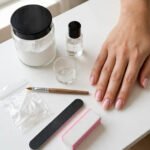
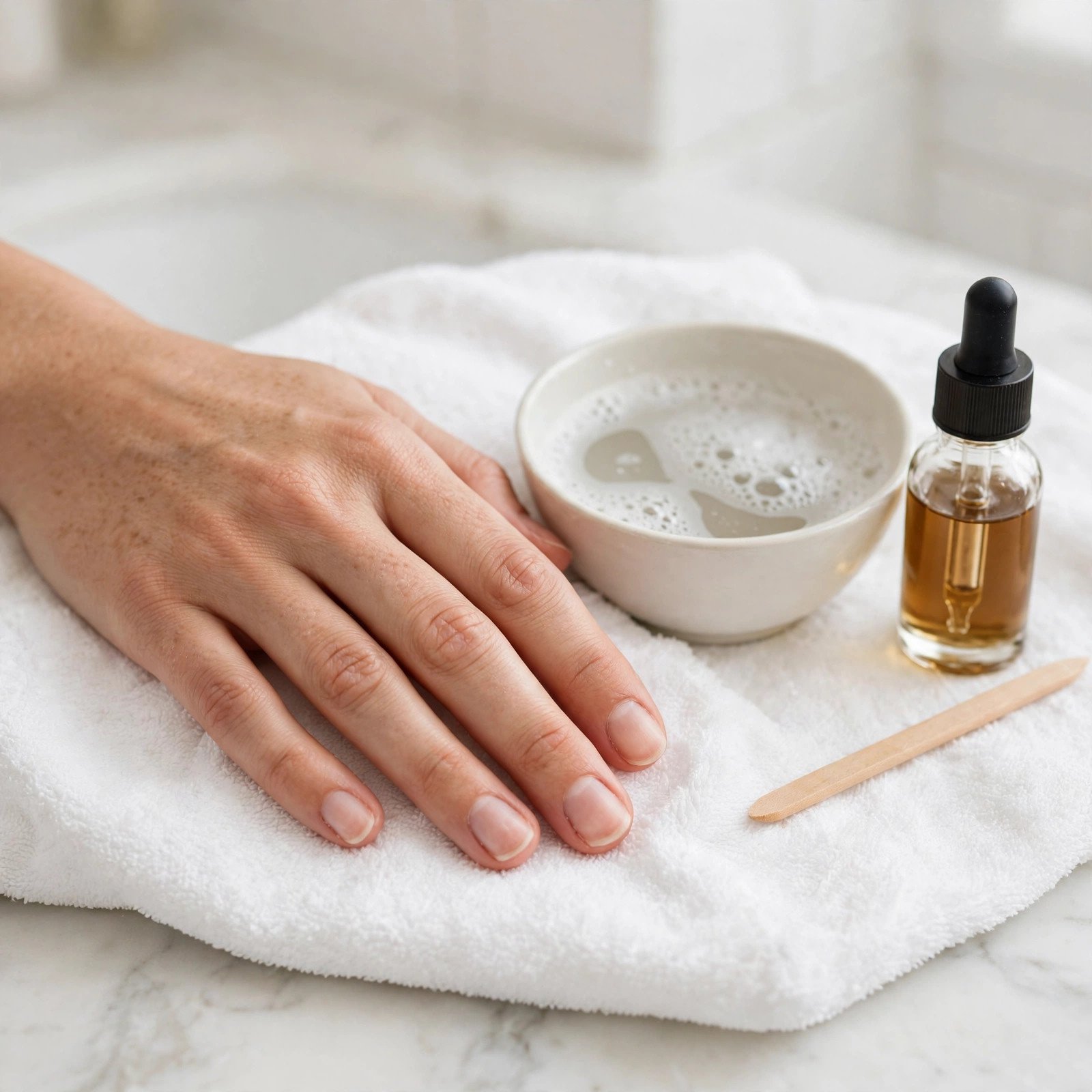
What you need for all the methods: a small bowl, warm water, mild soap, cuticle oil or a plain oil such as olive or jojoba, an orangewood stick or a soft cuticle pusher, a fine-grit buffer, a towel, and optionally pure acetone, cotton pads, and foil. That is the whole kit. You almost certainly have most of it already, and the acetone is the only thing you might need to buy — make sure it is 100 percent pure acetone, not regular nail polish remover, because most removers contain moisturisers and additives that dilute the acetone and prevent it from dissolving nail glue.
Method 1: The Acetone Foil Wrap (Fastest and Most Reliable)
This is the most reliable method for removing glue-on nails, and it is the one I use when I do not care about saving the press-ons. It works on all types of nail glue and takes fifteen to twenty-five minutes. Use 100 percent pure acetone only, not regular nail polish remover. First, clip the false nail down as short as possible without cutting your natural nail. Then lightly roughen the surface with a coarse file — a 100-grit file, a few light strokes — because the acetone needs to penetrate the top layer, and a shiny sealed surface slows it down. Do not file aggressively. You are scuffing the surface, not thinning the nail.
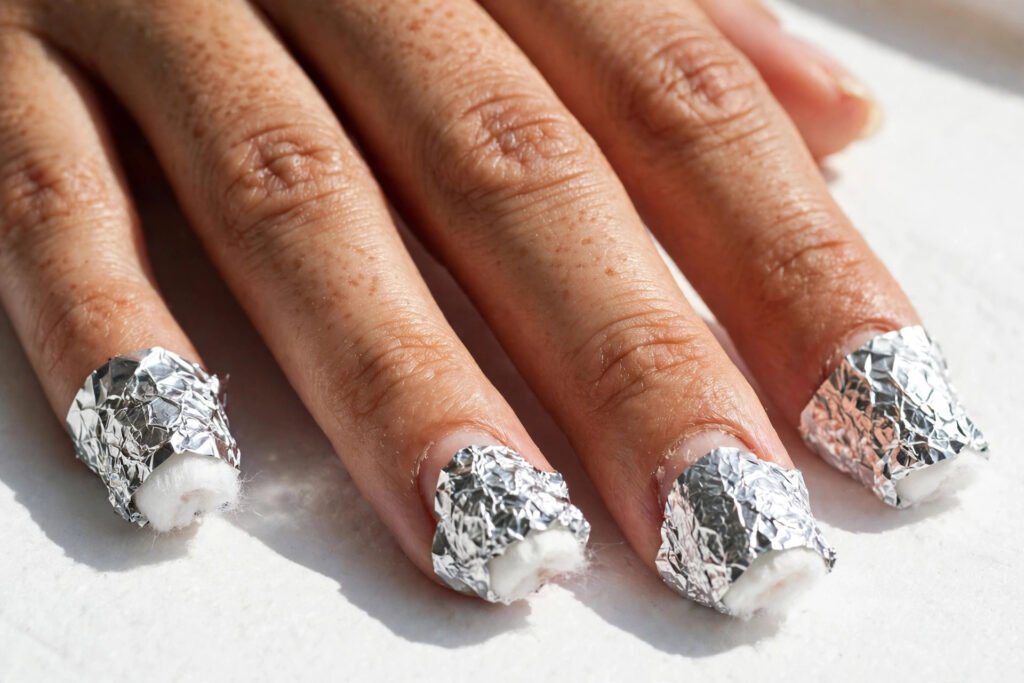
Soak a cotton ball in pure acetone and press it firmly against the top of the nail. Cut the cotton ball in half if you have small hands — the cotton should be thoroughly soaked but not dripping. Wrap a small square of aluminium foil tightly around your fingertip to hold the cotton in place. The foil traps heat and keeps the acetone from evaporating, which helps it penetrate the glue faster. Wait fifteen to twenty-five minutes. Do not check early. The most common mistake with this method is unwrapping at ten minutes, finding the nail still attached, and peeling it — which is exactly the damage you are trying to avoid. Wait the full time.
After fifteen to twenty-five minutes, unwrap one nail and test it. Use a cuticle pusher or an orangewood stick to gently push the softened nail off from the side. It should release with very light pressure. If it resists, rewrap it and wait another five minutes rather than forcing it. If the glue has not softened enough, the nail will feel firmly attached, and that is your signal to wait, not to pull. Once the nail is off, there will be a thin film of glue left on the natural nail — that is normal, and the residue section below covers how to deal with it. Work in a well-ventilated room, away from open flames, and do not smoke while using acetone. Acetone is highly flammable, and the vapour is what catches, not just the liquid.
Fino Tip: One popular trick for speeding up the acetone method is warming a cup of dry rice in the microwave, pouring acetone into a zip-lock bag with a piece of paper towel, putting your fingers in the bag, and nestling the bag into the warm rice. The gentle heat makes the acetone more effective. Never microwave or otherwise heat acetone on its own — it is highly flammable, and heating it directly is dangerous. Warm rice, not warm acetone.
Method 2: Warm Water and Oil (Gentlest, Best for Reusing Press-Ons)
This is the kindest method, and it is the one I use when I want to save the press-ons or when my nails are too thin for acetone. Fill a bowl with warm water — warm, never hot — and a few drops of gentle dish soap, and add a teaspoon of cuticle oil or olive oil. Soak your fingertips for ten to fifteen minutes. The water softens the glue by hydrating it from the edges inward, and the oil creeps under the edges and weakens the bond. After ten minutes, try to lift one nail gently from the side with an orangewood stick. If it resists, soak for another five minutes and try again. Do not force it. The whole point of this method is patience, and forcing a nail that has not loosened is how nails get damaged.
Once the nail starts to lift, work more oil into the gap. Apply cuticle oil around the sides and the free edge of the press-on, so it can seep under the glue line as you lift. Lift slowly, from one side toward the other, letting the oil do the work. If a nail stops moving, add more oil and wait. The process takes twenty to thirty minutes for a full set, which is longer than acetone, but the press-ons come off intact, the designs are undamaged, and your natural nails are not dried out. I have reused the same set of press-ons three times with this method, and they looked as good the third time as the first.
The limitation is that this method does not work well on a very strong bond — a tip glued with a heavy layer of glue, or a set that was applied with extra adhesive for a special occasion. If the water method is not working after thirty minutes, switch to acetone for the stubborn nails only, and use the water method for the rest. There is no rule that says you have to use one method for all ten nails.
Method 3: Rubbing Alcohol (The Middle Ground)
Rubbing alcohol — isopropyl alcohol mixed with water — is the method I reach for when acetone feels too harsh and water feels too slow. It softens cyanoacrylate more slowly than acetone but faster than water, and it is less drying than acetone, which matters if your nails and skin are already dry. Soak a cotton pad in rubbing alcohol, hold it against the glue for several minutes, and then try to lift the nail gently with an orangewood stick. For residue film, a cotton pad soaked in alcohol and held against the nail for two to three minutes will soften the film enough to buff it off.
The practical use for this method is spot work: one stubborn nail that did not come off with water, a patch of residue that water did not soften, or a situation where you have no acetone in the house. It is not the fastest method and it is not the gentlest, but it is the most available — most people have rubbing alcohol at home already — and it is the best compromise when you need something stronger than water but gentler than acetone. Keep the alcohol away from broken skin, because it stings, and moisturise afterwards, because it is drying, though less so than acetone.
Removing the Residue Film Everyone Misses
After the nails are off, run your finger over each natural nail. If it feels rough, tacky, or slightly bumpy, there is a film of glue left, and this is the step most people skip. The film is a thin layer of cyanoacrylate that stayed bonded to the nail plate when the press-on came off, and it will not come off with water alone. Soak a cotton pad in pure acetone and hold it against the nail for two to three minutes, then buff the softened film off gently with a fine-grit buffer. Use light pressure — you are removing glue, not nail. If the film is thin, warm soapy water and a gentle buff will do it without acetone at all.
The mistake is buffing the film off dry, without softening it first. Dry buffing takes nail layers with the glue, and it leaves the nail surface rough, which makes the next manicure streak and chip. Soften first, then buff lightly, then check with your finger. If the nail feels smooth, you are done. If it still feels rough, repeat the soak for another two minutes. The whole process takes five minutes for all ten nails, and it is the difference between nails that feel healthy after removal and nails that feel like sandpaper for a week.
How to Get Nail Glue Off Your Skin
Glue on skin is the most common nail glue accident, and the rule is the same as for nails: dissolve, never peel. Soak the area in warm soapy water for ten to fifteen minutes, then gently roll the glue off with your fingers or an orangewood stick. If the glue is between two fingers that are stuck together, do not pull them apart — soak them until they separate on their own. Warm water, not hot, because hot water irritates skin that is already stressed. If the glue is on a large area, use oil — cuticle oil, olive oil, coconut oil — massaged into the edges of the glue, which softens it and lets it roll off.
Two safety notes. First, if glue gets into your eye, rinse with water immediately and call your local poison control line or seek medical advice — do not try to remove it yourself. Second, if the skin stays irritated, red, or dry after the glue is off, rinse with lukewarm water, moisturise, and see a dermatologist rather than trying harder. Scrubbing irritated skin makes it worse. And never use acetone on a large area of skin, because it strips the natural oils and causes cracking. Acetone is for nails, in small amounts, with foil. Water and oil are for skin.
Aftercare: Rehydrating Your Nails After Removal
Your nails are dehydrated after glue removal, especially after acetone, and the aftercare is what determines whether they recover in a day or a week. The routine is simple: cuticle oil, twice a day, for at least three days after removal. Massage it into the nail plate and the cuticles, not just onto the surface. The oil replaces the moisture that the acetone stripped out, and it keeps the nail flexible instead of brittle. Do not apply polish for twenty-four to forty-eight hours after an acetone removal, because the nail needs time to rehydrate, and polish applied to a dehydrated nail chips faster and looks dull.
If your nails feel thin or paper-like after removal — and they will, if you peeled even once — give them a week before your next set. Use a nail strengthener, keep them short, and let the oil do its work. The nail plate grows out in about three months, and the damaged layer will grow away with it, but only if you stop damaging it. My nail recovery plan covers the full routine for nails that need real repair, and my acrylic aftercare routine covers the daily habits that keep nails healthy between sets.
Fino Tip: The best aftercare is the removal you do next time. Use the water and oil method for your next set, apply glue sparingly — one small drop in the centre of the press-on, not a flood — and your nails will come out of the next removal looking better than they went in. Glue is not the enemy. Too much glue, removed too fast, is.
Mistakes to Avoid
The first mistake is peeling. I have a scar from it, and I will say it one more time: never peel a glue-on nail off dry. The glue is stronger than your nail. You will lose.
The second mistake is unwrapping the acetone foil too early. Fifteen minutes is the minimum. If you check at ten minutes and the nail is still attached, rewrap it and wait. Peeling a half-softened nail is worse than waiting five more minutes.
The third mistake is buffing the residue film off dry. Soften it first — acetone or warm water — then buff lightly. Dry buffing takes nail layers with the glue.
The fourth mistake is using regular nail polish remover instead of pure acetone. Most removers contain moisturisers and additives that dilute the acetone and prevent it from dissolving nail glue. You will soak for thirty minutes and wonder why nothing is happening. Buy pure acetone.
The fifth mistake is heating acetone. Never microwave acetone, never pour hot water into it, never use it near a flame. The warm-rice trick warms the rice, not the acetone. Acetone vapour is flammable, and the risk is not worth the two minutes you save.
The sixth mistake is skipping aftercare. Acetone strips moisture from the nail, and a dehydrated nail is a brittle nail. Oil twice a day for three days, no polish for twenty-four hours, and your nails will recover. Skip the oil and your nails will peel for a week.
FAQ
Does nail glue damage your natural nails? The glue itself does not damage your nails — the removal does. Cyanoacrylate bonds to the nail surface, and if you peel it off, it takes nail layers with it. If you dissolve it properly with acetone or soften it with water and oil, your nails come out undamaged. The damage is in the method, not the product.
Can I remove nail glue without acetone? Yes. Warm soapy water with a little cuticle oil, soaked for ten to fifteen minutes, will loosen most glue, and rubbing alcohol is a middle ground that is faster than water but gentler than acetone. The water method is also the only method that lets you reuse the press-ons, because acetone damages most press-on designs.
How do I get nail glue off my skin? Soak in warm soapy water for ten to fifteen minutes, then gently roll the glue off. Use oil on the edges to help it release. Never peel glue off skin, never use acetone on a large area of skin, and if glue gets in your eye, rinse with water and seek medical advice immediately.
Can I reuse press-on nails after removing them? Yes, if you remove them with the warm water and oil method. Acetone softens, clouds, and damages most press-on materials and painted designs. Remove with water and oil, clean the old glue off the back of the press-on with a gentle buff, and they are ready to wear again.
How long does it take to remove nail glue? Fifteen to twenty-five minutes with the acetone foil wrap, twenty to thirty minutes with warm water and oil, and five minutes for the residue film afterwards. Anyone who tells you it takes two minutes is selling you a peeling injury.
What is the white stuff on my nails after removing glue? That is the residue film — a thin layer of cyanoacrylate that stayed bonded to the nail plate. Soften it with acetone on a cotton pad for two to three minutes, then buff it off gently with a fine-grit buffer. It is not damage, and it comes off easily once it is softened.