Why Are My Nails Green Under Acrylics? Causes & Fixes That Actually Work
I found out my nail was green in the worst possible way: at a dinner party, holding a wine glass, under the kind of warm lighting that makes everything look good except, apparently, my ring finger. There it was — a greenish stain spreading under my acrylic, visible through the clear-ish polish I’d chosen that week, and my first thought was the one most people have: it’s mold. It’s fungus. My nail tech gave me a fungus. I spent the next hour Googling in the bathroom and panicking quietly, and then I spent the next week learning what was actually going on — and the truth was both less scary and more useful than the panic.
Here’s the short version, which I’ll explain properly below: a green nail under acrylics is almost always a bacterial infection called green nail syndrome, or chloronychia, caused by a bacterium called Pseudomonas aeruginosa. It’s not mold. It’s not usually fungus. It’s a surface stain caused by bacteria that thrive in trapped moisture, and it’s fixable — but you have to do the right things, in the right order, and the most important thing is removing the acrylic. Not covering it. Not painting over it. Removing it.
Green nails under acrylics and green nail syndrome mean the same condition, and I’ll use both terms in this article — the first is what you search, the second is what your doctor or nail tech will call it. If you’re dealing with this right now, start with the “what to do now” section. If you’re reading to prevent it, the prevention checklist at the end is the part that matters most. And if you’re an acrylic wearer generally, my how long do acrylic nails last guide and my how to remove acrylic nails at home guide are the companion pieces to this one — because the fill schedule and the removal method are the two things that determine whether this happens to you.
In This Article
- What Green Nail Syndrome Actually Is
- Why Acrylics Create the Perfect Setup
- Green Nails: Bacteria or Fungus? (The Myth That Matters)
- What to Do Right Now If Your Nail Is Green
- How Long Until the Green Goes Away
- Green Nails and Other Enhancements (BIAB, Gel, Press-Ons)
- Can I Just Cover It with Polish?
- How to Prevent Green Nails: The Checklist
- When to See a Doctor
- Mistakes to Avoid with Green Nails
- FAQ
What Green Nail Syndrome Actually Is
Green nail syndrome, or chloronychia, is a bacterial infection of the nail plate — and the word “infection” sounds worse than it is, because in most cases it’s a surface colonisation, not a deep infection. The bacterium responsible is Pseudomonas aeruginosa, an opportunistic bacterium that’s found almost everywhere in the environment: in soil, in tap water, on kitchen sponges, in bathroom drains, on your skin right now. It’s a normal part of the world, and it only becomes a problem when it finds the right conditions — moisture, darkness, and a sheltered surface — and the space between your natural nail and a lifting acrylic is exactly that.
The green colour comes from pigments the bacteria produce: pyocyanin, which is blue-green, and pyoverdine, which is yellow-green. When they mix on the nail plate, you get that distinctive greenish or sometimes greenish-black stain. Here’s the part that surprised me when I learned it: the bacteria don’t eat into the nail plate the way a fungus would. They colonise the surface, living in the moisture and oils trapped in the gap, and the green you see is their pigment — a stain, not a living organism growing through your nail. That’s why the condition is usually painless, why there’s no swelling or pus in most cases, and why the treatment is mostly about removing the conditions that let the bacteria thrive, rather than fighting an infection in the medical sense. It’s also why the green doesn’t go away when you remove the acrylic — the stain is in the nail plate, and it has to grow out, which takes time, and I’ll give you the honest timeline below.
The other thing worth knowing is that Pseudomonas is everywhere, which means the bacteria didn’t necessarily come from your salon. I spent a week convinced my nail tech had given me something, and the truth is more ordinary and less blameworthy: the bacteria live in tap water and soil, they live on skin, and they colonise any warm, moist, sheltered space they find. Your acrylic lifting created the space. The bacteria just moved in. That doesn’t mean your salon is blameless — dirty tools and poor prep can introduce bacteria, and I’ll cover the salon conversation below — but in most cases, the cause is the lifting and the trapped moisture, not a dirty salon.
Why Acrylics Create the Perfect Setup
When acrylic is first applied, it bonds tightly to the natural nail. But over the following days and weeks, tiny gaps develop. The acrylic lifts slightly at the edges or near the cuticle — because of normal nail growth, because you bumped your nails on something hard, or simply because the adhesion weakens over time. Water from handwashing, showering, or any prolonged contact with liquids seeps into those gaps and becomes trapped. And trapped water, in a dark space, between two surfaces, is the perfect breeding ground for Pseudomonas.
Certain habits and situations raise the odds, and I recognised most of them in my own routine when I looked back honestly. Overdue fills are the biggest one — the longer you wait between salon visits, the more the acrylic lifts from the growing nail, and the bigger the gap gets. I had stretched my fills from three weeks to five because I was busy, and that two-week gap was almost certainly when it happened. Frequent handwashing and wet work matter too — if you wash dishes without gloves, swim regularly, or work in water, you’re giving the bacteria more moisture to work with. Gardening without gloves is another one, because soil is full of Pseudomonas. And any damage to the nail — a knock, a crack, a nail that separates slightly from the nail bed (a condition called onycholysis) — creates an opening where bacteria can get in and thrive.
The honest truth is that acrylic doesn’t cause green nails by itself. Millions of people wear acrylics without ever getting a green nail. What causes it is the combination: an enhancement that lifts, plus trapped moisture, plus time. And the time factor is the one you control most directly — fills on schedule, and removal at the first sign of lifting, are the two habits that prevent this. My why do my gel nails keep lifting guide covers the lifting problem across all enhancement types, and the same principles apply here: lifting is never just cosmetic, it’s the opening that lets moisture in.
Fino Tip: The single best early-warning habit is the “press test”: once a week, press gently on each acrylic nail near the cuticle and the free edge. If it moves, clicks, or feels hollow underneath, it’s lifting — and lifting means water is getting in. Book a fill or a removal that week, don’t wait for your next scheduled appointment. A lifting nail is a countdown, not a cosmetic issue.
Green Nails: Bacteria or Fungus? (The Myth That Matters)
This is the distinction that matters most, because it determines the treatment — and getting it wrong means treating the wrong thing. Green is almost always bacteria. Fungal nail infections exist, and they’re common, but they produce white, yellow or brownish discoloration and a thickened, crumbly nail plate. If your nail is green, bacteria are the overwhelmingly likely culprit. That’s not my opinion — it’s the clinical consensus, and every dermatologist who writes about this says the same thing: green means Pseudomonas, not fungus.
Why does this matter? Because if you treat a bacterial green nail with an antifungal cream, it won’t work. Antifungals kill fungi, not bacteria, and you’ll waste weeks on a treatment that can’t help, while the bacteria keep thriving under your acrylic. And the reverse is also true — if you treat a real fungal infection with an antibacterial product, it won’t work either. The colour is the diagnostic clue: green or blue-green points to bacteria; yellow, white or brown with a thickened, crumbly nail points to fungus. If you’re unsure, or if the nail is painful, swollen, or producing pus, see a doctor — they can confirm it in minutes, and getting the right diagnosis is worth more than any home treatment.
The “mold” myth deserves a specific call-out, because it’s the one I believed for an entire evening. Green nails are not mold. Mold is a type of fungus, and while fungal infections do exist under acrylics, the green colour specifically is a bacterial signature. When people say “I have mold under my acrylics”, they’re almost always describing green nail syndrome, and the treatment is different from what you’d do for mold. Knowing the right name — chloronychia, Pseudomonas, green nail syndrome — matters, because it means you search for the right treatment, you ask your tech the right questions, and you don’t waste money on antifungal products that won’t help.
What to Do Right Now If Your Nail Is Green
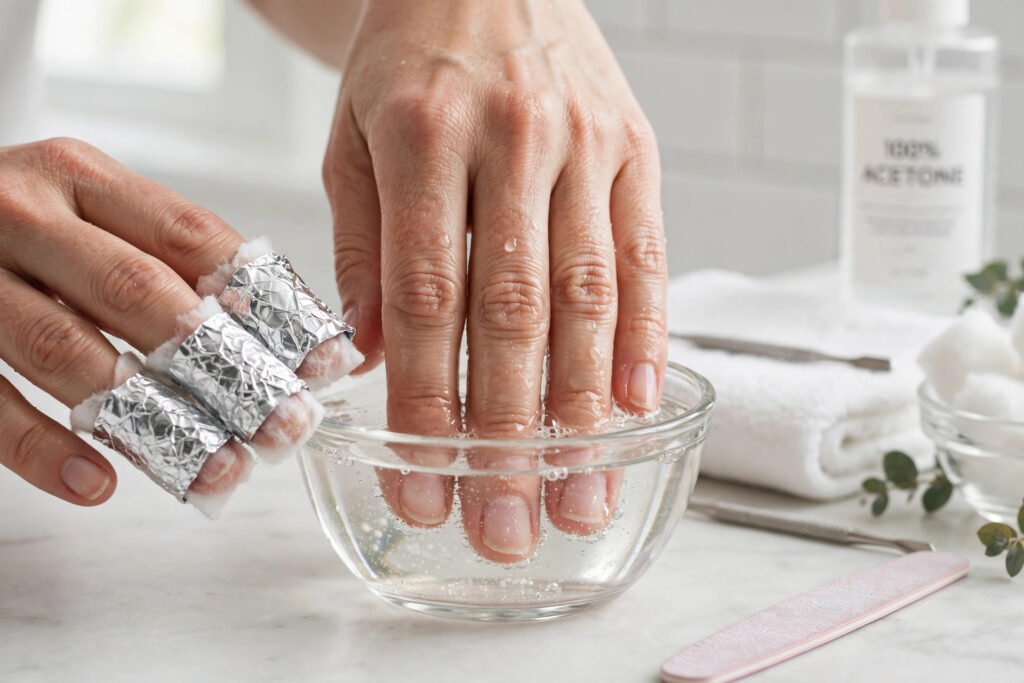
If you’re reading this with a green nail right now, here’s what to do, in order. First, remove the acrylic nail. This is the step that matters most, and it’s non-negotiable. The bacteria are living in the space between the acrylic and your natural nail, and as long as the acrylic is there, that space stays warm, moist and dark — exactly what they need. Removing the acrylic exposes the nail to air and light, which is the opposite of what Pseudomonas wants. Remove it properly: soak it off in acetone, don’t pry it off, because prying damages the nail plate and creates more openings for bacteria. If you can’t soak it off at home, book a removal appointment and tell the salon why — any good tech will prioritise a removal when there’s a green nail involved.
Second, clean the nail. Once the acrylic is off, wash the nail with soap and water, dry it thoroughly, and wipe the nail plate with rubbing alcohol or an antiseptic. Alcohol dries the nail out, and dry is the enemy of Pseudomonas — the bacteria need moisture to survive, and a dry, exposed nail is a hostile environment for them. Some dermatologists recommend diluted white vinegar soaks (one part vinegar to four parts water, ten minutes, once a day) because the acidity makes the nail inhospitable to the bacteria. I’ve heard mixed reports on vinegar — it helped some people, did nothing for others — but it’s cheap, harmless, and worth trying while the stain grows out.
Third, leave the nail bare. Don’t put a new enhancement on, don’t cover it with polish, don’t hide it. The nail needs air and light to recover, and covering it just recreates the conditions that caused the problem. I know this is the hardest step — a bare, green-stained nail isn’t what anyone wants to show the world — but it’s the step that actually works. Keep it clean, keep it dry, moisturise the skin around it (not the nail plate itself), and let it breathe. If the green is on a toenail, wear open-toed shoes when you can, and change your socks if your feet get sweaty — the same moisture logic applies.
Fourth, watch it. In most cases, the bacteria die off once the nail is exposed and dry, and the green stops spreading within a few days. If the green keeps spreading, if the nail becomes painful, swollen, or starts producing pus, or if the skin around the nail becomes red and inflamed, see a doctor — you may need a topical antibiotic, and that’s a medical decision, not a DIY one. But in the straightforward case — a green stain, no pain, no swelling — the treatment is removal, cleaning, air, and patience.
How Long Until the Green Goes Away
Here’s the honest answer nobody wants to hear: the green stain takes as long as your nail takes to grow out, because the pigment is in the nail plate, and the only way to remove it is for the stained nail to grow forward and be trimmed away. Fingernails grow about 3 millimetres a month, and a full fingernail takes 4–6 months to replace itself completely. If the stain is near the tip, it might grow out in a few weeks. If it’s near the cuticle, it could take three or four months. My stain was in the middle of the nail, and it took about ten weeks to grow out completely — ten weeks of looking at a faint green shadow every time I reached for something, and ten weeks of reminding myself that it was a stain, not an infection, and it was going away.
There are things that help, and things that don’t. Buffing the nail very gently can lighten a surface stain, because some of the pigment sits on the surface of the nail plate — but be careful, because over-buffing thins the nail and makes it weaker, and a weak nail is more vulnerable to the next problem. Keeping the nail short helps, because you’re trimming the stained part away faster. Eating well and staying hydrated supports nail growth generally, but there’s no food or supplement that makes nails grow dramatically faster — anyone who tells you otherwise is selling you something. And the vinegar soaks I mentioned above may help the bacteria clear faster, even if they don’t remove the stain itself. The stain will fade as the nail grows, and the timeline is the timeline. Patience is the treatment, and that’s frustrating, but it’s also the truth — and I’d rather tell you the truth than sell you a miracle cure that doesn’t exist.
Green Nails and Other Enhancements (BIAB, Gel, Press-Ons)
Green nail syndrome isn’t specific to acrylics — it can happen under any enhancement that lifts and traps moisture, and that includes gel polish, BIAB, and press-ons. The mechanism is the same in every case: the product lifts, water gets in, bacteria colonise the gap. Gel polish is slightly less risky than acrylic, because it’s thinner and flexes with the nail, so it lifts less — but it can still happen, especially if the gel is applied over unprepped nails or if you pick at it. BIAB is similar to gel in risk: it’s a builder gel that adds structure, and it can trap moisture if it lifts, but the lift is usually less dramatic than acrylic. Press-ons are the lowest risk of the enhancement family, because they’re designed to come off — but if you glue a press-on over a damaged nail, or wear it for too long without removing it, the same trapped-moisture problem can occur.
The practical advice is the same for every system: if you see green, remove the enhancement, clean the nail, leave it bare, and let it grow out. Don’t switch to a different enhancement to cover it — a BIAB over a green nail is the same trapped, moist, dark space as an acrylic over a green nail, and the bacteria don’t care what product is on top of them. Give the nail a break. I know that’s hard when you’re used to having your nails done, but a month of bare nails is a small price for a healthy nail plate, and the alternative — covering it and letting the bacteria thrive — is how a surface stain becomes a real problem. My how to remove BIAB nails at home and how to remove Gel-X nails at home guides cover the removal methods for the other systems if you need them.
Can I Just Cover It with Polish?
No. I know that’s not what you want to hear, and I know the temptation is real — the stain is ugly, you have an event, one coat of opaque polish and nobody would know. But covering a green nail with polish recreates the exact conditions that caused it: a sealed, dark, moist space where bacteria thrive. The polish doesn’t kill the bacteria. It hides them while they keep growing. And when you eventually remove the polish, the green will be worse, not better, because you’ve given the bacteria weeks of uninterrupted breeding time.
The one exception is if the bacteria are already dead — if you’ve removed the enhancement, cleaned the nail, left it bare for a week or two, and the green has stopped spreading and is clearly just a stain growing out. At that point, a coat of polish over the stain is cosmetic, not medical, and it’s your call. But even then, I’d use a breathable polish if you can find one, keep it to one coat, remove it after a few days, and let the nail breathe again. The nail is recovering, and the recovery works best in air and light. Cover it for a wedding, not for a month.
Fino Tip: If you absolutely must cover a healing green nail for one event, use a peel-off base coat under the polish. It comes off without acetone, without soaking, and without disturbing the nail plate — so you’re not re-creating the trapped-moisture problem for long, and you’re not damaging the recovering nail when you take it off. One night, peel off, back to bare. That’s the compromise that works.
How to Prevent Green Nails: The Checklist
Prevention is straightforward, and it’s mostly about the fill schedule and the lifting. Get fills every 2–3 weeks, not every 4–5. I stretched mine to five weeks and that’s almost certainly when it happened — the acrylic had lifted, the gap was there, and I gave the bacteria two extra weeks of breeding time. If your schedule is tight, a shorter fill interval is worth more than any product or treatment. Second, check for lifting weekly with the press test I described above — press gently near the cuticle and the free edge, and if the nail moves or feels hollow, book a fill or a removal that week. Don’t wait.
Third, keep your nails dry. Wear gloves for washing dishes, cleaning, and gardening. Dry your hands thoroughly after washing them — not just a quick shake, actually dry them, including under the nails. If you swim regularly, dry your nails carefully afterwards and consider a shorter fill interval, because chlorinated water is still water, and it still gets trapped. Fourth, choose your salon carefully: clean tools, proper prep, and a tech who takes the time to dehydrate the nail plate before applying the product. Poor prep is the root cause of most lifting, and lifting is the root cause of most green nails. If your acrylics always lift within a week, the problem is the prep, not your nails, and a different salon may solve it. Fifth, don’t pick at your enhancements. Picking creates gaps, gaps trap water, and water breeds bacteria. If a nail is lifting, get it fixed properly — don’t peel it off in the car.
And finally, give your nails a break between sets. I know this is the advice nobody follows, because the whole point of enhancements is never having bare nails — but a week or two of bare nails every few months lets you inspect the nail plate, lets any minor issues resolve, and lets the nail recover its moisture balance. Think of it as maintenance, not a sacrifice. Your nails will be healthier for it, and your next set will last longer because it’s going onto a healthy base.
When to See a Doctor
Most green nails resolve with removal, cleaning and patience. But there are situations where you should see a doctor, and I want to be clear about them, because this is the part where DIY advice stops and medical advice starts. See a doctor if the nail is painful, if the skin around it is red, swollen or warm, if there’s pus or discharge, if the green keeps spreading after you’ve removed the enhancement and kept the nail clean and dry for a week, or if you have diabetes or a weakened immune system — because in those cases, a minor bacterial colonisation can become a real infection, and it needs proper treatment. A doctor can confirm the diagnosis, prescribe a topical antibiotic if needed, and rule out the less common causes — a fungal infection coexisting with the bacteria, or a deeper infection that needs more than home care. They may also take a small sample to identify the organism, which is the only way to be certain whether you’re dealing with bacteria, fungus, or both at once. This article is not medical advice, and if anything I’ve described sounds like your situation, the right move is a doctor’s appointment, not another Google search.
Mistakes to Avoid with Green Nails
Treating it as fungus. Green means bacteria, not fungus, and antifungal cream won’t help. If you treat the wrong thing, you waste weeks and the bacteria keep thriving. Get the diagnosis right first.
Covering it with a new enhancement or polish. Covering the green recreates the trapped, moist, dark conditions that caused it. Remove the enhancement, leave the nail bare, and let it breathe.
Prying the acrylic off. Prying damages the nail plate and creates more openings for bacteria. Soak it off properly, or book a removal appointment.
Blaming your salon without checking the fill schedule. In most cases, the cause is lifting plus trapped moisture plus time — and the time factor is usually overdue fills. Check your own habits before you blame the tech, and then have an honest conversation with the salon about prep and lifting.
Expecting it to disappear overnight. The bacteria die quickly once the nail is exposed and dry, but the stain takes weeks or months to grow out. Patience is the treatment, and anyone selling you a quick fix is selling you something that doesn’t work.
FAQ
Why is my nail green under my acrylic? A green nail under acrylics is almost always green nail syndrome (chloronychia), a bacterial infection caused by Pseudomonas aeruginosa. The bacteria thrive in the warm, moist space between your natural nail and a lifting acrylic, and they produce green pigments (pyocyanin and pyoverdine) that stain the nail plate. It’s not mold, and it’s usually not fungus — green is a bacterial signature.
Is a green nail under acrylics dangerous? In most cases, no — it’s a surface stain, not a deep infection, and it’s painless. The bacteria colonise the surface of the nail plate rather than eating into it. But it can become a problem if it’s ignored, if the nail becomes painful or swollen, or if you have diabetes or a weakened immune system. If there’s pain, swelling or pus, see a doctor.
How do I get rid of green nails under acrylics? Remove the acrylic (soak it off, don’t pry it), clean the nail with soap and water, wipe it with rubbing alcohol, and leave it bare so it gets air and light. The bacteria die off once the nail is exposed and dry. The green stain itself takes weeks to months to grow out, because the pigment is in the nail plate and only disappears as the nail grows.
Can I put new acrylics over a green nail? No — don’t cover a green nail with a new enhancement. Covering it recreates the trapped, moist, dark conditions that caused the problem, and the bacteria will keep thriving underneath. Wait until the green has stopped spreading and the nail has had at least a week or two bare before you consider a new set, and tell your tech about it so they can check the nail first.
How long does it take for a green nail to grow out? Fingernails grow about 3 millimetres a month, and a full nail takes 4–6 months to replace itself. A stain near the tip might grow out in a few weeks; a stain near the cuticle can take three or four months. Keeping the nail short helps, because you’re trimming the stained part away faster.
How can I prevent green nails under acrylics? Get fills every 2–3 weeks, check weekly for lifting with the press test, keep your nails dry (gloves for dishes, cleaning and gardening), dry your hands thoroughly after washing, don’t pick at your enhancements, and give your nails a break between sets. The single most effective prevention is the fill schedule — overdue fills are the biggest risk factor.