

In This Article
- My Nails Went Paper-Thin After Gel — And What I Learned
- What “Thin and Bendable” Actually Means
- The 10 Causes of Thin, Bendable Nails
- Born Thin vs Made Thin: Two Different Fix Plans
- The 3–6 Month Recovery Timeline: What to Expect
- What to Wear on Your Nails While They Recover
- Mistakes to Avoid With Thin Nails
- FAQ
I noticed my nails were paper-thin on a Tuesday, in the shower, when my thumbnail bent backwards against a shampoo bottle and I felt it fold like a piece of paper. I had just had a gel manicure removed — soaked off properly, or so I thought — and underneath the gel my nails were so thin I could see the pink of my nail bed through them. They bent when I pressed them. They peeled at the tips. They split if I looked at them wrong. I had spent two years getting gel manicures every two weeks, and my nails had quietly paid the price. Some people search “why are my nails thin and bendable” and some search “why are my nails soft and bendy” — same problem, same worry, and I use both phrases here because I typed both of them into Google myself on the day I found out.
It took me four months to get my nails back, and I learned more about nail biology in those four months than in the previous ten years of manicures. The most important thing I learned is that thin, bendable nails are not one problem — they are two. Some people are born with thin nails, because the size of their nail matrix determines how thick their nails grow. Other people, like me, had perfectly normal nails and made them thin through water, chemicals, over-filing, and aggressive removal. The fix is different for each group, and most of the articles I read treated them as the same problem, which is why none of them helped me. This article gives you both fix plans, the honest timeline for recovery, and what to wear on your nails while you wait for the thin part to grow out — because you cannot fix a nail that is already grown, you can only grow a new one.
What “Thin and Bendable” Actually Means
A healthy nail plate is made of keratin, the same protein as your hair, layered in sheets that give the nail its hardness and resilience. A healthy nail feels firm with a slight give — you can press it and it flexes a tiny amount and springs back. A thin, bendable nail has fewer or weaker keratin layers, so it bends easily, feels soft or papery, peels at the tips, and splits instead of breaking cleanly. The key to knowing whether your nails are a problem is consistency and degree. A nail that flexes slightly under pressure is normal. A nail that folds when you press it, that you can bend with ease, that feels like paper, or that splits and peels every time it grows past your fingertip — that is a nail with compromised structure, and it is worth figuring out why. The other thing to know is that the nail you see today was made three to six months ago, deep under your cuticle in the nail matrix. That means whatever is wrong with your nails right now started months ago, and whatever you do to fix them today will not show up in the visible nail for months. I found that frustrating at first, and then I found it reassuring — it meant I had time, and it meant the damage was not permanent, because nails grow, and new nail is always coming.
Fino Tip: The half-moon on your thumbnail — the lunula — is the visible edge of your nail matrix, and its size tells you something real about your nails. A large matrix can produce thicker nails; a small matrix produces thinner ones. Look at your thumbnails: if the half-moons are small and your nails have always been thin, that may simply be your baseline, not a problem to fix.
The 10 Causes of Thin, Bendable Nails
01. Your Nail Matrix (Genetics)
Some people are born with thin nails, and there is nothing wrong with them. Your nail matrix — the growth centre hidden under your cuticle — determines the size, thickness, and quality of your nails, in the same way your hair follicles determine whether your hair is fine or thick. If you have a small nail matrix, you are more likely to have thin nails, and if several family members have similarly thin, flexible nails, natural nail structure is probably part of the picture. This is the cause that most articles mention last and I am putting first, because it changes everything about the fix: if your nails have always been thin and have not suddenly changed, that may simply be your baseline, and the goal is not to make them thick — it is to protect the thin nails you have and make the most of them. I spent a month trying to “fix” my nails with supplements before I understood that my friend, whose nails have always been thin, was never going to grow thick nails no matter what she took, and what she actually needed was a protection strategy, not a cure.
02. Repeated Water Exposure
Water is the most underestimated cause of thin, bendable nails, and it is the one I was most guilty of. When nails absorb water, they expand, and when they dry, they contract, and that repeated expansion and contraction creates micro-cracks in the keratin layers and weakens the bonds between them. The result is nails that are soft when wet, brittle when dry, and bendable all the time. I wash dishes, I wash my hands constantly, I take long hot showers, and I never wore gloves for any of it. My nails were soaking and drying ten times a day, and I was surprised they were weak. Research shows that working in wet conditions leads to increased nail brittleness, and repeated water exposure also causes peeling. The fix is boring and it works: wear gloves for dishes and cleaning, keep your showers shorter and cooler, and moisturise your nails and cuticles after every wash. I bought a pair of rubber gloves and put them next to the sink, and within a month my nails stopped peeling at the tips.
03. Harsh Chemicals and Cleaning Products
Overexposure to harsh chemicals in cleaning products can cause bendy nails, and you do not have to work as a cleaner to be exposed — you just have to clean your own home without gloves. Detergents, solvents, bleach, and even some soaps strip the natural oils from the nail plate and weaken its structure, and the effect is cumulative: one afternoon of cleaning without gloves will not ruin your nails, but a year of it will. I was cleaning my bathroom with a spray cleaner, bare-handed, every week, and wondering why my nails were peeling. The fix is the same as for water: gloves, every time, for every chemical. And it is worth checking your hand soap too — a harsh antibacterial soap used ten times a day is a chemical exposure, and switching to a gentler soap made a visible difference to my nails within three weeks.
04. Over-Filing and Aggressive Buffing
If the natural nail is repeatedly over-filed, it becomes thinner, more flexible, tender, and prone to splitting, and the affected portion stays thin until it grows out — which takes months. Over-filing happens in two ways: filing the nail surface itself, which some techs do to “prep” for gel or acrylic, and filing the free edge too aggressively, which thins the tip. I had a tech who buffed my nails smooth before every gel application, and I thought she was being thorough. She was removing a layer of my nail every two weeks. The fix is to ask your tech not to buff the nail plate, or to switch to a tech who preps with a gentle dehydrator instead of a file. And if you file your own nails, file in one direction only, use a fine-grit file, and never file the surface of the nail — the surface is not yours to remove.
05. Forceful Gel or Acrylic Removal
This is the cause that got me, and it is the most common one among people who wear enhancements. Gel and acrylic do not have to damage the natural nail, but forceful removal does — picking, peeling, scraping, or prying a manicure off takes layers of the natural nail with it, and the nail that grows back is thinner until the damaged portion grows out. I had my gel soaked off properly most of the time, but twice I got impatient and peeled it off in the car on the way home, and those two times did more damage than a year of proper wear. The rule is simple and non-negotiable: never peel, never pry, never scrape. Soak it off with acetone and foil, wait the full fifteen minutes, and let the product slide off. If it does not slide off, soak it longer. My gel polish removal guide and my acrylic removal guide both walk through the safe method, because removal is where most nail damage actually happens.
06. Nail Biting, Picking, and Peeling
Repeated biting, picking, peeling, scraping, or aggressive buffing can thin or split the nail plate and make breakage more likely, and the damage is worse than it looks because it is not just the tip that suffers — the picking damages the nail bed and the matrix underneath, which affects the nail that grows next. I bit my nails as a teenager and I picked at my cuticles as an adult, and both habits kept my nails thin for years longer than they needed to be. The fix is not willpower alone — it is replacing the habit with something else, like cuticle oil or a fidget, and keeping the nails short while they recover so there is less to pick at. My guide to stopping nail biting covers the habit-breaking side of this in detail, because the habit is the cause and the thin nails are the symptom.
07. Nutritional Deficiencies
Nutritional deficiencies can affect nails, but they are not the most likely explanation for every case of thin nails, and I want to be honest about that because the supplement industry would like you to believe otherwise. Iron deficiency can lead to thin, weak nails that bend or develop a concave spoon shape, and biotin is crucial for keratin production, and zinc and protein all play a role. But a true biotin deficiency is rare, and most people who take biotin for thin nails are fixing a problem they do not have. I took biotin for three months — my 90-day biotin test is the full story — and my nails did get slightly stronger, but the change was small compared to what gloves and gentle removal did. The honest advice is to eat well, get enough protein and iron, and only consider supplements if your diet has a real gap or your doctor suggests it. If your nails became suddenly bendy and you have other symptoms, an iron check is worth asking your doctor about.
08. Thyroid Disorders and Anaemia
Certain internal issues can cause nails to become thin and bendy, and the two most common are thyroid disease and iron-deficiency anaemia. Both reduce the oxygen and nutrients reaching the nail matrix, which weakens the nail that grows. The key signal is change: if your nails were normal and then became thin, and the change came with other symptoms — fatigue, hair loss, weight changes, feeling cold all the time — that is worth a conversation with your doctor, not a new nail polish. I am not a doctor and this is not medical advice, but I wish someone had told me that sudden nail changes are a legitimate reason to ask for blood work, because I spent months treating my nails as a cosmetic problem when they were actually the first sign that something else was going on. For most people, thin nails are not a medical issue. But sudden, persistent change across many nails is.
09. Ageing
Ageing leads to a decrease in cholesterol content in the nail, which results in increased brittleness, and nails naturally lose moisture as we get older, which makes them weaker and more prone to bending, peeling, and splitting. This is not a problem to fix so much as a reality to adapt to: older nails need more moisture, gentler handling, and shorter lengths, and they benefit enormously from cuticle oil and a ridge-filling base coat. My mother is in her sixties and her nails are thinner than they were at forty, but they are also the healthiest they have ever been, because she keeps them short, oils them daily, and never wears enhancements for more than two weeks at a time. Ageing does not mean giving up on nice nails. It means changing the strategy.
10. Medication and Skin Conditions
Certain medications and inflammatory skin conditions can affect the nails, making them soft, ridged, discoloured, or thin. Psoriasis can affect the nails as well as the skin, and some medications list nail changes as a side effect. If your nails changed after starting a new medication, or if the change came with pitting, thickening, separation from the nail bed, swelling, or pain, that is a conversation for your doctor or dermatologist, not a nail article. I include this cause because it is the one people are least likely to connect to their nails, and the one where professional advice matters most.
Born Thin vs Made Thin: Two Different Fix Plans
If your nails have always been thin — small half-moons, family members with the same nails, no sudden change — your fix plan is protection, not repair. Keep them short, because short thin nails break less than long thin nails. Wear a strengthening base coat or a BIAB overlay, which adds a protective layer that lets the thin nail underneath grow without bending. Use cuticle oil daily, wear gloves for wet work, and choose your manicures for protection: a BIAB overlay is the best option for naturally thin nails, because it is a flexible builder gel that adds strength without the rigidity of acrylic. My BIAB guide explains the system in detail, and my BIAB verdict covers whether it is the right choice for you.
If your nails used to be normal and became thin — after gel, after acrylic, after a period of picking or over-filing — your fix plan is recovery, and it is different. Stop the damage first: no more enhancements until the thin part grows out, no more peeling, no more aggressive filing. Then protect what is growing: cuticle oil daily, gloves for everything wet, a strengthening base coat, and short nails while the damaged portion grows out. The thin part of your nail will not get thicker — it is already grown, and its structure is set — but the new nail growing in from the matrix will be healthy if you stop damaging it, and in three to six months the thin part will have grown out completely. That is the timeline, and it is the hardest part of this whole article to accept, because there is no shortcut. I tried every shortcut. There is no shortcut.
Fino Tip: Take a photo of your nails on day one of your recovery. You will not notice them getting better day by day, but when you compare the photo to your nails three months later, the difference is obvious — and that visible proof is what keeps you from giving up in month two.
The 3–6 Month Recovery Timeline: What to Expect
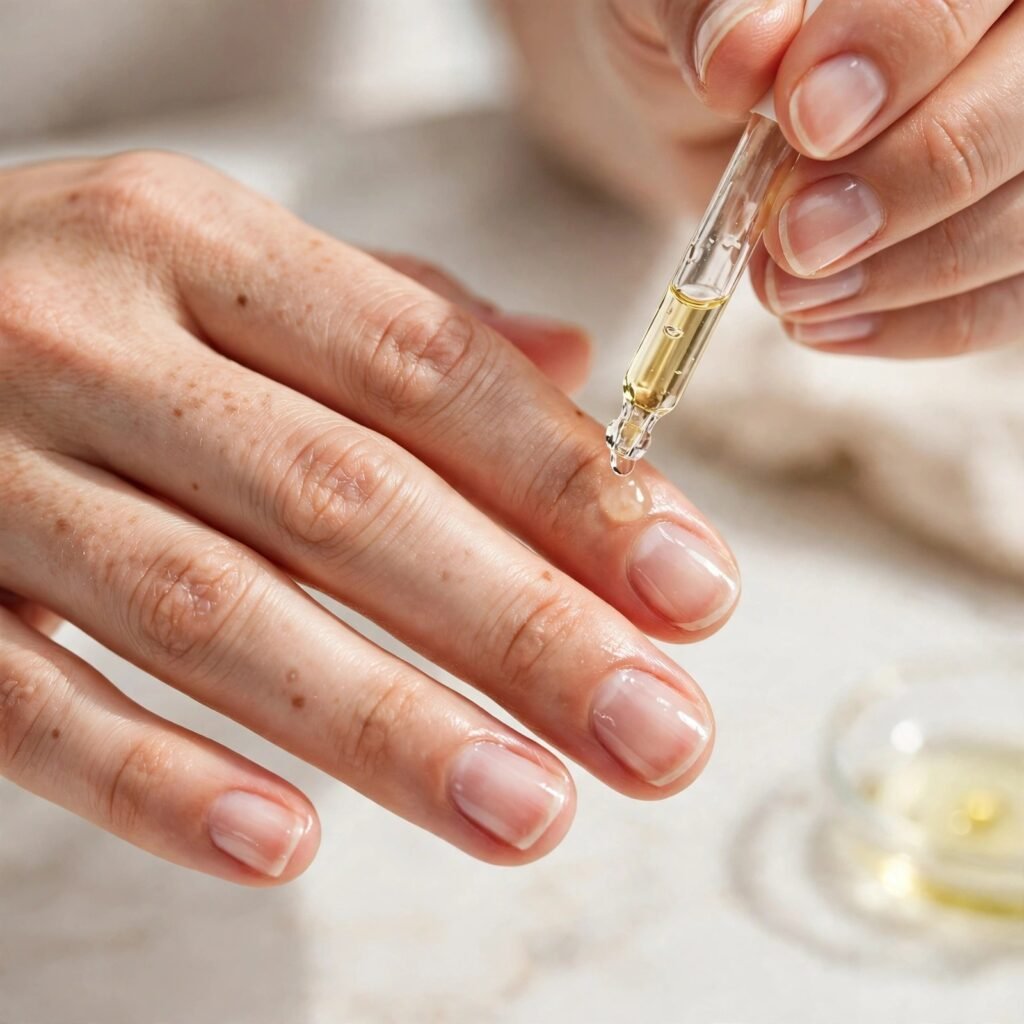
Fingernails grow about three millimetres a month, which means a full nail takes three to six months to replace itself, and that is your recovery timeline. Month one is the hardest: your nails are still thin, they still bend, they still peel, and nothing you do seems to make a difference, because the nail you are looking at was made months ago. What is actually happening in month one is invisible — the matrix is producing healthier nail, but it is still hidden under your cuticle. Month two is when you start to see it: a band of stronger, smoother nail emerging from the cuticle, with a visible line where the old thin nail meets the new healthy nail. Month three is when the difference becomes obvious, and the thin part is now halfway down the nail. Months four to six are the home stretch: the thin part reaches the free edge, you file it off, and what is left is the new nail, grown under your protection. I tracked my recovery with photos, and month two was the turning point for me — seeing that band of healthy nail was the first proof that the work was paying off, and it kept me going through month three, when the thin part was at its most annoying, flapping at the tips and catching on everything. By month five, my nails were back to normal, and I have not had a gel manicure without a break since.
What to Wear on Your Nails While They Recover
The question everyone asks is what to wear while the thin part grows out, and the answer depends on how thin your nails are. If they are mildly thin and bendable, a strengthening base coat with regular polish is enough — the base coat adds a protective layer, the polish adds a little more, and you can still have pretty nails while you recover. If they are very thin and paper-like, a BIAB overlay is the best option, because it is a builder gel that adds real strength and flexibility, and it protects the nail underneath while it grows. I wore BIAB for two months during my recovery and it was the single best decision I made — my nails stopped bending, they stopped peeling, and the BIAB came off to reveal healthy nail underneath. What I would not recommend during recovery is acrylic, which is rigid and requires aggressive prep, or gel polish applied with heavy buffing, which thins the nail further. And press-ons are a mixed bag: my press-on guide covers them in detail, but during recovery they are a reasonable short-term option as long as you use gentle adhesive tabs rather than strong glue, and you do not wear them for more than a few days at a time. The goal during recovery is protection, not beauty, and the prettiest thing you can wear is a nail that is getting stronger.
Mistakes to Avoid With Thin Nails
The first mistake is trying to fix thin nails with supplements alone. Biotin, iron, and zinc all matter, but if your nails are thin because you peel your gel off or wash dishes without gloves, no supplement will fix that, and you will waste three months waiting for a pill to do the work that gloves would have done in a week. The second mistake is filing the surface of the nail to “smooth” it. The surface is not yours to remove, and every layer you file off makes the nail thinner. The third mistake is wearing long nails while they recover. Long thin nails break, and every break sets the recovery back, because the nail has to grow out again from the break point. Keep them short until they are strong. The fourth mistake is getting another gel or acrylic set before the thin part has grown out, because the removal will damage the new nail you just grew. Wait. The fifth mistake is using acetone remover every day to change your polish. Acetone strips moisture from the nail, and daily use on thin nails is like sanding an already thin piece of wood. Use a non-acetone remover during recovery, and change your polish less often. And the sixth mistake is ignoring a sudden change. If your nails were fine and then suddenly became thin across all ten fingers, and it came with fatigue or other symptoms, that is not a cosmetic problem — it is a reason to talk to your doctor.
FAQ
Why are my nails so thin and bendable all of a sudden? A sudden change across many nails usually points to something that happened weeks or months ago: a period of gel or acrylic wear with aggressive removal, a stretch of heavy water or chemical exposure, over-filing, or a health change such as thyroid issues or iron deficiency. Because nails grow slowly, the cause is often months old by the time you notice it. If the change is sudden and comes with other symptoms, talk to your doctor.
Can thin nails become thick again? The thin part of your nail will not get thicker — it is already grown and its structure is set. But the new nail growing from your matrix can be healthy and strong if you stop the damage, and in three to six months the thin part will have grown out completely and been filed off. So yes, your nails can recover, but the recovery happens by growing new nail, not by fixing the old nail.
Is it bad if my nails are bendy? Bendy nails are often a sign that something is amiss, usually related to a deficiency, overhydration, or external damage. A nail that flexes slightly is normal; a nail that folds easily, feels like paper, or splits and peels is a sign of compromised structure. It is not dangerous on its own, but it is worth figuring out the cause, because the cause is usually fixable.
What is the best treatment for thin, bendable nails? The best treatment is protection while new nail grows: cuticle oil daily, gloves for wet work and chemicals, short nails, a strengthening base coat or BIAB overlay, and no enhancements until the thin part grows out. Eat well, get enough protein and iron, and only consider supplements if your diet has a real gap. The treatment is boring, and it works.
How long does it take for thin nails to recover? Fingernails grow about three millimetres a month, so a full recovery takes three to six months. You will see a band of healthier nail emerging from the cuticle around month two, and the thin part will reach the free edge and be filed off between months four and six. There is no shortcut, but the recovery is reliable if you protect the new growth.
Should I wear nail polish on thin nails? Yes — polish actually protects thin nails by adding a layer between the nail and the world. Use a strengthening base coat, a regular polish, and a top coat, and change your polish with a non-acetone remover during recovery. What to avoid is gel or acrylic applied with aggressive buffing, and any manicure that requires peeling or prying to remove.


Pingback: Gel Polish vs Press-On Nails: Which Is Better? (2026)