

November has its own colour language, and I learned it the year I walked into the month still wearing October. My nails were bright pumpkin orange, cheerful and loud, and suddenly they looked wrong against wool coats, grey skies, and early dark evenings. November is not October with the heating turned up. It is deeper, quieter, and more expensive-looking, and the shades that work now are the ones that behave like good knitwear: rich, soft-edged, and a little bit serious. That is why I use November nail colors as my main phrase here, even though I know many of you search November nails or fall November shades for exactly the same thing. They all describe this in-between moment, but November nail colors is the clearest name for it, so that is the one I will stick with.
I spent the last three Novembers testing this palette properly, not just swatching it in a shop. I wore cranberry through a long weekend of cooking and cleaning, I took chestnut brown to work for two solid weeks, I tried olive when I was not sure I could pull it off, and I learned which finishes survive real life and which ones chip the moment you open a tin. Some of these colours surprised me. Olive, which I expected to hate on my skin, became the shade I reached for when I wanted to look put-together without trying. Black cherry, which I thought would be too dramatic for daytime, turned out to be the most forgiving colour I owned. This list is built from that kind of wear, not from a colour chart.
What follows is not a random round-up of pretty polishes. I have chosen twelve shades that cover the whole November mood, from the deep reds everyone saves to the quiet neutrals and the one birthstone wildcard that makes the month feel personal. If you want a broader autumn starting point first, my fall nail colors for 2026 guide is where I set out the season as a whole, but this article is narrower and more useful: it is only November, only shades that earn their place, and only advice I would give a friend sitting next to me at the salon table.
In This Article
- 01. Cranberry, the juicy red that is brighter and livelier than oxblood, and why the distinction matters.
- 02. Chestnut and Espresso, the warm browns that anchor coats, boots, and every November outfit.
- 03. Olive, the muted green that looks surprisingly polished and endlessly wearable.
- 04. Mushroom and Cashmere Neutrals, soft taupe-greige shades for quiet, expensive-looking nails.
- 05. Burnt Copper and Bronze Chrome, warm metallics that catch low November light beautifully.
- 06. Plum and Midnight Purple, the wildcard purple that reads as a deep, moody neutral.
- 07. Forest Green, the rich evergreen shade that carries you straight toward December.
- 08. Black Cherry, the almost-black red with a wine glow at the edges.
- 09. Warm Sheer Nude, the your-nails-but-better shade for minimal November manicures.
- 10. Gold and Champagne Metallic Accents, warm shimmer used sparingly for light and celebration.
- 11. Navy, the deep blue that works like black but feels softer and more interesting.
- 12. Citrine and Topaz, November birthstone-inspired amber shades with personal meaning.
01. Cranberry, the Red I Reach for First
Cranberry is the November red I reach for first, chosen deliberately over oxblood every time. Oxblood is dense and almost black, and it can swallow a short nail whole. Cranberry is juicier: a true berry red with a pink-red heart, bright enough to read as red in daylight, deep enough to feel seasonal after dark. In glossy crème it looks freshly polished for days, flatters fair skin by lifting it, and looks rich, not stark, on medium and deep skin.
I wore it with a camel coat, black jeans, and gold hoops, and strangers commented on it that week. It survived cooking, handwashing, and unpacking boxes, with only a tiny tip chip on day six. Ask for a true cranberry crème, not burgundy or cherry, with a high-shine top coat and rounded square shaping.
Best for: anyone who wants a classic November red that still feels alive, especially on short to medium nails.
02. Chestnut and Espresso, My Coat-Matching Browns
Chestnut and espresso are the browns I plan my November wardrobe around, two ends of the same useful shade. Chestnut is warmer and redder, like polished conkers, and it glows against cream knitwear and tan leather. Espresso is cooler and deeper, almost black-brown, and it behaves like a neutral with grey, navy, black, and burgundy. I wore espresso for two weeks straight because it made every outfit look intentional, even jeans and an old jumper. Chestnut is for warmth, espresso for polish.
Warm, golden skin looks wonderful in chestnut, while cool skin often suits espresso better, because the cooler brown does not pull yellow. Espresso gel lasted eight days for me with no visible tip wear; chestnut polish lasted five days before the edges dulled. Ask for chestnut with a warm red undertone, or espresso one shade above black, with neat, short shaping.
Best for: daily wear, work manicures, and anyone building a November wardrobe around brown leather and wool.
03. Olive, the Colour That Converted Me
Olive converted me, although I walked into the salon last November fully prepared to dislike it. I expected muddy, flat, and a little bit military. Instead I got a muted sage-olive green that made my hands look calm and expensive in a soft crème finish with no shimmer. It sits between green and neutral, reading as a colour from a distance and a quiet neutral up close. It flatters warm skin, harmonising with its yellow-green undertone, and looks rich and earthy on deep skin. Fair, cool skin needs a greyer olive, or it can pull sallow.
I wore olive with a forest-green scarf, a grey coat, and silver rings, and it pulled the outfit together without matching anything exactly. The muted tone hides tiny tip wear far better than a bright colour, and I stretched a gel manicure to nine days. Ask for a muted olive crème, not bright sage or khaki, desaturated like dried herbs rather than fresh leaves.
Best for: anyone bored of reds and browns who wants a November colour that still feels grown-up and wearable.
04. Mushroom and Cashmere Neutrals, Quiet Luxury
Mushroom and cashmere neutrals are the shades I wear when I want my nails to whisper rather than talk. If 01 felt too bold, this is its quieter sibling, and I mean that as a compliment. Mushroom is a taupe-greige, grey-brown with a soft mauve whisper, while cashmere is warmer, like milky coffee with a drop of pink. Neither is plain beige. They look deliberate, and in a glossy finish they give the cashmere-jumper effect: expensive without announcing it. They suit short nails, because the pale tone lengthens the nail.
These shades are the most skin-tone sensitive here, so swatch before committing. Fair skin suits a pinker cashmere, medium skin looks beautiful in true mushroom, and deep skin glows in a richer mushroom with visible taupe depth, because too pale a shade can look ashy. I wore mushroom with a charcoal blazer and felt quietly polished all day. Ask for two thin coats plus a glossy top coat, so the colour never looks chalky.
Best for: minimal manicures, short nails, work settings, and anyone who loves quiet luxury.
05. Burnt Copper and Bronze Chrome, November Light in a Bottle
Burnt copper and bronze chrome are November light in a bottle, saved for grey-sky days when I need my hands to glow. Burnt copper is warm and rusted, deeper than rose gold and less orange than a copper penny. Bronze chrome is smoother and more reflective, almost polished metal, catching lamplight as no crème can. I wore bronze chrome on almond nails to dinner in early November and watched it shift from bronze to warm gold as I moved my hands. It is dramatic, but its warmth keeps it seasonal rather than flashy.
Chrome flatters warm and medium skin beautifully, and looks molten on deep skin, but fair, cool skin can find very orange copper overwhelming, so deeper bronze is safer. Chip wear shows faster at the tips, and the surface can scratch, so I get it only in gel, sealed under two layers of no-wipe top coat. Ask for burnt copper chrome with a warm finish, not glitter, and keep the other nails simple.
Best for: evenings, celebrations, and anyone who wants metallic impact without going full gold glitter.
06. Plum and Midnight Purple, the Wildcard That Works
Plum and midnight purple are my wildcard, recommended whenever someone is bored but wants nothing loud. Plum is deep purple with a warm, wine-red base, while midnight purple is cooler, darker, and almost navy in low light. Both read as neutrals, giving depth without shouting. I wore plum with a black coat and burgundy scarf and loved how it sat between them. On fair skin, plum adds warmth and looks jewel-like; on medium and deep skin, midnight purple looks especially rich.
Undertone and finish are the trick. Too blue a purple looks cold in November daylight; too red, and it drifts into burgundy and loses its identity. I ask for a warm-based plum crème with a glossy finish, because gloss stops dark purple looking flat. Dark purples hide tip wear well, and my gel plum lasted ten days with only slight dullness at the free edge. Ask for plum leaning wine, not violet, in almond or soft square shape.
Best for: anyone who wants a change from red and brown but still needs a shade that works everywhere.
07. Forest Green, the Evergreen That Earns Its Keep
Forest green earns its keep because it does two jobs at once. Now it is a rich woodland green matching scarves, coats, and the last autumn leaves. In three weeks it will be a Christmas green without repainting, a smart November choice. The shade I love is deep and slightly blue-green, like pine needles after rain, in glossy crème. Too yellow, and it turns olive; too bright, and it turns festive too early. Depth is everything.
Forest green flatters many skin tones. On fair skin it contrasts beautifully and looks elegant, especially with silver jewellery. On medium skin it looks lush and natural; on deep skin, deep and jewel-like. I wore it with a cream roll-neck, dark jeans, and brown boots, and a simple outfit felt styled. It wore well: eight days in gel with minimal tip wear. Ask for deep pine or forest crème, glossy, and avoid shimmer, which can look like a bauble too soon.
Best for: November into December, nature lovers, and anyone who wants one manicure to carry across two seasons.
08. Black Cherry, Almost Black, All Glow
Black cherry is almost black, and that is exactly why I love it in November. Indoors it looks dark and polished. Outside, or under a lamp, a wine-red glow appears at the nail edges, like light through red wine. That depth separates it from plain black. Black cherry has warmth and movement, and in high gloss it looks like patent leather. It flatters every skin tone, but is especially beautiful on deep skin, where the glow is rich, and on fair skin, where the contrast is striking.
I wore black cherry on short, rounded nails for a week of work, dinners, and errands, and it was my most forgiving dark shade. Tiny chips barely showed, regrowth was invisible, and it went with everything from grey tailoring to a red lip. It lasted nine days in gel before any dullness at the tips. Ask for black cherry, not black or burgundy: a near-black base with cherry-red depth in bright light, plus a high-shine top coat.
Best for: drama without brightness, evening wear, and anyone who finds plain black too flat.
09. Warm Sheer Nude, Your Nails but Better
Warm sheer nude is the your-nails-but-better shade I turn to when my nails need rest or my calendar is full. Unlike opaque beige, which can look like a bandage if the tone is wrong, a sheer nude lets your natural nail show through, warmed with pink, peach, or caramel. The result is clean, healthy-looking nails that go with everything. I wore it for ten days last November through meetings and a family weekend, and it never once felt wrong. It flatters short nails, because translucency does not shorten them.
Undertone is the whole game. Fair skin suits a sheer pink-nude, medium skin glows in peachy caramel sheer, and deep skin looks best in a richer warm sheer with caramel or toffee depth, because a pale sheer can look grey or ashy. If 01 felt too bold, this is the shade for weeks between statement colours. Ask for sheer warm nude, two thin coats, glossy top coat, and translucency, not coverage. Chip wear is almost invisible.
Best for: low-maintenance weeks, short nails, nail recovery, and minimal, polished everyday looks.
10. Gold and Champagne Metallic Accents, Used Sparingly
Gold and champagne accents are where I hold back, because used sparingly they are magic, and used everywhere they are tinsel. I do not wear full gold nails in November. I wear gold as one accent nail, a thin French tip, a half-moon at the cuticle, or a delicate line over forest green or black cherry. Champagne is softer than yellow gold, with pale, warm shimmer reading as light rather than metal, and I choose it for daytime. True gold is richer and warmer, saved for evenings and celebrations.
Metallic accents flatter every skin tone when the base is right, because shimmer against a deep shade creates contrast. On fair skin, champagne looks luminous without overpowering; on medium and deep skin, warm gold looks molten and expensive. Metallic polish shows brush strokes and chips faster than crème, so I get accents in gel and keep designs simple enough to touch up. Ask for champagne shimmer or a fine gold chrome line, not chunky glitter.
Best for: accent nails, French-tip twists, celebrations, and adding light to a dark November manicure.
11. Navy, Softer Than Black, Smarter Than Blue
Navy is softer than black and smarter than bright blue, and the most underrated November colour here. Deep, inky navy in glossy crème reads as a neutral from a distance, like black, but up close it has a cool blue richness black never manages. I wore navy with a grey wool coat, white trainers, and a navy scarf, and it looked intentional. It flatters fair skin with elegant contrast, suits medium skin beautifully, and looks polished on deep skin, especially with silver jewellery.
Navy is also highly practical. It hides tip wear better than red, does not show regrowth like a pale colour, and goes with denim, grey, camel, burgundy, and black without clashing. I got nine days from navy gel with only slight shine loss at the tips, fixed by a fresh top coat. Ask for deep midnight navy crème, not royal or dusty blue, because too bright a navy stops looking like November. Keep the shape clean and the finish glossy.
Best for: work, denim days, and anyone who wants a dark neutral with more personality than black.
12. Citrine and Topaz, the November Birthday Shade
Citrine and topaz are the November birthday shades. Citrine is the warm, golden-yellow birthstone, from pale champagne-yellow to deep amber, and golden topaz is warm honey-amber glowing like late-afternoon light. On nails, that means warm amber, honey, and golden-topaz shades, often with soft shimmer or a translucent, jewel-like finish. I wore honey-amber for a November birthday dinner and loved how personal it felt: a nod to the month. It flatters warm and medium skin, and on deep skin rich amber looks golden and radiant.
Yellow-toned shades are unforgiving if too pale or neon, so depth and warmth are essential. Fair, cool skin should choose deeper honey-amber over pale lemon citrine, which can wash you out. I ask for warm amber or golden topaz with soft shimmer or a glazed finish, never flat yellow crème, on almond or oval nails so the warmth feels soft, not sharp. Mine lasted seven days in gel, shimmer hiding scratches. Ask for honey-amber topaz, warm and jewel-like, not yellow.
Best for: November birthdays, birthstone gifts, and anyone who wants a warm, personal golden shade.
How I Pick a November Colour
I pick a November colour the way I pick a coat: I start with what I already own, not with what looks pretty in a bottle. I look at my coats, my scarves, and the bag I carry every day, and I ask whether a shade will argue with them or pull them together. Cranberry pulls a camel coat together. Espresso makes a grey coat look deliberate. Navy works with everything I own that is denim. That wardrobe test saves me from the most common November mistake, which is choosing a colour I love in isolation and then discovering it clashes with the three coats I actually wear. I also think about my week. A week full of typing, cooking, and cleaning calls for a forgiving dark or sheer shade, while a quiet week with a dinner in it can carry chrome or metallic accents without the same wear worries.
Skin tone comes next, and I mean undertone, not just light or dark. Warm undertones, where gold jewellery looks better than silver and veins look greenish, glow in chestnut, cranberry, burnt copper, and honey-amber. Cool undertones, where silver wins and veins look bluish, suit espresso, navy, forest green, and midnight purple. Neutral undertones can wear almost everything here, which is a genuine advantage. The fastest test I know is to hold a shade against your hand in daylight, not under salon lights, and look at whether your hand looks healthy or tired. If your hand looks tired, the undertone is wrong, however beautiful the bottle is. I learned that with a grey-mushroom shade that looked perfect in the shop and sallow on me until I switched to a warmer cashmere version.
Finish is the third decision, and it changes a colour more than most people expect. The same cranberry in a flat matte finish looks modern and a little severe, while in high gloss it looks classic and rich. I choose gloss for most November shades because low light needs reflection to keep a dark colour alive, and I save matte for one or two accent nails at most. Length matters too: short nails suit sheer nudes, mushroom neutrals, and black cherry, because those shades do not cut the nail short visually, while longer almond nails carry chrome, forest green, and plum with real drama. My simple rule, which has never let me down, is to choose the colour for the wardrobe, the undertone for the skin, and the finish for the light you will actually live in. If you want simpler everyday versions of this palette to start from, my simple November nail ideas guide is a good low-effort companion to this colour-first list.
Fino Tip: Before you commit to a full set, ask for one nail painted in your chosen shade and walk outside with it in natural daylight. Salon lighting is warm and flattering and lies about undertones, and that sixty-second daylight check has saved me from at least three colours I would have regretted by lunchtime.
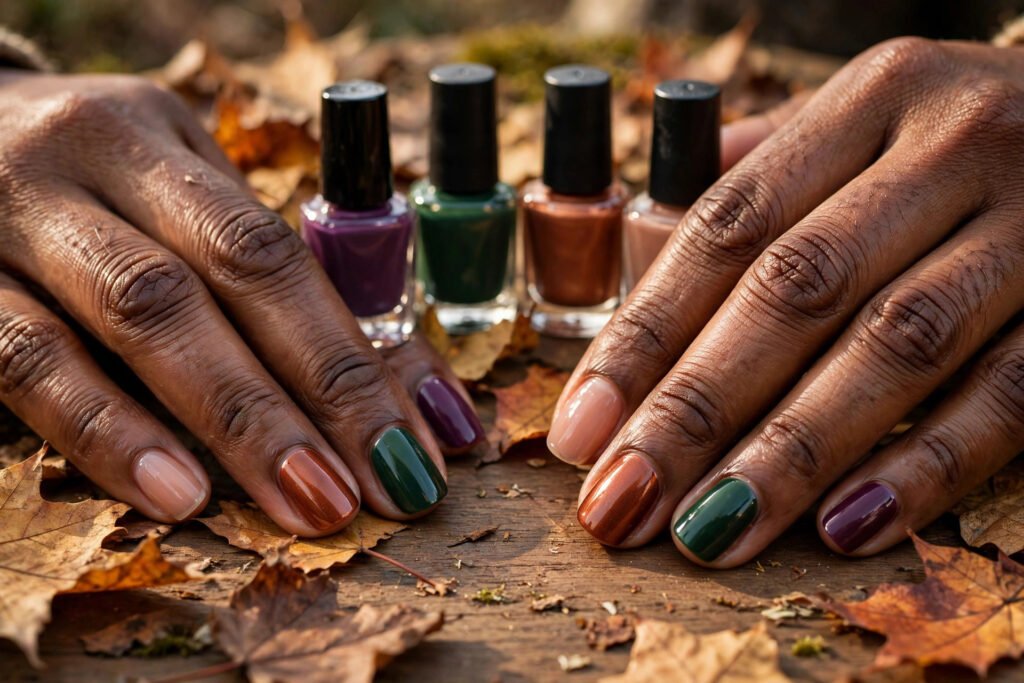
The Finishes That Make November Colours Look Expensive
The finish is what makes a November colour look expensive, and I learned this the expensive way, by paying for a beautiful forest green that looked flat and dull until my technician added the right top coat. Gloss is the November default for a reason: dark colours need shine to show their depth, and in low autumn light a glossy surface catches lamps, candles, and phone screens in a way that keeps the colour moving. A high-shine gel top coat over cranberry, black cherry, or navy is the difference between a colour that looks freshly done and one that looks tired by day three. I reapply a clear top coat at home on day four, and that one habit extends the glossy life of almost every shade on this list by several days.
Velvet and cat-eye finishes are the November upgrade I reach for when I want a dark shade to feel special without adding glitter. A velvet, or magnetic cat-eye, finish uses fine shimmer particles pulled into a soft, light-shifting band, and on plum, forest green, or black cherry it creates a depth that looks like velvet fabric. It is not glitter, it is not chrome, and it does not scream for attention, which is why it works for daytime as well as evenings. I tried a cat-eye plum last year and was stopped twice in one week by people asking what colour it was, which almost never happens with a plain crème. If you want to try it yourself, my cat-eye nails DIY guide walks through the magnet technique at home, but at the salon just ask for a velvet cat-eye effect in your chosen base shade and let the technician control the magnet angle.
Chrome is the high-impact finish, and it belongs on burnt copper, bronze, and gold accents rather than on every nail. A full set of chrome can look hard and a little cold in November daylight, while one or two chrome accent nails against a deep crème base look deliberate and luxurious. Cable-knit and textured finishes, whether created with builder gel texture, sugaring, or a matte raised pattern, are the cosy option: they make a mushroom neutral or a chestnut brown feel like knitwear, and they are wonderful for a weekend manicure, though they do catch fluff and need gentle cleaning. Glazed, or donut-style, finishes are the softest option of all: a sheer shimmer layer over a nude, mushroom, or amber base that gives a lit-from-within glow without obvious sparkle. My rule is one special finish per manicure. Gloss everywhere, plus velvet, chrome, texture, or glaze in one place, keeps the result expensive rather than busy.
Fino Tip: If a dark colour looks flat by day three, do not assume the polish is bad. Wipe the nails with a lint-free pad, apply one thin layer of high-shine top coat, and let it dry fully without touching anything. I have rescued forest green, navy, and plum this way more times than I can count, and it costs nothing.
How to Mix Colours Without a Skittle-Set Disaster
Mixing November colours is where good taste lives or dies, and my formula is deliberately boring: one hero, one supporter, and one quiet neutral, and never more than three colours on ten nails. The hero is the colour that does the talking, usually cranberry, forest green, black cherry, or plum. The supporter is a colour in the same temperature family that backs it up, like chestnut with cranberry, or olive with forest green. The quiet neutral is mushroom, cashmere, or a warm sheer nude, and its job is to give your eyes somewhere to rest. When I follow that formula, a mixed manicure looks styled. When I break it and use five bright colours, it looks like a skittle set, however much I loved each shade on its own.
Temperature matching is the detail most people miss. Warm heroes like cranberry, chestnut, burnt copper, and honey-amber want warm supporters: chestnut, mushroom with a warm cast, or gold accents. Cool heroes like navy, forest green, and midnight purple want cool supporters: espresso, mushroom with a grey cast, or silver-toned accents, though warm gold can still work as a deliberate contrast if it is the only warm element. I keep finishes consistent too. If the hero is glossy, the supporters should be glossy, and any special finish, chrome or velvet, should appear on one or two nails only. A useful starting combination I return to every year is cranberry on most nails, espresso on the ring finger, and a thin gold line at the cuticle of the accent nail, which ties the warmth together without adding a fourth colour. For more warm brown and gold combinations that follow the same logic, my brown and gold fall nail ideas guide shows how those two families work together across a full set.
Placement matters as much as colour choice. I put the darkest shade on the thumb and pinky, where it frames the hand, the hero colour on the middle three nails, and the accent or neutral on the ring finger, which is the natural focal point. Alternating two colours nail by nail can work, but only if the two shades are close in depth, like mushroom and cashmere, or plum and black cherry; alternating a pale nude with a near-black shade creates a striped effect that looks accidental. If you are unsure, paint the combination on a nail wheel or on press-on tips first and live with it on the table for a day. I did that with an olive and copper combination I was convinced would work, and seeing it together for twenty-four hours told me the copper was too orange for the olive I had chosen, so I swapped it for bronze and the set finally clicked.
Mistakes to Avoid
The first mistake I made, more than once, was choosing a November colour under salon lighting and never checking it in daylight. Salon lights are warm, bright, and flattering, and they make cool undertones look warmer than they are and make dark shades look richer than they will at home. I came home with a plum that looked wine-rich in the salon and almost grey-purple in my kitchen, and I wore it for a week feeling slightly wrong without knowing why. Now I always do the daylight check, even if it means walking to the door with one painted nail, and I would rather feel fussy for sixty seconds than regretful for ten days.
- Picking oxblood when you meant cranberry, or burgundy when you meant black cherry, because you described the mood instead of the shade. Name the exact colour, the undertone, and the finish, and show a photo if you have one, because mood words mean different things to different technicians.
- Going full matte on a very dark November shade. Matte black cherry, navy, and plum can look chalky and flat by day two, especially on short nails, and they show every scratch. Keep dark shades glossy, and save matte for one accent nail or a textured design.
- Using chrome or glitter on all ten nails for a whole month. It looks exciting on day one and tiring by day four, and it chips and scratches faster than crème. One or two accent nails give you the impact without the maintenance, and you can change the accent without redoing the whole set.
- Ignoring your undertone and choosing a mushroom or nude that is too pale or too grey for your skin. A nude that is wrong for you will make your hands look washed out in photos, while the right warm sheer or rich mushroom will make them look healthy. Swatch on your own nail, not on a plastic tip, before you commit.
- Forgetting a top coat refresh mid-week. November air, hot water, and handwashing dull gloss faster than summer does, and a two-minute top coat on day four is the difference between a manicure that looks expensive for nine days and one that looks tired by day five.
- Mixing warm and cool heroes in the same set without a plan. Cranberry and navy can both be beautiful, but together without a neutral bridge they fight, and the set looks accidental. Pick one temperature family per manicure, or use mushroom or sheer nude as the bridge between them.
I also learned not to chase every trend shade in the same month. November already gives you twelve strong colours here, and trying to wear all of them before December means no manicure ever gets worn long enough to enjoy. I pick two heroes for the month, wear each for ten days or so, and save the rest for next year, when they will still be beautiful. That restraint is what makes a November manicure feel considered rather than frantic, and it is why I keep a short list of the shades I actually wore, not just the ones I photographed.
FAQ
What nail colours are trending for November 2026?
The colours trending for November 2026 are the deep, wearable shades in this list: cranberry, chestnut and espresso browns, olive, mushroom neutrals, burnt copper and bronze chrome, plum, forest green, black cherry, and navy, with warm sheer nudes and gold accents alongside them. What ties them together is depth without brightness: November trends favour rich, muted, expensive-looking colour over neon or pastel, and finishes like velvet cat-eye and glazed shimmer are trending because they add movement to dark shades without glitter. If you choose one trend to follow, choose cranberry or forest green, because both are strong now and carry well into December.
Which finishes look most expensive on November colours?
High-gloss looks most expensive on most November colours, because shine shows the depth in cranberry, black cherry, navy, and plum, and it keeps dark shades looking freshly done. Velvet and cat-eye finishes look expensive on plum, forest green, and midnight purple, because the soft light-shift adds fabric-like depth without sparkle. Chrome looks expensive only in small doses, on one or two accent nails in burnt copper, bronze, or gold, while a glazed finish looks expensive over sheer nudes, mushroom neutrals, and honey-amber shades. Full matte on a very dark shade is the finish most likely to look flat and cheap, so I save matte for accents.
How long do November colours carry into December?
Most November colours carry well into December, and forest green, black cherry, navy, plum, and gold accents carry the furthest, because they already read as festive without needing Christmas motifs. Cranberry and chestnut also work through early December, especially paired with gold or champagne accents for celebrations. Olive, mushroom neutrals, and warm sheer nudes work all winter, because they are neutrals rather than seasonal statements. The shades to retire first are burnt copper and citrine-amber if they feel too autumnal for you, though I personally wear amber through December as a warm contrast to cold weather. For Thanksgiving-specific designs that bridge the two months, my Thanksgiving nail ideas for 2026 guide shows how November colours work with holiday nail art.
What is the best November colour for short nails?
The best November colours for short nails are warm sheer nude, mushroom and cashmere neutrals, black cherry, and cranberry, because they either lengthen the nail visually or create a neat, polished frame without overwhelming a short nail bed. Sheer and muted shades are the most forgiving on short nails, since they do not cut the nail off visually the way a stark, opaque dark shade can. Black cherry and cranberry work well on short nails when the shape is rounded or soft square and the finish is glossy, because the shine keeps the nail looking intentional. I would avoid full chrome or very dark matte on very short nails, because both finishes emphasise the short length rather than flattering it.
What is the difference between cranberry and oxblood nail polish?
Cranberry is a brighter, juicier berry red with a pink-red heart that reads clearly as red in daylight, while oxblood is a much deeper, denser wine-red that is almost black-red and reads as a dark neutral in low light. Cranberry feels lively and classic, and it flatters a wide range of skin tones because its brightness lifts the hand. Oxblood feels moodier and more severe, and it can swallow a short nail or look almost black indoors. If you want a red that other people notice as red, choose cranberry. If you want a near-black shade with a wine depth that only appears in bright light, choose oxblood or, better for November, black cherry, which gives you that hidden glow with more warmth.
What are the November birthday nail shades?
The November birthday shades are citrine and golden topaz, the birthstones for November, translated into warm amber, honey, and golden-topaz nail colours with a soft shimmer or glazed, jewel-like finish. Citrine ranges from pale champagne-yellow to deep amber, and golden topaz is a warm honey-amber, so the most wearable versions are honey-amber and warm golden shades rather than pale yellow. These shades are personal and celebratory, and they work beautifully as a full manicure for a birthday week or as an accent nail alongside espresso, black cherry, or navy. Choose a deep, warm amber over a flat yellow crème, and keep the finish glazed or softly shimmering so the colour reads as a gemstone rather than a bright yellow.



Pingback: 12 November Square Nail Ideas for 2026
Pingback: 12 Brown Chrome Nail Ideas for Fall 2026
Pingback: 12 Fall-to-Winter Nail Art Ideas for 2026
Pingback: 12 November Nail Art Ideas for 2026 (My Saved Designs)