

I noticed my yellow nails in a photograph. I was holding a coffee cup, the light was bright, and my bare nails, which I had just taken polish off after six weeks of continuous dark red, were unmistakably yellow at the tips, like old piano keys. I panicked quietly for about ten minutes, googled far too much, and then did the sensible thing, which was to stop, look properly, and work out whether I was dealing with a stain or something more serious. It was a stain, as it is for most of us, and it grew out within a few months once I changed my habits. Why are my nails yellow and how to fix yellow nails describe the same question, really, what has discoloured your nails and what will actually make them clear again, and I use why are my nails yellow because that is what most of you search for, even though I think of it simply as the stain question. This guide is the honest version I wish I had read that afternoon: how to tell a stain from a condition, what actually causes yellowing, which home remedies work and which ones damage, and the prevention system that stopped it happening to me again.
Before we go any further, the most important thing in this guide is the triage in the first section, because it decides everything else. Most yellow nails are cosmetic staining from polish, and they are annoying but harmless. Some yellow nails are a sign of something that needs a doctor, and no amount of lemon juice will fix those. I am not a doctor, and this is not medical advice, but I will show you the clear, practical distinction I learned, and I will be honest about where home remedies stop and professional help starts. If you have just come off a long stretch of dark polish, my manicure longevity guide is the routine that kept polish on my nails for those six weeks in the first place, and my nail growth tips list covers the growth cycle that eventually replaces a stained nail entirely, because a stain, unlike a condition, always grows out.
In This Article
- Stain or Condition? The Triage First
- What Actually Causes Yellow Nails
- Reading the Pattern: What Your Nails Are Telling You
- The Home Remedies, Compared Honestly
- The Polish-Break Routine
- The Base-Coat System That Prevents Staining
- Gel, Acrylic, and Top-Coat Yellowing
- Mistakes That Make Yellowing Worse
- When to See a Doctor
- Frequently Asked Questions
This guide is organised in the order that keeps you safe, because with yellow nails the diagnosis matters more than the remedy, and a guide that starts with lemon juice before it starts with triage is a guide that can waste your time. The first section is the triage itself, the four questions that decide whether you are dealing with a stain or a condition, and it is the section to read before anything else. The next two sections explain the causes and the patterns, so you understand what happened and why, and can recognise the difference between a stain growing out and a problem that is not improving. The middle sections are the practical work: the remedies compared honestly, the polish-break routine that is the real fix, and the base-coat system that prevents the whole problem recurring. The final sections cover enhanced nails, the mistakes that make yellowing worse, and exactly when to see a doctor. Read the triage first, then work through the rest in order, and do not skip to the remedies.
Stain or Condition? The Triage First
Before you try a single home remedy, do this triage, because it takes two minutes and it decides whether you need lemon juice or a doctor. Ask yourself four questions. First, have you worn polish, especially dark polish, continuously for weeks without a break? If yes, staining is the most likely cause, and the yellowing will usually be gradual, across most or all of your nails, with the nail surface itself feeling normal. Second, is the yellowing on one or two nails only, or did it appear suddenly? A single yellow nail, or a sudden change, is more concerning than gradual yellowing across all ten, and it deserves professional attention. Third, has the texture of the nail changed? Thickening, crumbling, curving, lifting from the bed, or pain are all red flags that point away from simple staining. Fourth, do you smoke, use self-tanner on your hands, or take any medication that lists discoloration as a side effect? All three can stain nails cosmetically, and all three are fixable by addressing the cause rather than bleaching the nail.
The rule I live by is this: gradual yellowing, across most nails, after polish, with normal-feeling nails, is almost certainly staining, and the remedies in this guide are appropriate. Sudden yellowing, one nail only, yellowing with thickening, crumbling, pain, swelling, or a bad smell, or yellowing that does not improve as the nail grows out, needs a doctor or dermatologist, and I mean that seriously. I have seen too many people spend months bleaching a nail that needed treatment, because they assumed every yellow nail was a stain. The triage is not scary, it is empowering, because once you have ruled out the serious causes, you can treat the stain calmly and effectively, without the anxiety that made me google for an hour in a coffee shop. If you are in any doubt at all, get it checked. A dermatologist appointment is cheaper than months of the wrong treatment, and it buys you certainty, which is worth more than any home remedy in this guide.
What Actually Causes Yellow Nails
The most common cause, by an enormous margin, is nail polish staining. Dark polishes, reds, purples, blacks, deep browns, and dark blues, contain strong pigments that seep into the porous surface of the nail plate over days and weeks of wear, especially when the polish is worn without a base coat. The longer the polish stays on, the deeper the pigment penetrates, which is why a dark red worn for three weeks stains far more than the same shade worn for three days. I stained my own nails with a dark burgundy I wore continuously for six weeks, with no base coat and no break, and the yellow tinge at the tips was the direct, predictable result of that. The polish itself was not faulty, and my nails were not unhealthy. The pigment had simply soaked in, the way tea stains a mug, and it needed time, and new growth, to clear.
The other cosmetic causes are worth knowing, because they change the fix. Smoking stains nails with nicotine and tar, just as it stains teeth, and the staining is usually worst on the index and middle fingers of the smoking hand. Self-tanner on the hands can stain nails orange-yellow, especially around the cuticles and the free edge, and it is often mistaken for polish staining. Natural darkening with age is real, and it is gradual and even, and it does not respond to whitening the way a fresh stain does. Formaldehyde in some older polishes and hardeners can also discolour nails, making them yellow, brittle, and weak over time, which is one more reason to check ingredients and choose modern, formaldehyde-free formulas. Less commonly, persistent yellowing can signal a fungal infection, psoriasis, a thyroid condition, diabetes, or a rare condition called yellow nail syndrome, which involves continually yellow, ridged, thick nails alongside respiratory or lymphatic problems. Those are the conditions the triage is designed to catch, and they are the reason this guide starts with a doctor check rather than a lemon.
Reading the Pattern: What Your Nails Are Telling You
The pattern of yellowing tells you more than the colour itself, and learning to read it is the skill that stops the panic. Yellowing across all ten nails, gradual, worse at the tips, after dark polish, is the classic stain pattern, and it is the pattern I had in that coffee-shop photograph. The tips stain most because the free edge is the oldest, most porous part of the nail, and it has had the longest exposure to pigment. Yellowing that is strongest under the polish line, where the polish sat, and fainter near the cuticle, where new growth is coming through, is also a stain, and it is actually reassuring, because it shows healthy, clear nail growing in behind the stain. Watch the cuticle area over the next few weeks: if the new growth is clear, the stain is growing out, and you are dealing with a cosmetic problem that time will solve.
Yellowing on one nail only, or on two nails on the same hand, tells a different story, and it is the pattern that should prompt a professional check. A single yellow nail can indicate a fungal infection, trauma to that nail, or a localised condition, and it will not respond to the whitening remedies in this guide in the same way. Yellowing accompanied by thickening, where the nail becomes noticeably thicker, harder, or more curved than its neighbours, is another pattern that points away from staining, as is yellowing with crumbling, flaking, or a nail that lifts from the bed. Yellowing that spreads, or that comes with pain, swelling, redness, or a smell, needs prompt attention. I am deliberately repeating this, because it is the most important distinction in the whole guide, and because the internet is full of whitening hacks that treat every yellow nail as a stain. Read the pattern first. Treat second. That order has never once let me down.
The Home Remedies, Compared Honestly
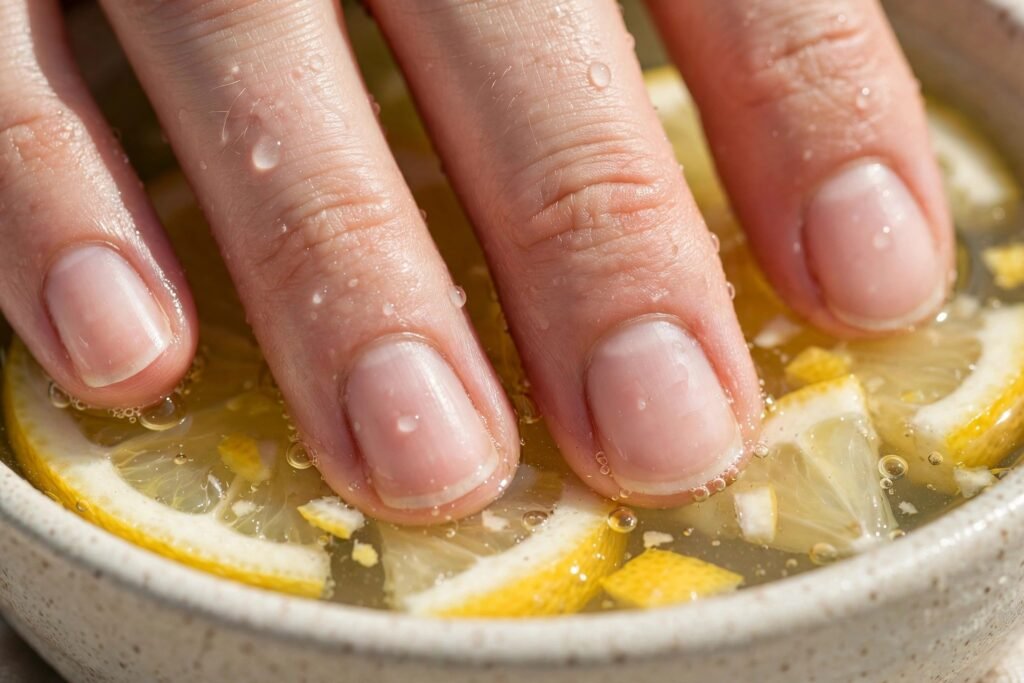
There are four home remedies that actually work for polish staining, and they are not equal, so here is the honest comparison I wish I had read before I tried them all in one frantic weekend. The lemon and baking soda soak is my go-to. Mix the juice of half a lemon with a teaspoon of baking soda in a small bowl, it will fizz, that is normal, and soak your fingertips for ten minutes, once a week, when you are between polishes. The mild acidity of the lemon plus the gentle abrasion of the baking soda lifts surface staining remarkably well, and I saw a visible difference after two sessions. The cost is dryness: lemon is drying, and it stings on broken skin or hangnails, so do not use it if your cuticles are cut or sore, and moisturise with cuticle oil immediately afterwards. Do not do it daily, because daily acid soaks will dry and weaken the nail plate, and the cure becomes worse than the stain.
The whitening toothpaste scrub is the fastest method, and the one I use for quick touch-ups. Apply a pea-sized amount of white, paste toothpaste, not gel, to each nail, scrub gently with a soft toothbrush for a minute, rinse, and oil. The mild abrasives in whitening toothpaste are designed for stain removal, and nails respond the same way teeth do. It lifts light, surface staining in one session, but it will not shift a deep, six-week stain on its own, and scrubbing too hard will thin the nail surface. The hydrogen peroxide soak is the strongest home remedy, and the one to use with the most care. Mix three to four tablespoons of 3% hydrogen peroxide with half a cup of warm water, soak for two minutes, scrub gently, rinse, and oil. It works on deeper staining, but it is an oxidiser, and overuse, or using a stronger concentration, will dry and weaken nails and irritate skin. I use it at most twice a week, for severe staining only, and I never mix it with lemon, because combining acids and oxidisers is unnecessary and harsh. Light buffing, one gentle pass with a soft buffer block, can also lift surface staining, but buffing is the remedy I use least, because every buff thins the nail slightly, and repeated buffing is how people end up with thin, bendy nails chasing a stain that would have grown out on its own.
What I do not recommend: bleach-based hacks, which are far too harsh for nails and surrounding skin, and which I have seen recommended online with alarming confidence. Denture cleaning tablets, which are mildly effective but no better than the lemon soak and considerably more faff. Nail whitening pencils, which do not whiten the nail at all, they paint a white line under the free edge and hide the stain cosmetically, which is fine for a photograph but not a fix. And commercial whitening treatments, which vary enormously, some are gentle and effective, some are essentially peroxide in fancy packaging, and none of them will fix a stain faster than the nail grows out. The honest truth about every remedy in this section is that none of them removes a deep stain instantly. They lift the surface, they brighten the appearance, and they buy you time while the stained nail grows out and is trimmed away, which takes weeks to months depending on how far the stain penetrated. Set your expectations accordingly, and you will not be disappointed.
The Polish-Break Routine
The polish break is the real fix, and it is the part of this guide that most people skip, because it requires patience rather than a product. After removing polish, leave your nails completely bare for at least a week, ideally two, before painting them again. During the break, oil your cuticles twice a day, keep your nails short and filed, and let the nail plate breathe and rehydrate. I know the word breathe is not technically accurate, nails do not breathe, but the break does two real things: it stops new pigment from soaking in while the old stain grows out, and it lets the nail plate rehydrate after weeks under polish and remover, which restores flexibility and shine. I take a polish break every two to three months now, as a matter of routine, and my nails have not stained since I started doing it, even with dark colours.
During the break, resist the urge to buff the stain away. I buffed aggressively during my first break, trying to erase the yellow in an afternoon, and I ended up with thin, shiny nails that still looked yellow, because the stain was through the nail plate, not just on the surface. The stain will grow out. A fingernail takes about six months to grow from cuticle to free edge, but the visible improvement comes much faster, because the clear new growth at the cuticle pushes the stain towards the tip, where you trim it away a little at a time. File your nails regularly during the break, keep them short, and you will trim the stain off in stages. If you cannot bear bare nails, a single coat of clear, nourishing base coat is acceptable, but do not wear colour during the break, because colour is what caused the problem, and wearing it again immediately restarts the clock. The break is boring, and it works, and those two facts are related.
The Base-Coat System That Prevents Staining
Prevention is simpler than any remedy, and it comes down to one product used properly: a base coat, every single time, without exception. A base coat creates a physical barrier between the pigment in your polish and the porous surface of your nail, and it is the single most effective anti-staining step that exists. Since I started never skipping base coat, my staining problem basically disappeared, even with the darkest reds and purples I own. The base coat must be applied to a clean, dry nail, in one thin, even coat, and allowed to dry completely before colour goes on, or it will not form a proper barrier. For very dark shades, I use two thin coats of base coat, which sounds excessive until you have peeled off a three-week-old burgundy and found clear nails underneath, and then it feels like genius.
The rest of the system is about limits. Do not wear dark polish for more than two weeks at a stretch, because the longer pigment sits, the deeper it penetrates, and two weeks is the point where staining accelerates noticeably in my experience. Change your polish regularly, give your nails a break between manicures, and choose modern, formaldehyde-free formulas, because formaldehyde can discolour and weaken nails over time. If you wear gel or acrylics, the system is slightly different, and the next section covers that, but the principle is the same: a barrier, a time limit, and a break. I also keep a dedicated base coat for dark colours, separate from my everyday base coat, so I am never tempted to skip it because the bottle is empty or buried. It lives next to my dark polishes, and it gets used every time, without negotiation. That small organisational habit has saved me more whitening soaks than any remedy in this guide.
Gel, Acrylic, and Top-Coat Yellowing
Yellowing on enhanced nails is a different problem from staining on natural nails, and it needs a different fix. Gel polish and acrylics do not stain the natural nail in the same way, because the enhancement sits on top of the nail, but the enhancement itself can yellow, and the natural nail underneath can discolour when the enhancement is removed. Top-coat yellowing is the most common version: a clear top coat, especially a cheap one, or one exposed to a lot of sunlight or UV, turns yellow over time, and the whole manicure takes on a dingy, aged cast. I have had this happen with a top coat I left in a sunny bathroom for a summer, and the fix was simple: replace the top coat, and store it away from light and heat. Smoking also yellows enhancements, just as it yellows natural nails, and the yellowing is usually worst on the fingers that hold the cigarette.
UV exposure is another cause that people miss. Gel nails cured under a UV lamp, and nails exposed to a lot of sunlight, can yellow over time, and some gel products are more prone to it than others. If your gel set yellows within days, the product, the lamp, or the curing time is usually the cause, and it is worth discussing with your technician rather than trying to whiten the set at home, because home whitening remedies will not fix a cured gel that has yellowed from the inside. When enhancements are removed, the natural nail underneath can look yellow for two reasons: pigment from coloured gel that penetrated during wear, which is staining and will grow out, or damage from removal, which is a different problem entirely and needs the aftercare in my removal guides. If your nails look yellow after every gel removal, talk to your technician about the base product they use, and about whether an infill routine, which avoids full removal, would suit you better. For the removal methods themselves, my gel polish removal guide and my acrylic removal guide cover the safe, soak-don’t-scrape approach that protects the nail underneath.
Mistakes That Make Yellowing Worse
The first mistake is buffing too hard, too often, trying to erase a stain in one session. I did this, and I ended up with thin, shiny nails that still looked yellow, because the stain was through the nail plate, not on the surface, and the buffing had thinned the nail without removing the colour. Buff gently, once, with a soft block, or not at all, and let the stain grow out. The second mistake is overusing peroxide or lemon, daily soaks, strong concentrations, or combining the two, which dries and weakens the nail plate and irritates the surrounding skin. These remedies work because they are mild and occasional. Used aggressively, they become the problem. The third mistake is using lemon or peroxide on broken skin, hangnails, or cuticles that are cut or sore. It stings, it irritates, and it can make a small cut worse, so check your skin before you soak, and skip the remedy if anything is broken.
The fourth mistake is repainting immediately after removing stained polish, with no break and no base coat, which restarts the staining cycle before the old stain has had a chance to grow out. The fifth mistake is using bleach or other harsh household chemicals on nails, which I have seen recommended online and which should never, ever go near your hands. Bleach damages skin, weakens nails, and will not fix a stain any faster than the gentle remedies in this guide. The sixth mistake is ignoring the pattern and bleaching a nail that needs medical attention. If the yellowing is on one nail, or it comes with thickening, crumbling, pain, or a smell, stop the home remedies and get it checked. Whitening a nail that needs treatment wastes months and can make the underlying problem harder to diagnose. The remedies in this guide are for cosmetic staining, diagnosed by the triage at the start, and they are excellent for that purpose. They are not a substitute for a doctor, and they were never meant to be.
When to See a Doctor
See a doctor or dermatologist if the yellowing came on suddenly, affects only one or two nails, or comes with thickening, crumbling, curving, lifting, pain, swelling, or a bad smell. See a doctor if the yellowing does not improve as the nail grows out, if new growth remains yellow, or if the yellowing is accompanied by other changes, such as ridges, pitting, or discoloration of the skin around the nail. See a doctor if you do not wear polish and your nails are yellowing anyway, because that rules out the most common cosmetic cause and raises the likelihood of something else. And see a doctor if you have a condition that affects your nails, or you take medication that lists nail changes as a side effect, and you notice a new pattern of yellowing. I am repeating this section’s advice deliberately, because it is the part of the guide that matters most, and because the internet’s whitening hacks never mention it.
What to expect at the appointment is straightforward. A dermatologist will look at the nail, ask about your polish habits, smoking, medications, and health history, and may take a small sample to test for fungus, if that is suspected. Treatment depends on the cause: antifungal treatment for a fungal infection, management of the underlying condition for psoriasis or thyroid-related changes, or reassurance and a growth-out plan for a stubborn stain. None of this is scary, and all of it is more effective than another month of lemon soaks on a nail that needed treatment. If the doctor says it is a stain, you can return to this guide with confidence, use the remedies calmly, take the polish break, fix the base-coat system, and watch the clear nail grow in. That certainty is worth an appointment, and I would take it every time over guessing. Your nails are telling you something. The triage in this guide helps you hear it, and a doctor helps you act on it properly.
Frequently Asked Questions
Why are my nails yellow all of a sudden? Sudden yellowing, especially on one or two nails, or yellowing that appears without a change in polish habits, is more concerning than gradual yellowing after dark polish, and it deserves a professional check. Gradual yellowing across most nails after weeks of dark polish is almost certainly staining. Sudden, single-nail, or texture-changing yellowing is not, and the triage section at the start of this guide explains the distinction in detail. If you are in any doubt, get it checked rather than guessing.
How do I whiten yellow nails fast? The fastest cosmetic improvement comes from the whitening toothpaste scrub, which lifts light surface staining in one session, or a single lemon and baking soda soak, which brightens noticeably after one or two sessions. Neither will remove a deep, six-week stain instantly, because the pigment is through the nail plate, not just on the surface. The stain grows out over weeks to months, and the remedies in this guide brighten the appearance while that happens. Anyone promising instant whitening is selling you something that will damage your nails.
Does lemon whiten nails, and is it safe? Yes, lemon juice with baking soda lifts surface staining effectively, and it is safe when used correctly: once a week, ten minutes, on unbroken skin, followed immediately by cuticle oil. It is not safe daily, it is not safe on broken skin or hangnails, where it stings and irritates, and it is not safe as a substitute for medical attention if the yellowing is not a simple stain. Used occasionally and gently, it is the remedy I reach for first, and the one I recommend most often.
Will yellow nails go away on their own? Yes, if the cause is polish staining, because the stained nail grows out and is trimmed away, and clear new growth replaces it. A fingernail takes about six months to grow fully, but the visible improvement comes much faster, as clear nail appears at the cuticle and the stain moves towards the tip. If the yellowing does not improve as the nail grows, or new growth remains yellow, that is a sign the cause is not staining, and it needs a doctor’s assessment rather than more waiting.
Does a base coat really prevent yellow nails? Yes, completely, in my experience. A base coat creates a barrier between pigment and nail, and since I started using one every time, without exception, and using two coats for very dark shades, my staining problem disappeared. The base coat must be applied to a clean, dry nail and allowed to dry before colour goes on, or it will not form a proper barrier. Skipping base coat is the single most common cause of staining, and fixing it is the single most effective prevention step in this guide.
Can smoking cause yellow nails? Yes, nicotine and tar stain nails yellow-brown, just as they stain teeth, and the staining is usually worst on the fingers that hold the cigarette. The fix is to address the smoking itself, because no whitening remedy will keep up with ongoing exposure, and the staining will return as fast as you remove it. The remedies in this guide will lift smoking stains cosmetically, but they are a temporary fix unless the cause changes. If you smoke and your nails are yellowing, the staining is also a useful, visible reminder of what is happening less visibly elsewhere, and it is worth taking seriously.
My Verdict on Yellow Nails
Yellow nails scared me the first time I saw them, and they did not need to, because mine were a stain, and stains grow out. The lesson I took from that coffee-shop photograph was not about lemon juice or toothpaste, although both helped. It was about the triage: look first, work out whether it is a stain or something more serious, and then treat calmly, with a polish break, a base coat, and patience. If your nails are yellow after dark polish, with normal-feeling nails and clear growth coming through at the cuticle, you are almost certainly dealing with a stain, and this guide will fix it. If the pattern worries you, get it checked, and do not apologise for asking. Your nails are worth the appointment, and the certainty is worth more than any remedy. Start with the triage, oil your cuticles, and let the clear nail grow in. It will, given time, and it will look better than it did before, because you will have fixed the habit that caused the stain in the first place.


