
Every nail growth tips article I read before starting my experiment promised the same thing: grow longer nails in a week with some miracle trick. I’ve tried most of them now — the olive oil soaks, the garlic rubs, the biotin gummies — and I can tell you straight: there is no trick that makes your nails grow faster than your biology allows. But “how to grow nails faster” and “make nails grow longer” are the two phrases I typed into Google a hundred times, and they led me to a much more useful truth. You can’t speed up the factory much, but most of us are hemorrhaging growth before it ever shows.
Here’s what I mean. My nails grow about 3 millimeters a month — right around the average — but for years I never got to enjoy that growth because every millimeter was lost to peeling, snapping, or me biting them off in meetings. The nail growth tips that actually worked for me weren’t the ones that claimed to accelerate growth; they were the ones that stopped me from losing the growth I was already producing. Eight weeks of deliberate habit changes took me from nails that never survived past my fingertips to nails I actually file into shape.
One more honest note before we start: genetics set your ceiling. My dominant-hand nails grow measurably faster than my non-dominant ones, my summer growth outpaces winter, and nothing I do will make me a 5mm-a-month person. That’s fine. These ten tips are about reaching YOUR ceiling, not someone else’s. I tested every one of them over two months, tracked weekly photos, and I’m ranking them by what actually moved the needle for me.
In This Article
- How fast nails actually grow (and what limits yours)
- My 8-week experiment: what I tracked
- The 10 nail growth tips that actually worked
- Mistakes to avoid (I made all of these)
- Nail growth FAQ

How fast nails actually grow (and what limits yours)
I measured mine with a cheap plastic ruler and weekly photos, and the numbers were humbling. Fingernails grow about 2.5 to 3.5 millimeters per month on average, and toenails grow at roughly half that rate. Mine clocked in at 3.1mm on my right hand and 2.7mm on my left — yes, your dominant hand really does grow faster, something to do with better circulation and more use. Full nail replacement takes about 4 to 6 months for a fingernail. Read that again: when you change a habit today, you will not see its full payoff on your nail for half a year. The free edge of my nail — the part I can actually see and file — reflects decisions I made months ago.
The limiters nobody talks about are mostly mechanical and environmental, not nutritional. The biggest one for me was moisture cycling: nails swell in water and shrink as they dry, and every wash-dishes, wash-hands, shower cycle flexes the nail plate like a tiny bridge being stressed back and forth. That repeated flexing causes delamination — the peeling layers on my index fingers that I blamed on “weak nails” for years. Cold dry air was the second limiter; my winter nails lose moisture from the plate itself, making them brittle exactly when I wanted them long for holiday manicures. The third limiter was my own mouth. Biting and picking the sides of my nails removed growth faster than my matrix could produce it, and I was doing it unconsciously at my desk.
What does NOT meaningfully limit most people is diet, assuming you eat reasonably. I spent money on biotin before I understood this — more on that expensive lesson in the mistakes section. Unless you’re deficient in something specific (and most healthy adults aren’t), your nail matrix already has the building blocks it needs. The bottleneck is retention: keeping every millimeter of growth intact from cuticle to tip without it breaking, peeling, or being chewed off. Once I reframed the goal from “grow faster” to “lose less,” every tip on this list started making sense.
Fino Tip: Measure your own baseline before changing anything. Put a tiny dot of polish at your cuticle line on one nail and photograph it weekly for a month. Knowing your personal growth rate — mine was 3.1mm — stops you from chasing fake “miracle” timelines and lets you measure what actually works.
My 8-week experiment: what I tracked
I started with a clean slate: I cut all ten nails short on day one — genuinely short, below the fingertip — and photographed each hand from the same angle every Sunday morning. I tracked four things: length at the longest nail (millimeters, measured with a ruler), number of visible breaks or peels, how many times I caught myself biting per day (I kept a tally on a sticky note), and a 1-to-10 “look” score for overall nail appearance. Unscientific? Absolutely. But it beat my previous method of just hoping.
The tips weren’t all introduced at once — I added two per week so I could isolate what was doing what, roughly. Weeks 1–2 were cuticle oil and the glass file switch. Weeks 3–4 added the “no nails as tools” rule and a protective base routine. Weeks 5–6 brought the gloves-for-dishes rule and the filing-shape change. Weeks 7–8 were diet tweaks and the anti-bite system. The oil and the no-tools rule produced the earliest visible wins: by week 4, peeling on my index fingers had visibly reduced, which makes sense since both target mechanical damage directly. The shape change (almond instead of square) showed up in the break count — fewer corner snags by week 6. Nothing dramatic happened in any single week, which is exactly the point. Nail growth is a compounding game.
Final numbers after 8 weeks: longest nail went from 0mm past the fingertip (I started at zero) to 6mm past the fingertip, zero full breaks in the last three weeks, peeling reduced from seven nails showing visible layers to two, and my daily bite tally went from “stopped counting, too many” to zero on most days. The look score climbed from a 3 to an 8. The most surprising finding: the weeks where I was consistent with the boring basics (oil twice a day, gloves on, no picking) beat the weeks where I tried “exciting” stuff like growth serums. Boring wins this game.
10 nail growth tips that actually worked for me
Ranked by impact, not by how fun they are. Tip 01 is the single biggest lever I found; tip 10 is the one everyone obsesses over that did almost nothing for me.
01. Oil your cuticles and nail beds twice a day, every day
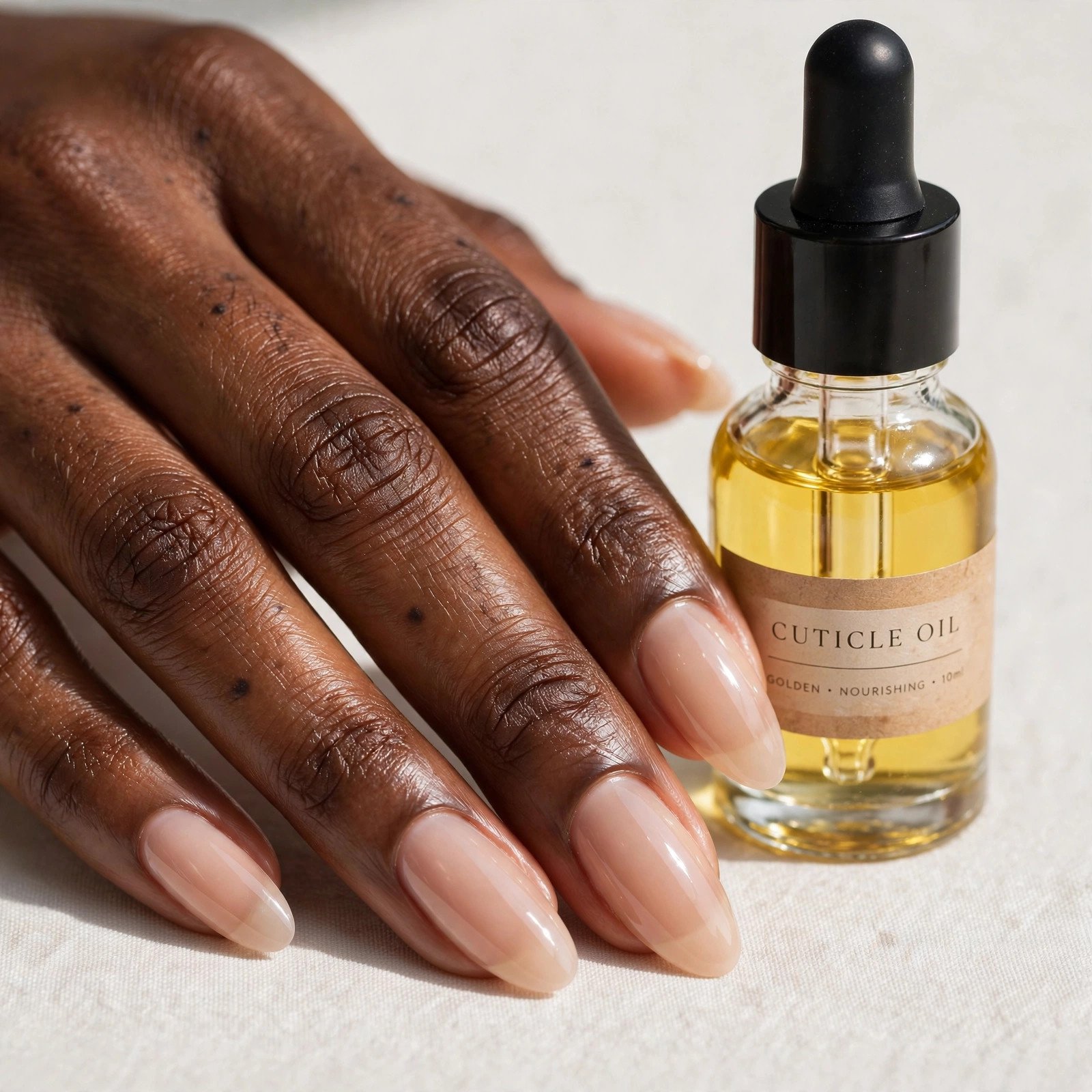
This is the one tip I would keep if I could only keep one. I used a jojoba-based cuticle oil — jojoba because its molecule is small enough to actually penetrate the nail plate, unlike heavier oils that just sit on top — and I applied it twice daily for the full eight weeks: once in the morning after washing my hands, and once at night before bed, massaging it into the cuticle and the whole nail for about ten seconds per nail. The first two weeks felt pointless. By week four, the chronic peeling on my index and middle fingers had visibly calmed. By week eight, my nail plates looked denser and the white spots I’d assumed were permanent had faded.
The nuance nobody mentions: oil works because a hydrated nail plate is a flexible nail plate, and a flexible nail bends instead of snapping. Dry nails are glass; oiled nails are plastic. I also learned the hard way that timing matters — oil right after water exposure, not before, because oil can’t seal in moisture that isn’t there. And if you wear polish, oil over the polish is fine; the oil still reaches the cuticle, which is the growth-command center. I burned through one 15ml bottle in the eight weeks, applying generously. Cost per week: about the price of a coffee.
Best for: Peeling, splitting layers, and nails that snap before they ever get long. If your nail surface looks flaky, start here.
02. File with a glass file, in one direction only
I filed my nails with a cheap emery board for years, sawing back and forth like I was cutting wood. That sawing motion frays the keratin layers at the free edge and starts micro-tears that become full splits weeks later — damage you blame on “weak nails” when it was really the filing. Week two of my experiment, I switched to a glass (crystal) file and filed in one direction only, from the side toward the center, with light pressure. Glass files have a finer, more even grit than emery boards and they seal the edge as they shape it.
The directional thing sounds fussy until you see the difference under good light: one-direction filing leaves a smooth, sealed edge; sawing leaves a feathery mess. I also stopped filing dry, brittle nails in the middle of the day and started doing maintenance filing in the evening after oiling — the nail is slightly more flexible and less prone to tearing. My files lasted the whole experiment without going dull, which never happened with emery boards that I replaced monthly. One more detail: keep the file clean. A clogged file drags instead of cutting, and dragging is just sawing with extra steps.
Best for: Nails that split at the tips or peel in horizontal layers starting from the free edge. If your splits always begin at the tip, this is your tip.
03. Stop using your nails as tools
This was the hardest habit to break and the second-most impactful change. I tallied it for a week before the experiment: I was using my nails to open cans, scrape stickers, pick at seams, pry open boxes, and pop open my laptop lid — roughly a dozen times a day. Every one of those is a stress event concentrated on the thinnest, weakest part of the nail. I started carrying a tiny multi-tool on my keychain and deliberately reaching for it instead, which felt ridiculous for about three days and then became automatic.
The connection to growth is pure mechanics: your free edge is a lever, and prying multiplies force at the stress point where the nail meets the fingertip. That’s exactly where my nails always broke — the sides of my index fingers, the classic “snagged on a can tab” break. After I stopped the tool-use, my break count dropped faster than from any other single change. Tip 04 below only fully works if you’re already doing this one, because no protective layer survives being used as a screwdriver. I also retrained how I type — flatter finger pads instead of digging in with tips — after noticing my nails clicking hard on the keyboard was another daily stress event.
Best for: Chronic side-breaks, nails that “always break at the same length,” and anyone whose breaks happen during daily tasks rather than randomly.
04. Keep a protective layer on the nail at all times
Bare nails take the full force of every bump, every water cycle, every bit of friction. For the middle four weeks of my experiment I kept my nails continuously covered — either clear strengthening base coat or actual polish, reapplied as needed, with the tip “wrapped” (painting a thin line of polish along the very edge of the nail to seal it). The polish acts as a sacrificial layer: it absorbs the micro-damage that would otherwise hit the keratin. My nails grew noticeably during these weeks, and I credit the protection more than any “growth” ingredient in the bottles.
The practical system that worked: a strengthening base coat as the foundation, two thin coats of color if I wanted it, a glossy top coat, and — this is the part most people skip — a fresh thin layer of top coat every two to three days to keep the seal intact. Chipped polish left on for days is worse than no polish, because water gets under the chip and lifts more of the plate. I removed and redid the whole thing weekly. If you want the full retention system for keeping manicures intact between applications, my two-week manicure routine covers the exact method I still use. Thin coats are non-negotiable — thick coats chip in sheets and take nail layers with them.
Best for: People whose nails grow fine but never survive — the length is there, it just never lasts. Also great if you wash your hands constantly.
05. Wear gloves for dishes, cleaning, and cold
Hot water and detergent are a demolition crew for nail length. Dish soap is designed to strip oils — including the natural oils in your nail plate — and prolonged hot water swells the nail, then air-drying shrinks it fast, stressing the keratin with every cycle. I started wearing rubber gloves for dishes and any cleaning with chemicals, and the difference in how my nails felt after a sink session was immediate: no more of that soft, bendy, waterlogged feeling that used to precede a break by a day.
The cold part surprised me. I added cotton gloves for walking the dog on cold mornings in week six after reading that cold air pulls moisture from the nail plate, and my winter brittleness that week was noticeably less — though to be fair, one week in mild October cold isn’t a full test. I’ll be repeating this in January. The habit design matters more than the gloves themselves: I keep rubber gloves under the sink and cotton ones by the door, because a habit that requires hunting for supplies dies in three days. If gloves feel like too much, even just oiling before and after wet work (tip 01) covers most of the damage — but gloves plus oil is the real answer.
Best for: Anyone whose nails get soft and bendy after water exposure, or who notice seasonal breakage every winter.
06. Switch to an almond or oval shape while growing
Square nails look sharp and break sharp. Every corner of a square nail is a stress concentrator — a point where force collects and a crack starts. I wore squoval for years because I liked the look, and my break log from the experiment’s first two weeks confirmed the pattern: breaks almost always started at a corner. In week five I filed everything into a soft almond, and corner breaks stopped entirely. The oval/almond shape distributes force along a curve instead of concentrating it at two points, which is simple physics that took me embarrassingly long to apply.
There’s a trade-off I’ll be honest about: almond makes fingers look longer and more elegant, but it also makes nails look slightly less “edgy,” and if your style is square, this feels like a compromise. My compromise: grow in almond, then file back to a soft squoval once I’ve reached my target length and the nail has some thickness and resilience behind it. A new, thin nail in a square shape is asking for trouble; the same nail three months later can handle corners. I also keep the length modest on my dominant hand’s index finger — the highest-traffic nail — and let the others run longer.
Best for: Corner snags and breaks, square-shape wearers whose nails never survive past a certain length, and anyone hard on their hands.
07. Moisturize your hands like you mean it
Your nails are part of your skin system, and they dry out with it. I was oiling my cuticles religiously (tip 01) but ignoring the backs of my hands and the skin around my nails, and the result was hangnails — those little torn bits of skin at the nail fold that I would then pick at, which damaged the cuticle area and set back growth. In week five I added a proper hand cream after every hand wash, and the hangnails stopped within ten days. No hangnails meant no picking, which meant the cuticle area stayed intact.
The product detail that matters: I used a cream with urea and ceramides for the hands — urea gently softens rough skin around the nail folds, ceramides support the skin barrier — and I kept a tube at every sink. The cuticle oil handles the nail plate and cuticle; the hand cream handles everything around it. They’re a pair, not substitutes. I also started applying hand cream before bed and sleeping with it on, which sounds like a lot but takes fifteen seconds. Dry, cracked skin around the nail doesn’t just look bad — every crack is a snag point and a picking invitation, and picking at the nail fold can damage the matrix underneath where the nail is actually made.
Best for: Hangnails, dry cracked skin around nails, cuticle pickers, and anyone whose nail problems start at the skin rather than the plate.
08. Fix breaks immediately — don’t let them travel
A small tear at the free edge will travel. I watched this happen in week three: a tiny snag on my thumbnail that I ignored for two days became a crack running a third of the way down the nail, and I lost a week’s growth filing it out. From that day on, the rule was: any snag gets dealt with within the hour. A dab of nail glue or a silk wrap on a small crack can genuinely save the nail — the glue bonds the keratin back together and the silk distributes the stress — and for bigger breaks, filing down just that one nail beats losing all of them to sympathetic picking.
I keep a tiny emergency kit in my bag now: a mini glass file, a tube of brush-on nail glue, and a couple of pre-cut silk strips. Total cost was a few dollars and it has saved at least five nails since the experiment ended. The technique that works: glue under and over the crack, press a silk strip onto the wet glue, let it set, then file smooth and seal with base coat. It’s invisible under polish and it holds through normal life. If the break is below the smile line and painful, don’t be a hero — file it down and let it regrow. I have a full walkthrough of the repair methods in my broken nail fix guide, because one saved break is worth a week of growth.
Best for: Anyone mid-growth-journey whose progress gets wiped out by a single break. This tip protects your gains.
09. Feed the matrix: protein, iron, and water (but skip the miracle supplements)
Your nail matrix builds keratin from the amino acids you eat, so chronic undereating of protein genuinely shows up in nails months later — thin, slow-growing, ridged. I didn’t overhaul my diet; I just made sure I was getting a palm-sized portion of protein at each meal during the experiment, plus iron-rich foods a few times a week since low iron is one of the few deficiencies actually linked to nail problems (spoon-shaped nails are the classic sign). I also drank water consistently instead of living on coffee until 3pm. Did it make my nails grow faster? Honestly, probably not measurably in eight weeks. But my nails looked healthier, and healthy-looking growth is what we’re after.
Here’s the part that saves you money: biotin. I took it for a month before the experiment because every growth article recommends it, and it did nothing for me — because biotin only helps if you’re deficient, and deficiency is rare in people who eat normally. The studies showing benefit were in people with brittle nail syndrome or actual deficiency. If your diet is reasonable, a biotin gummy is an expensive placebo with a side of potential acne (it gave me jawline breakouts, which is a known thing). Get your protein, eat your greens, drink water, and spend the supplement money on good cuticle oil instead. The exception: if your nails are spoon-shaped, extremely pale, or you’re exhausted all the time, that’s a conversation with a doctor about iron — not a supplement aisle decision.
Best for: Overall nail quality and the long game. This is foundation work, not a quick fix — and it costs nothing extra if you’re already eating decently.
10. Consider builder gel (BIAB) as training wheels for weak growers
I’m putting this last because it’s the most divisive and the most “cheating”-feeling, but it deserves honesty: a thin layer of builder gel — the brush-on kind, often called BIAB — was the single thing that got my weakest nails (my thumbnails, which peeled relentlessly) through their fragile phase. Builder gel adds a flexible, protective structure over the natural nail that absorbs impact and prevents the flexing that causes delamination. My thumbnails finally grew past the fingertip once they had that armor on. It’s not growing your nails faster; it’s a cast that lets them grow undisturbed.
The caveats are real and I won’t minimize them: it costs money (salon) or time and a learning curve (DIY with a lamp), removal must be done by soaking off — never peeling, which rips up the nail plate and sets you back months — and some people’s nails react badly to the curing process. I did DIY with a careful soak-off routine and had no damage, but I also know people who wrecked their nails peeling off gel in frustration. Think of it as training wheels: wear it for two or three growth cycles until your natural nails have enough length and thickness to survive on their own, then transition off. My full breakdown of the method, products, and the soak-off routine that kept my nails intact is in my builder gel guide.
Best for: Nails so weak they can’t survive the growing phase at all, chronic peelers who’ve tried everything else, and special-occasion growers on a deadline.
Fino Tip: Tips 01, 03, and 04 are the power trio — oil for flexibility, no tool-use for stress reduction, and a protective layer for armor. If you only adopt three things from this entire article, make it those. They reinforce each other: oil keeps the nail flexible, the no-tools rule removes the biggest stress events, and the polish layer absorbs whatever’s left.
Fino Tip: Photograph your nails weekly in the same light and angle. Progress at 3mm a month is invisible day to day, and “invisible progress” is why most people quit in week three. My week-4 photo is what kept me going — I could finally SEE the difference, and that carried me through the boring middle weeks.
Mistakes to avoid (I made all of these)
Cutting your cuticles is the big one, and I did it for years with those little nippers, thinking I was “cleaning up.” Your cuticle is a living seal that keeps bacteria and water out of the nail matrix — the factory where your nail is made. Cut it and you get a ragged, inflamed seal that grows back thicker and uglier, plus an open door for infection that can damage the matrix and leave permanent ridges. What actually works is what my cuticle care routine covers: soften with oil, gently push back with an orangewood stick after a shower, never cut. My cuticles looked worse for about two weeks after I stopped cutting, then looked better than they ever had.
Over-buffing is the silent killer I never suspected. I used to buff my nails to a shine every week because I liked the glossy look, and I was literally sanding away the top layers of my nail plate — thinning the exact structure I was trying to grow. A nail plate is only about half a millimeter thick; aggressive buffing removes a meaningful fraction of it. Now I buff lightly, maybe once a month, with the finest-grit side only, and never on the same nail two sessions in a row. If your nails feel thin and flexible in a bad way, ask yourself when you last buffed.
Using nails as tools we’ve covered (tip 03), but the specific version that kept biting me was opening cans and peeling stickers — both concentrate force at the weakest point. The biotin-without-deficiency trap is covered in tip 09: expensive, probably useless, possibly breakout-inducing. Two more quick ones: picking at gel or polish instead of soaking it off — peeling takes layers of your natural nail with it every time, and I lost a full month of growth to one impatient peeling session — and ignoring a break until it travels (tip 08 exists because I learned this the painful way). Finally, the meta-mistake: changing everything at once. When I tried five new products in one week back in September, something irritated my cuticles and I had no idea which product did it. Change one thing at a time, give it two weeks, then judge.
Fino Tip: The “two-week rule” saved my sanity: never judge a nail change before two weeks of consistent use. Nails grow slowly and react slowly. I almost quit the glass file in week one because nothing looked different — by week three the edge quality was obviously better. Patience isn’t just a virtue here, it’s the whole method.
Nail growth FAQ
How long does it take to grow long nails from short? Based on my measured 3mm-a-month rate, going from fingertip-short to 6mm of free edge took me eight weeks of consistent habits — and that was with zero major breaks. Realistically, plan on two to three months for a noticeable transformation and four to six months for genuinely long natural nails, because the first month is mostly about stopping the damage cycle before growth can accumulate.
Do nail growth serums actually work? In my experience, no better than plain cuticle oil. I tried one popular peptide serum in week six alongside my usual jojoba oil on the other hand, and after two weeks there was no visible difference between the hands. Serums are mostly oil with marketing. Save your money and buy a bigger bottle of jojoba-based oil instead.
Why do my nails grow but always break at the same length? Because you’ve hit your “breakage ceiling” — the length at which everyday stress exceeds what your nail plate can handle. The fix isn’t growing faster, it’s raising the ceiling: switch to almond shape (tip 06), keep a protective layer on (tip 04), stop tool-use (tip 03), and oil daily (tip 01). My ceiling moved from fingertip-length to 6mm past it in eight weeks without my growth rate changing at all.
Is it bad to keep nail polish on all the time while growing? Not if you do it right. Continuous coverage protected my nails through the whole experiment. The rules: always use a base coat (never color directly on the nail), remove and redo weekly rather than letting chips sit, moisturize the cuticles over the polish, and give your nails one or two polish-free days between manicures now and then to check their condition. What damages nails isn’t polish — it’s improper removal and leaving chipped polish on for weeks.
Can biting my nails permanently stop them from growing? Chronic severe biting can damage the matrix and cause permanently ridged or misshapen nails, but for most biters — including me — the damage is reversible once you stop. My bite tally went from constant to near-zero using the most unglamorous method possible: bitter-tasting polish plus keeping my nails polished so there was nothing satisfying to bite. The exception: if your nail beds look very short or scarred after years of biting, a dermatologist can tell you whether the matrix is damaged.
Does filing in one direction really matter? Yes, and it was the cheapest win in my whole experiment. Sawing back and forth frays the keratin at the free edge and starts the micro-tears that become splits. One-direction filing with a glass file seals the edge instead. It takes maybe thirty seconds longer per hand and it eliminated the tip-peeling that had plagued my index fingers for years.
Eight weeks ago my nails never survived past my fingertips, and I was convinced I just had “bad nail genetics.” I didn’t — I had bad nail habits, and habits are fixable. Start with the oil, put down the emery board, stop prying things open with your thumbnails, and give it two honest months. Take the weekly photo. Future you, filing actual length into an actual shape, will be glad you started today instead of buying another miracle serum.


Pingback: Why Do My Nails Keep Peeling? 10 Causes & Fixes
Pingback: How I Stopped Biting My Nails & Grew Them Long
Pingback: Why Are My Nails Yellow? Causes & Fixes
Pingback: Best Nail Polish Remover for Natural Nails (2026)