

In This Article
- My Chipping Story: The Manicure That Lasted One Day
- Why Polish Chips: Adhesion vs Cohesion, in Plain Language
- Fix 01. Dehydrate the Nail Plate
- Fix 02. Never Skip the Base Coat
- Fix 03. Thin Coats, Always
- Fix 04. Cap the Free Edge
- Fix 05. Give Each Coat Time to Dry
- Fix 06. Gloves for Water and Cleaning
- Fix 07. Stop Using Your Nails as Tools
- Fix 08. Fix the Nail Underneath the Polish
- Fix 09. Refresh the Top Coat Every Two Days
- Fix 10. Know When Regular Polish Has Hit Its Limit
- Winter Chipping: Why Cold Weather Makes It Worse
- How to Spot-Fix a Chip Without Redoing the Manicure
- Mistakes to Avoid
- Frequently Asked Questions
My Chipping Story: The Manicure That Lasted One Day
I painted my nails on a Sunday evening, a deep burgundy I had been looking forward to all week, and by Monday lunchtime the tip of my index finger had a chip the size of a grain of rice. By Tuesday there were three. By Wednesday I was peeling the rest off in the car, which is the most undignified way to end a manicure and also the worst thing you can do to your nails. I blamed the polish. I blamed the brand. I bought a more expensive polish, and it chipped in two days instead of one, which was somehow more insulting. It took me an embarrassing amount of time to accept that the polish was never the problem. The problem was everything I did before, during and after painting — and once I fixed those things, the same cheap polish I had blamed lasted a full week.
That is the story behind this article, and it is the story behind the question itself: why does my nail polish chip so fast? The answer is almost never one thing. It is a small stack of small mistakes, each one costing you a day, and the fixes are just as small. I have ranked the ten fixes below by how many extra days each one buys you, based on my own wear, because “do better prep” is not useful advice and “this fix buys you two days” is. If you want the wider picture on making a manicure last, my how to make your manicure last two weeks covers the full routine, and my why nails keep peeling explains the nail underneath the polish, which is half of this story.
Why Polish Chips: Adhesion vs Cohesion, in Plain Language
A chip is a mechanical failure, and there are only two kinds. Adhesion failure is when the polish loses its grip on the nail — it peels off in flakes, usually starting at the cuticle or the sides, and it means something got between the polish and the nail: oil, moisture, lotion, or a cuticle that was never pushed back. Cohesion failure is when the polish film itself cracks — it splits at the tips or across the nail, and it means the film was too thick, too brittle, or flexed more than it could handle. Everything that makes nails chip faster feeds one of those two failures, and the fixes split the same way: the prep fixes solve adhesion, the application and habit fixes solve cohesion. When you look at a chip, you can diagnose it. Flakes peeling off whole? Adhesion — fix the prep. Cracks at the tips? Cohesion — fix the application and the habits. That diagnosis is the most useful thing in this article, because it tells you which half of the list to start with.
Nails are not dead armour; they are flexible plates that absorb water, bend under load and dry out just like skin. They swell when they are wet and shrink as they dry, and that swelling and shrinking flexes the polish film until it cracks. A nail that has been in hot water for twenty minutes is a different size from the same nail an hour later, and the polish has to survive that change. Regular polish air-dries into a relatively soft film, which is why some tip wear within a few days is normal, and why gel polish — which cures into a hard, bonded layer — lasts two to three weeks where regular polish lasts one. None of that is a flaw in your polish. It is physics, and the fixes below are all ways of working with the physics instead of against it.
The Ten Fixes, Ranked by Extra Days
Fix 01. Dehydrate the Nail Plate
Buys you: two to three days. This is the single biggest fix on the list, and it is the one most people skip. Natural oils, hand cream, cuticle oil and even the moisture from washing your hands all leave a slippery layer on the nail plate, and polish applied over that layer never bonds properly — it peels off in flakes within a day or two. The fix takes thirty seconds: wipe each nail with pure acetone or a dedicated nail dehydrator on a lint-free pad, and do not touch the nail with your fingers afterwards, because your fingertips are oily too. Do it immediately before the base coat, not ten minutes before, because the oils come back. I used to think this step was salon fussiness. Then I tried a manicure with it and a manicure without it, same polish, same day, and the dehydrated hand lasted three days longer. That is the whole argument. Best for: anyone whose polish peels off in flakes rather than cracking.
Fix 02. Never Skip the Base Coat
Buys you: one to two days, plus no staining. A good base coat creates a bonding layer between the natural nail and the coloured polish. It fills minor ridges, gives the colour a consistent surface to sit on, and stops dark colours from staining the nail underneath. Without it, polish lifts more easily, particularly around the tips and sides, and the colour grips the nail directly, which is a worse bond than colour gripping base coat. I use a ridge-filling base coat because my nails have a slight ridge, and the smoothing alone is worth it. One thin coat, fully dry before the colour goes on — if the base coat is still tacky, the layers slide apart and you have built a manicure on a fault line. The base coat is not optional, it is not a upsell, and it is the cheapest insurance in the bottle. Best for: everyone, always, no exceptions — and dark colours especially.
Fix 03. Thin Coats, Always
Buys you: two days. Thick coats are the most common reason a manicure chips, dents or peels, and they are the mistake I made longest. A heavy layer may look dry on the surface while remaining soft underneath, because the solvents cannot evaporate through the thick film. That soft underlayer never hardens properly, and the polish peels off in sheets. Thick polish also cannot flex with the nail: everyday movement puts pressure on the hardened colour, especially near the free edge, and instead of bending slightly, the bulky layer cracks. The fix is three thin coats instead of one thick one, with the brush wiped on the neck of the bottle so you are applying polish, not pouring it. Each coat should look slightly sheer. If you can see the nail through the first coat, you are doing it right. Best for: anyone whose polish peels off in big sheets, and dark colours, which show thick-coat streaks worst.
Fix 04. Cap the Free Edge
Buys you: two days. The free edge takes the most punishment of any part of the nail. Typing, opening drawers, searching through handbags, fastening jewellery, handling kitchen containers — all of it creates repeated friction at the tips, and chips start at the tip and spread. Sealing, or “capping,” the free edge is the fix: after painting the nail surface, lightly sweep the brush across the exposed tip, with the colour and again with the top coat. Do it thinly — a thick ridge of polish along the tip creates the opposite effect and makes chipping easier. I cap with the base coat too, so the tip is sealed at every layer. This one fix, done properly, is the difference between tip wear on day two and tip wear on day five, and it takes about ten seconds per hand. Best for: typists, and anyone whose chips always start at the tips.
Fix 05. Give Each Coat Time to Dry
Buys you: one day. Rushing between coats leaves polish vulnerable even when the surface feels dry. Each layer needs time for its solvents to evaporate, and when you apply another coat too quickly, you trap solvents underneath — the manicure stays soft for much longer than it should, and it dents and chips at the slightest touch. I give each coat two full minutes, which feels like an eternity when you are sitting still, and I use the time to do the other hand or to clean up the cuticles. A quick-dry top coat helps, but it does not replace the waiting — it dries the surface, not the layers underneath. The test is simple: if you can still smell the polish strongly, it is not dry. Wait. Best for: the impatient, and anyone who paints their nails late at night and then gets into bed.
Fix 06. Gloves for Water and Cleaning
Buys you: two days. Long water exposure is the quietest chip cause on this list. Nails absorb water and swell; as they dry, they contract again, and that swelling and shrinking flexes the polish film until it cracks. Hot water is worse than cold, dish soap is worse than water, and cleaning products are the worst of all — they soften the polish and dry out the nail underneath at the same time. The fix is a pair of rubber gloves for washing up, cleaning and anything involving prolonged water. I keep a pair by the sink and a pair under it, because the gloves only work if they are where you need them. This is also the fix that protects the nail underneath the polish, not just the polish itself, which is why it matters in winter, when hands are already dry. Best for: anyone who washes up by hand, and winter, when the water is hottest and the air is driest.
Fix 07. Stop Using Your Nails as Tools
Buys you: one to two days. Opening cans, scraping labels, picking at stickers, prying open packaging — every one of these puts a lever force on the tip of the nail, and the tip is exactly where chips start. I did this for years without noticing, and the day I started using the pads of my fingers and actual tools instead, my manicures gained two days overnight. The habit is unconscious, so the fix has to be conscious for a while: catch yourself, stop, find the scissors. It is the least glamorous fix on this list and one of the most effective, because tip impact is the single most common cause of cohesion failure. If your chips always start at the same two fingers — usually the index and thumb — this is your fix. Best for: anyone whose chips always start on the index finger and thumb.
Fix 08. Fix the Nail Underneath the Polish
Buys you: two days, and healthier nails. Soft, brittle or splitting nails are one of the main causes of polish that chips too soon, because the foundation is moving. Weakened keratin — from nutritional gaps, repeated micro-trauma, nail-biting or a lack of moisture — creates tiny cracks invisible to the naked eye that prevent polish from adhering properly. A thin, peeling nail plate flexes more than the polish can follow, so the polish cracks with it. The fix is not a polish, it is care: daily cuticle oil, a ridge-filling base coat, keeping nails at a length your plate can support, and not peeling gel or acrylic off, which thins the plate further. I spent a month oiling my nails every night before I noticed the difference, and then my manicures started lasting a week instead of four days. The nail underneath is the foundation; no polish can fix a bad foundation. Best for: thin, peeling or bendy nails, and anyone coming off acrylics or gel.
Fix 09. Refresh the Top Coat Every Two Days
Buys you: one to two days. A thin layer of top coat every two to three days restores the shine, seals any micro-chips before they spread, and adds a fresh layer of armour over the colour. It takes two minutes and it is the maintenance habit that separates the people whose manicures last a week from the people whose manicures last four days. I do it on Wednesday and Friday if I painted on Sunday, and I cap the free edge again each time. The top coat needs to be a good one — a cheap top coat that goes dull in a day is worse than no top coat at all, because it gives you a false sense of protection. This is also the fix that makes a manicure look freshly done on day five, which is worth something on its own. Best for: anyone who wants a week of wear from regular polish, and dark colours, which lose their shine first.
Fix 10. Know When Regular Polish Has Hit Its Limit
Buys you: the decision, not the days. If your regular polish is chipping within days despite good prep and sensible habits, you have hit the limit of air-dried lacquer. It dries by evaporation into a relatively soft film, and no top coat can fully change that. Gel polish cures under an LED lamp into a far harder, bonded layer that typically stays chip-free for three or more weeks — and BIAB adds a strengthening layer underneath the gel that makes the whole system tougher still. This is not a failure, and it is not a reason to buy more expensive regular polish; it is a signal to change the system. I switched to gel when my typing-heavy job kept defeating regular polish, and the difference was immediate. One honest caveat: gel solves chipping, but it raises the stakes on removal. Peel it off and you will trade chipped polish for thinned nails — always have it soaked off properly. My gel polish removal guide covers the safe method, and my best remover guide covers what to use. Best for: anyone who has fixed the prep and the habits and still chips in three days.
Winter Chipping: Why Cold Weather Makes It Worse
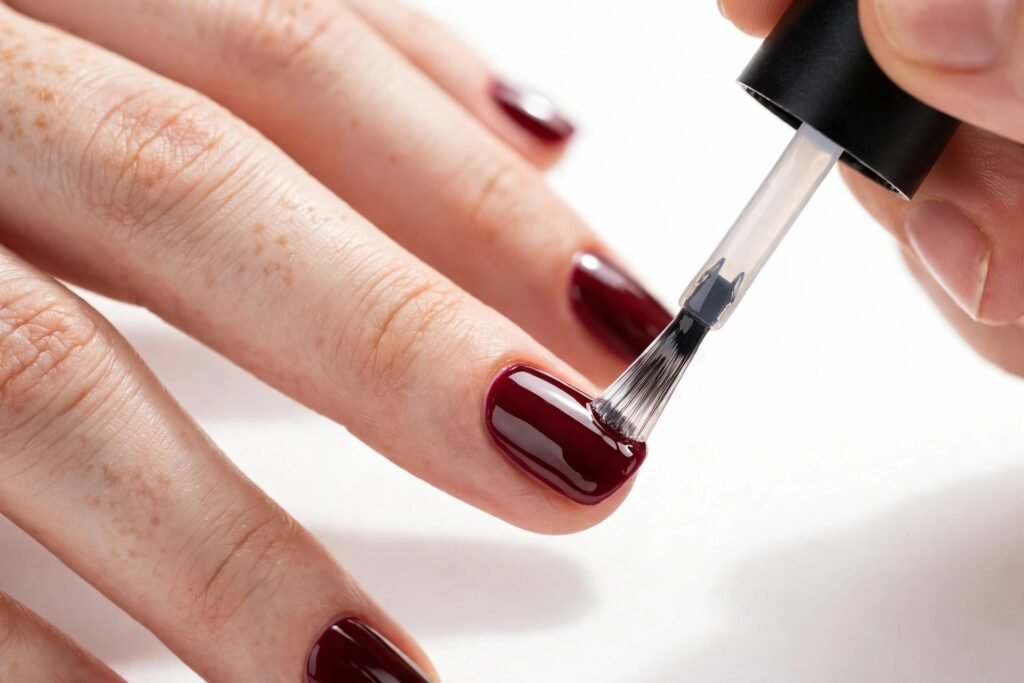
Winter is the worst season for chipping, and it is not your imagination. Cold air dries out the nail plate, hot water from washing up swells it, central heating dries it again, and the constant expansion and contraction flexes the polish until it cracks. Gloves outdoors help — not just for warmth, but because they protect the polish from cold and knocks — and cuticle oil matters more in winter than in summer, because oiled nails flex without cracking and dry nails snap. I also paint a shade darker in winter, because dark colours hide tip wear and winter is the season when tip wear is worst. The winter rule I live by is simple: gloves outside, gloves for washing up, oil every night, top coat every two days. It is not exciting, and it works.
How to Spot-Fix a Chip Without Redoing the Manicure
A chip does not mean the manicure is over. If the chip is at the tip, dab a tiny amount of the same colour onto the missing spot with the corner of the brush, let it dry for two minutes, and seal with top coat, capping the edge. If the chip is in the middle of the nail, fill it the same way and feather the edges so there is no ridge. If the chip is at the cuticle, it is usually a lifting problem rather than a chip, and the fix is to file the lifted edge smooth and seal it — do not peel it, because peeling takes the rest of the polish with it. A spot-fix will not be invisible, but it will be unnoticeable at conversation distance, and it buys you three more days, which is often all you need. The mistake is picking at the chip, which turns a two-millimetre problem into a whole-nail problem in about ten seconds.
Fino Tip: keep the bottle of the colour you are wearing in your bag for the week. A spot-fix needs the exact colour, and “close enough” is visible on dark shades. The bottle is small, the habit is free, and it has saved more manicures of mine than any top coat ever has.
Mistakes to Avoid
Blaming the brand. I did this for a year. The brand is almost never the problem — the prep, the coats and the habits are. Fix those first, and only then judge the polish.
Painting over hand cream. If you apply hand cream or cuticle oil shortly before painting, the polish cannot grip. Cream after painting, never before — and dehydrate the plate if you have moisturised in the last hour.
One thick coat instead of three thin ones. Thick looks faster and it is slower, because it never dries properly and it peels off in sheets. Thin coats are the whole game.
Peeling chipped polish off. Peeling takes layers of the nail plate with it, and a thinned nail chips faster next time. File the chip smooth, spot-fix it, or remove it properly with remover.
Skipping the top coat refresh. The top coat is not a one-time step. It wears down, and when it is gone the colour is unprotected. Two minutes every two days is the maintenance that makes the week happen.
Frequently Asked Questions
Why does my nail polish chip so fast? Usually a stack of small causes: oil or moisture left on the nail plate, coats applied too thick, the free edge left unsealed, thin or peeling nails underneath, hot water and cleaning products, or using your nails as tools. Diagnose the chip first — peeling flakes mean a prep problem, cracks at the tips mean an application or habit problem — and then fix that half of the list.
How can I make my nail polish last longer? Dehydrate the nail plate before the base coat, use a base coat, apply three thin coats, cap the free edge with colour and top coat, give each coat two minutes to dry, wear gloves for water and cleaning, and refresh the top coat every two days. Together those fixes take a three-day manicure to a full week.
Is it normal for nail polish to chip after two days? Some tip wear within a few days is normal for regular polish, especially if you type all day — regular polish air-dries into a soft film. If it is chipping badly on day one or two, the prep or the application is the problem, not the polish. Gel polish typically stays chip-free for two to three weeks.
Does base coat really stop chipping? Yes — it creates a bonding layer between the nail and the colour, fills minor ridges, and stops the colour from lifting at the tips and sides. A ridge-filling base coat also smooths the surface, which helps the colour sit evenly. Never skip it.
Why does my nail polish chip on one hand more than the other? Your dominant hand does more work — more typing, more opening, more impact — so it chips first. Cap the free edge more carefully on the dominant hand, and refresh its top coat a day earlier than the other hand.
Should I switch to gel polish if my polish always chips? If you have fixed the prep and the habits and regular polish still chips in three days, yes — gel cures into a much harder layer that lasts two to three weeks. Just have it soaked off properly, never peeled, or you will trade chipped polish for thinned nails. My cuticle care routine will help keep the nails underneath healthy while you wear gel.



Pingback: Why Is My Nail Polish Bubbly? Causes & Fixes That Work