

Does biotin grow nails faster, does biotin make nails stronger, is biotin for nail growth actually backed by anything real — it’s all the same question, and for years I dodged it because the answer felt like it should be an ad, not an experiment. Then last summer, after my nails snapped through an entire set of acrylics and refused to recover, I decided to stop reading other people’s opinions and run my own test. Ninety days, one daily dose, weekly measurements, and honest notes about everything — including the stuff supplement brands never put on the label. Here is the short version, because I respect your time: yes, biotin made a genuine, measurable difference to my nails — but not the way most people expect, not at the speed they promise, and not without trade-offs I wish someone had warned me about. The growth itself was modest. The reduction in splitting and peeling was the real win. And the side effects were more real than the results section of any study ever admitted. If you’re considering biotin for nail growth, this is the article I wish I’d had before I bought the bottle.
In This Article
- What Biotin Actually Does (and Doesn’t Do)
- My 90-Day Experiment: The Setup
- The Results, Month by Month
- The Side Effects Nobody Mentions
- Biotin vs. The Other Growth Methods I’ve Tried
- Mistakes to Avoid
- FAQ: Biotin for Nail Growth
What Biotin Actually Does (and Doesn’t Do)
Biotin is a B-vitamin — vitamin B7 — that your body uses to metabolise fats, carbohydrates, and amino acids, the building blocks of keratin, the protein your nails are made of. That’s the entire biological basis for the biotin-for-nails story: nails are keratin, keratin needs amino acids, biotin helps process them. It’s a plausible chain of logic, but it’s also where most supplement marketing stops thinking and starts selling. What the evidence actually says is more specific and less dramatic than the bottle labels. There is a small body of clinical work — most notably a German study and a US follow-up in the 1980s and 90s — in which people with brittle, splitting nails took biotin for several months and a meaningful majority showed thicker, less fragile nails. The sample sizes were small, the participants were deficient or borderline to begin with, and the results measured thickness and breakage far more than raw growth speed. That’s a crucial distinction. Biotin doesn’t appear to make the nail matrix generate cells dramatically faster; what it seems to do, in people whose nails are fragile, is improve the quality of the keratin being built, which means less peeling, fewer white-tipped splits, and nails that actually survive long enough to get long. In my experience, this matched exactly what I saw — and it’s the opposite of what the marketing promises. If your nails already grow at a normal rate and never break, biotin will probably do nothing you can see. If you’re like I was — nails that peel like onion skins and snap before they pass the fingertip — the mechanism is aimed right at your problem. One more honest note: true biotin deficiency is rare, and most of us get some from eggs, nuts, and sweet potatoes. The doses used in the nail studies were pharmacological, thousands of times the daily requirement, not dietary. So “I eat well, so biotin won’t help me” isn’t necessarily true — but “biotin is natural so it can’t hurt” isn’t true either, as I’ll explain in the side effects section.
My 90-Day Experiment: The Setup
I started on a Monday in early May, which I remember because I’d just had my acrylics soaked off and my natural nails looked like shredded paper — thin, flaking at the free edge, and breaking if I so much as looked at a can of soda. Perfect worst-case subjects. I chose 5,000 micrograms (5 mg) daily, the dose most nail-focused studies landed on, taken with breakfast. I didn’t go higher — 10,000 mcg is common on store shelves, but the evidence plateau doesn’t justify it in my view, and the side-effect risk climbs. To measure honestly, I needed numbers, not vibes. Every Sunday I did three things: measured each thumbnail from cuticle to free edge with a digital caliper (thumbnails because they’re the widest and easiest to measure consistently), took a close-up photo of both hands against the same white tile background with the same lighting, and wrote a paragraph of notes — breakage, splitting, texture, how the nails felt when filing. Controls mattered: I changed nothing else about my routine for the full 90 days. Same base coat, same cuticle care routine, same amount of hand-washing and dish-soap exposure. I also kept my diet and water intake roughly steady, because if I suddenly started eating like an athlete in week six, the results would be meaningless. If you’re wondering why this matters: I’d previously written a broad nail growth tips guide, and biotin was one tip among many — I wanted to know whether it deserved the prominence it was getting. This experiment was me fact-checking my own advice.
The Results, Month by Month
Weeks 1–4: absolutely nothing, and that’s normal. I want to say this loudly because nobody does: month one is a dead zone. Fingernails grow roughly 3–3.5 mm per month, and biotin works at the matrix, under the cuticle — the nail you’re looking at today was built weeks ago. So for the first month I saw zero change in the visible nail, which is exactly what the biology predicts. What I did notice, around week three, was that the new growth right at the base of the nail — that half-moon-adjacent fresh keratin — looked slightly more uniform, less ridged. It might have been wishful thinking. I wrote “maybe imagining it” in my notes, which I think is the most honest thing in this entire article.
Weeks 5–8: the breakage curve bent. This is where the experiment got interesting. My caliper readings showed growth rate essentially unchanged — thumbnails grew about 3.2 mm per month before, and about 3.3 mm during. Statistically nothing. But breakage plummeted. In a typical month I’d lose at least one nail to a sidewall split that started at the free edge and ran halfway down, forcing me to file everything short. During weeks five through eight, I lost zero. The peeling — the onion-skin delamination at the tips that had plagued me for years — visibly decreased. Filing felt different too: before, the file would catch and lift layers; now the edge came off clean, like cutting a single piece of material instead of laminated paper. I’d estimate nail thickness increased subtly, consistent with those old clinical studies, though my caliper measured length, not thickness, so this is observational. The photos from week eight compared to week one show the most dramatic difference in the nail plates’ surface smoothness — fewer transverse ridges, a more glassy look. This was the phase where I went from sceptic to believer, not about speed, but about structural quality.
Weeks 9–12: the compounding effect. Here’s the thing nobody explains: biotin doesn’t grow nails faster, it grows nails better, and “better” compounds. By month three, the average monthly growth was still only about 3.4 mm — a real but modest uptick — yet my nails were the longest they’d been in years, simply because nothing broke. Length is growth minus breakage, and biotin attacked the breakage side of the equation. I wore them bare for two weeks in month three just to look at them, and the free edges were intact, the tips were thicker and less translucent, and the chronic splitting at my index fingers — the worst offenders — had stopped entirely. I stopped the supplement at day 90 to see what would happen, and the benefits lingered for roughly six to eight weeks before the peeling gradually returned. That decay curve told me the effect was real and biotin-dependent, not a coincidence or a seasonal change.
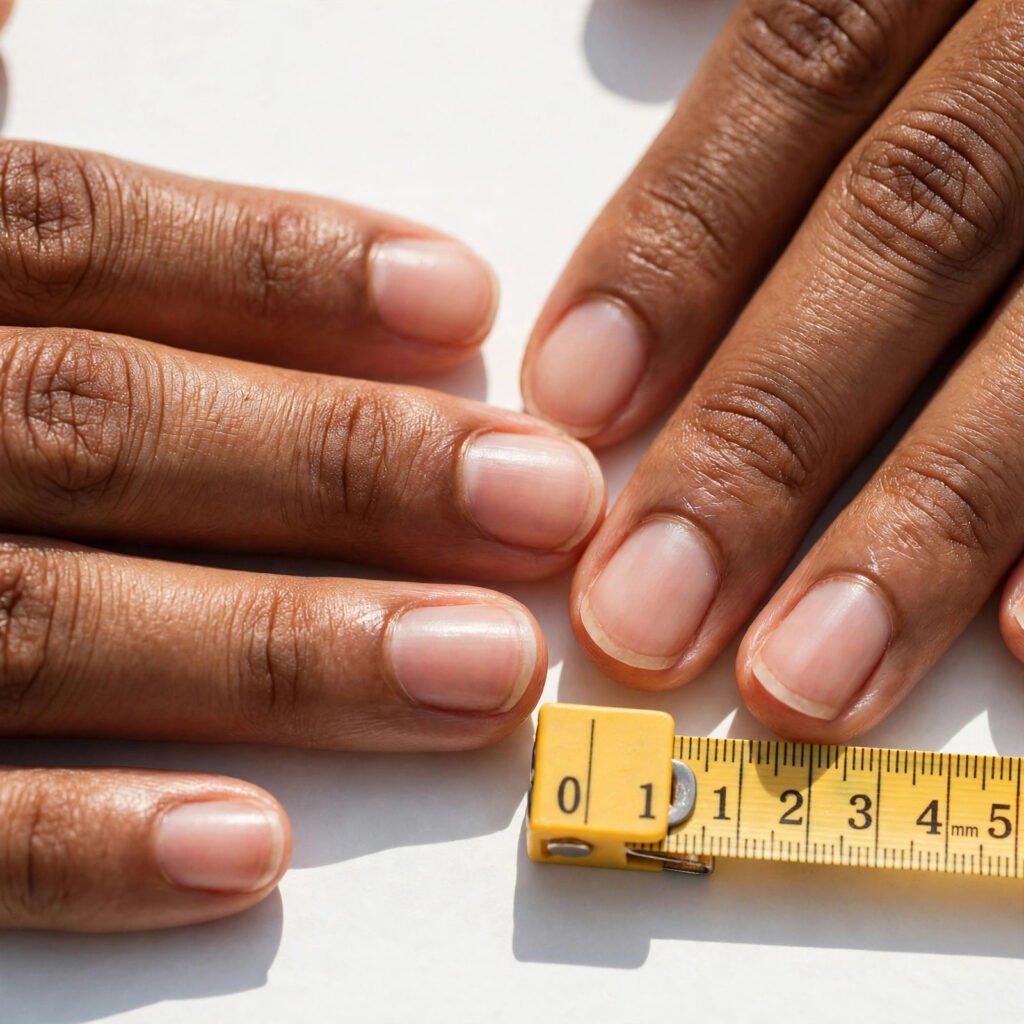
Fino Tip: Measure at the thumbnail, weekly, with a cheap digital caliper — and take photos against the same background every time. Your memory will lie to you about gradual changes; a photo series from week 1 to week 12 won’t.
The Side Effects Nobody Mentions
This is the section supplement brands hope you skip, and it’s why I was glad I ran this as an experiment rather than just buying into the hype. Around week two, I broke out — small, stubborn spots along my jawline and chin. Biotin competes with other B-vitamins, particularly B5 (pantothenic acid), for absorption, and B5 is involved in skin barrier function; dermatologists have noted this pattern for years. It wasn’t severe, but it was real, and it persisted until I stopped. I also noticed mild digestive queasiness if I took the dose on an empty stomach — with breakfast, nothing. The most important side effect, though, is one I didn’t experience but learned about mid-experiment and now consider mandatory disclosure: high-dose biotin can interfere with certain lab tests, including thyroid panels and cardiac troponin tests, potentially causing misleading results. The FDA has flagged this. If you’re having bloodwork done, tell your doctor you’re taking biotin and stop it several days before, per their guidance. Nobody at the supplement aisle told me this. None of these effects were deal-breakers for me personally — the jawline spots cleared within two weeks of stopping — but “natural vitamin, zero downside” is a fiction, and anyone selling biotin for nail growth without mentioning the trade-offs isn’t being straight with you. In my experience, the side effects were mild but persistent enough that I now only recommend people try biotin with a defined end date and a reason to stop, not as a forever supplement.
Fino Tip: Always take biotin with food, and if you’re prone to breakouts, try a lower dose (2,500 mcg) first. The lab-test interference is the one to actually worry about — mention it to your doctor before any bloodwork.
Biotin vs. The Other Growth Methods I’ve Tried
I’ve tried essentially everything the internet recommends for growing nails, so here’s my honest ranking based on what actually moved the needle in my own experience. Daily cuticle oiling comes first, and it’s not close — massaging jojoba oil into the cuticles nightly made a bigger difference to breakage in four weeks than biotin did in twelve, because hydrated nails flex instead of snapping. My winter nail care routine leans heavily on this, since dry air is the real enemy. Second is biotin itself — the structural improvement is genuine and it stacked well with oiling. Third is a hardener or strengthening base coat, which I rate as a useful crutch but not a fix: it protects weak nail while it’s on, but the nail underneath isn’t better. Fourth is diet — I eat decently and my nails were still terrible, so while protein and minerals matter at the margins, food alone never moved the needle for me the way a targeted supplement did. The honest hierarchy: oil externally every day, consider biotin internally for three months if your nails are genuinely brittle, use a strengthener as protection during the fragile phase, and don’t expect kale to fix splitting. What I do now, permanently, is nightly oiling plus a biotin round once a year when my nails feel fragile — usually in late autumn, when dry air starts the damage cycle. For anyone rebuilding after damage, the combination I used is close to what I describe in my guide to strengthening nails after acrylics: repair the surface, protect the edges, and support the growth from within at the same time.
Mistakes to Avoid
Mistake 1: Quitting at week three because “it doesn’t work.” I nearly did this. The visible nail is dead tissue built weeks ago; nothing you swallow today can change it. You need at least eight to twelve weeks before the improved keratin reaches the free edge in meaningful amounts. Anyone selling a “30-day biotin nail transformation” is selling biology that doesn’t exist.
Mistake 2: Taking it on an empty stomach. I learned this on day four with a churning stomach that ruined my morning. Biotin, especially at 10,000 mcg, wants food underneath it. This is a small thing that determines whether you actually stick with the experiment.
Mistake 3: Going straight to 10,000 mcg. More is not better here — the studies that showed nail benefits used moderate doses, and the breakout and absorption-competition issues scale with dose. I chose 5,000 mcg deliberately and never felt the need for more, because the results at twelve weeks were already clear.
Mistake 4: Not controlling the rest of your routine. If you start biotin the same week you also start oiling, switch base coats, and stop picking at your cuticles, you’ll have no idea what worked. I kept everything else identical for 90 days, which is the only reason I can say anything confident about biotin specifically. Run one variable at a time.
Mistake 5: Treating it as permanent. I stopped at day 90 and the benefits lingered for weeks. Cycling — three months on when nails are fragile, time off otherwise — gave me all the upside with the side effects clearing in between. A supplement you take forever without re-evaluating is a habit, not a strategy.
Mistake 6: Ignoring the lab-test issue. High-dose biotin can distort thyroid and cardiac lab results. This is the one mistake with consequences beyond cosmetics. If you’re on any dose above dietary levels, your doctor should know.
Fino Tip: Set a calendar reminder for day 90 before you take the first pill. The end date is what turns this from an open-ended habit into an experiment — and it’s what makes the “did it work?” question answerable.
FAQ: Biotin for Nail Growth
How long does biotin take to work on nails?
In my experience, expect nothing visible for the first four weeks — the nail you see was built before you started. Subtle improvements in breakage and peeling showed up around weeks five to eight for me, and the full effect was clear at twelve weeks. If you see nothing by week twelve, it’s fair to conclude it doesn’t work for your nails, because at that point the entire visible nail plate has been built during supplementation.
Can biotin damage your nails?
Biotin itself doesn’t damage nails — there’s no mechanism by which it weakens keratin, and I saw nothing suggesting harm in 90 days. What it can do is cause side effects elsewhere: breakouts from B-vitamin competition, mild stomach upset on an empty stomach, and interference with certain lab tests. So your nails are safe, but tell your doctor you’re taking it before any bloodwork.
What dose of biotin is best for nails?
I used 5,000 mcg daily, which matches the doses in the clinical studies that showed nail benefits. Many products sell 10,000 mcg, but the evidence doesn’t support needing more, and side effects scale with dose. Start at 2,500–5,000 mcg, and only go up if a lower dose did nothing after a full three months.
Does biotin work if your nails are already healthy?
Honestly, probably not in any visible way. Biotin seems to help fragile, brittle, splitting nails most — the studies were done on people with exactly that problem. If your nails already grow well and rarely break, there’s nothing for biotin to fix, and you’re more likely to notice the breakouts than any benefit.
Is biotin better than collagen for nails?
I haven’t run a controlled collagen experiment, so I’ll be careful here. The mechanism for biotin is better documented for nails specifically — there are actual nail-focused studies, small as they are. Collagen’s nail evidence is thinner and mostly extrapolated from skin and hair data. If I had to pick one for a brittle-nail experiment, I’d pick biotin first, based on the evidence we have.
The bottom line from my 90 days: biotin didn’t make my nails grow dramatically faster — about a 5–6% increase in monthly growth rate, which is barely measurable — but it made them genuinely stronger, thicker-feeling, and dramatically less prone to splitting, which meant they finally got long. If that’s the result you’re after, it’s worth the experiment. Just go in with a measuring tape, a calendar, and realistic expectations, not a miracle story.


Pingback: How I Stopped Biting My Nails & Grew Them Long
Pingback: How Long Do Nails Take to Grow? (2026)
Pingback: Why Are My Nails So Thin and Bendable? Causes & Fixes