January is the month pink nails either win or embarrass you. I learned that the hard way two winters ago, when I walked out of a salon in the second week of January wearing a glittery candy pink that had looked perfect on December 23rd and suddenly looked like a leftover Christmas cracker. Pink winter nails and pink January nails describe the same trend — I use pink winter nails since that’s what most of you search — but the pinks that work in January are not the pinks that work in December, and nobody seems to want to say that out loud.
Here’s the distinction I now live by: December pink is festive pink. It sparkles, it pairs with red and gold, it has a job to do at parties. January pink is winter pink. It’s quieter, dustier, warmer, the colour of a wool coat’s lining and the inside of a cashmere glove. It has to hold its own against grey skies, black coats, and the flat light of a winter morning, and it has to do it for weeks after the tree comes down. The twelve ideas in this article are all January pinks — soft, cozy, deliberately un-Christmassy — and I’ve worn or tested every single one of them, including the three that looked wonderful in the salon and terrible by week two. You’ll hear about those too.
One thing before we start: this is a different article from festive pink. If you want glitter, bows, and candy-cane-adjacent pink, I wrote about that separately — my pink Christmas nail ideas are all sparkle and celebration, and they’re the right call in December. What follows here is what I wear after the celebrations end, when the pink has to be the outfit, not the ornament.
In This Article
- Dusty Rose Quilt
- Icy Ballet Pink with a Silver Fade
- Deep Raspberry Matte
- Pink Velvet Cat-Eye
- Blush Almond with Chrome
- Pink Ombre Snowflake
- Rose Gold Foil on Nude
- Bubblegum Pink with Pearl Studs
- Mauve Line Art
- Pink Aura with Iridescent Flakes
- Hot Pink Accent on Frosted Matte
- Pink French with a Double Liner
Why Pink Works in Winter (And When It Doesn’t)
Pink has a reputation problem in winter, and honestly, most of it is earned. The pink most people reach for — bright, clean, bubblegum — is a spring colour pretending to be a winter one, and in January light it reads as a mistake, like wearing white linen in a snowstorm. But pink itself is not the problem. The problem is the wrong pink. Winter light is flat, blue-grey, and unforgiving; it drains warmth out of everything, including your hands. A pink with a grey, dusty, or warm brown undertone holds up in that light because it has something in common with the season. A pink that is purely bright and clean has nothing to lean on, so it floats off your hand like a sticker.
The second thing winter does to pink is expose it. In summer, a pink manicure is one note in a busy outfit — sandals, colour, skin, sun. In winter, your hands are the only skin showing, framed by a dark coat sleeve, and every nail is on display. That is actually why pink works so well once you pick the right shade: it becomes the softest thing about an otherwise hard, dark winter outfit, and people notice it precisely because everything else is charcoal and navy. I’ve had more compliments on a dusty rose manicure in January than on any red I wore in December, and I think it’s because the pink was doing a job — warming up the whole look — rather than competing with it.
When pink doesn’t work in winter is when it argues with the season instead of cooperating with it. Neon pink against a camel wool coat is the classic clash; both are fighting for attention and neither wins. Glittery pink after the holidays reads as a hangover from a party you weren’t invited to. And pink with a blue-white base on very fair skin in January can make hands look colder than they are, which is the opposite of what anyone wants. The fix is never to abandon pink — it’s to choose the pink the way you’d choose a coat: dusty over bright, warm over icy (unless the icy is deliberate, as in look 02), and textured over flat. Everything in this article follows that rule, and the winter nail colours I keep coming back to follow it too — the dusty and muted shades in that guide are the same family these twelve pinks belong to.
The 12 Pink Winter Nail Ideas
I’ve ordered these the way I’d actually wear them through January: starting with the quietest, coziest pinks and building toward the bolder ones, so you can stop wherever your comfort level stops. Each one includes the technique, the time it takes, how long it lasts, and my honest verdict on who it’s best for. A few of these are salon jobs; several are genuinely doable at home with a steady hand and a good lamp. And if you need a press-on shortcut for any of them, I’ve noted it — press-ons have quietly become the best way to try a winter pink for a week before committing to it in gel, and nobody in the competitor guides I read bothered to mention that.
01. Dusty Rose Quilt
This is the pink I reach for when I want my hands to look like they belong in a candlelit room. A dusty rose base — think OPI’s “You Don’t Know Jacques!” gone warmer, or Essie’s “Angora Cardi” — with a quilted pattern pressed or painted into the two ring fingers in the same shade, just a touch deeper. The quilting is done with a thin brush or a stamping plate, crossing diagonal lines into diamonds, and a matte top coat makes the whole thing read as fabric instead of polish. It takes about 45 minutes in gel and wears for two to three weeks, because matte hides tiny chips. The difficulty is moderate, but because it’s tonal — same colour family, no contrast — small wobbles disappear. Press-on shortcut: buy a matte dusty rose set and add the quilted look with a nail art pen on two nails.
Best for: anyone who wants winter pink that reads as expensive and quiet — office-safe, coat-friendly, and the single most complimented January manicure I own.
02. Icy Ballet Pink with a Silver Fade
If 01 was the quilt by the fire, this one is the walk home through fresh snow. The base is a sheer ballet pink — the kind that barely covers, like Essie “Ballet Slippers” — and the tips fade into soft silver, either chrome powder burnished into the free edge or fine silver glitter that thins as it travels down the nail. The trick is the fade: a hard silver line looks like a French manicure from 2004, but a gradient dissolving into pink looks like frost. It takes about 40 minutes in gel; the chrome step is the only fiddly part, needing a no-wipe top coat and quick work before the powder sets. Wear is excellent, two to three weeks, because the sheer base makes grow-out nearly invisible. This is the one pink here with a cool undertone, and it works precisely because it leans into the cold instead of fighting it.
Best for: fair to light skin tones and anyone who loves winter itself — it looks best against snow, silver jewellery, and pale grey knitwear.
03. Deep Raspberry Matte
This is the boldest pink in the first half of the list, and the one I wear when January feels too long and I need my hands to look alive. Deep raspberry — darker than bubblegum, softer than burgundy, like Essie’s “Fishnet Stockings” warmed up a shade — worn matte on a short almond or squoval shape. The matte is doing real work here: glossy deep raspberry reads as a night-out colour, but matte pulls it back into daytime, into wool and leather and coffee cups. Application is simple — two coats, a matte top coat, no art — about 30 minutes, the easiest look on the list. The catch is wear: matte shows chips and scuffs faster than gloss, especially at the tips, so refresh the top coat at day five, and keep cuticles oiled because matte makes dry skin more visible.
Best for: anyone who wants one bold January pink without any nail art — medium and deep skin tones especially, where raspberry glows against the skin.

04. Pink Velvet Cat-Eye
Velvet cat-eye polish is the texture trick that made me fall back in love with pink in winter. A magnetic polish in a dusty or mauve pink — the magnet pulls the shimmer into a soft, shifting band that looks like velvet when you move your hand — and in January light it catches the low sun in a way flat polish never does. The technique is straightforward but unforgiving: hold the magnet over each nail for ten seconds right after the second coat, before curing — rush it and the band goes blurry. One coat is never enough; two coats and a glossy top coat are what give it depth. It takes about 50 minutes for a full gel set and lasts two to three weeks. Ask for a muted rose or mauve magnetic, not bright pink, and ask for the magnet held diagonally so the band sits off-centre, like fabric rather than a gimmick.
Best for: anyone who wants dimension without nail art — the closest thing to a party nail that still belongs in January.
05. Blush Almond with Chrome
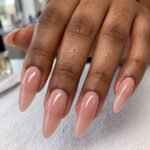
This is the one I wore to a January wedding last year and the one strangers asked about most. A blush pink base on an almond shape — long enough to look elegant, short enough to type — with a sheer chrome powder rubbed over the whole nail so the pink turns pearlescent, like the inside of a shell. The chrome step is the whole look: too much powder and it goes mirror-silver, too little and it vanishes, so the sweet spot is a light dusting over a no-wipe top coat, sealed with another top coat. It takes about an hour in gel and needs a salon or a steady hand, because chrome powder gets everywhere. Wear is two to three weeks, and the almond shape is genuinely practical in winter: no sharp corners to catch on knitwear, the biggest cause of January chips. If 04 felt too textured or too dark, this is its quieter, shinier sibling.
Best for: special occasions in January — weddings, dinners, anything where your hands will be photographed — and almond-shape loyalists.
06. Pink Ombre Snowflake
The only snowflake in this list, and deliberately the softest one. A pink ombre — dusty rose at the cuticle fading to pale blush at the tip — with a single tiny snowflake stamped or hand-painted on one accent nail per hand, in white, no glitter, no rhinestones. The restraint is the point: a full set of snowflakes is a Christmas manicure, but one small snowflake on a pink ombre is a winter manicure, and it stays wearable well into February. The ombre is the hard part — sponge it on in three thin layers, or ask for an airbrush ombre, which is faster and smoother. The snowflake takes five minutes with a stamping plate. About an hour in gel; wear is excellent because the pale tip hides grow-out. I wore this in the last week of January and got asked if it was new — exactly the test a January pink should pass.
Best for: anyone who still wants a whisper of winter whimsy after Christmas — and the best snowflake option for people who hate Christmas nails.
07. Rose Gold Foil on Nude
Rose gold foil is my January cheat code, because it gives you sparkle without glitter, and glitter after Christmas is a hard sell. The base is a sheer nude pink — your nails but better, like OPI “Bubble Bath” — and torn pieces of rose gold foil are pressed onto two or three accent nails while the base is still tacky, then sealed under a glossy top coat. The foil catches light in warm flashes instead of the cold sparkle of silver glitter, which is why it works in January: it reads as jewellery, not decoration. It takes about 40 minutes, and the difficulty is low — foil is forgiving, because torn edges are supposed to look organic. Wear is two weeks in gel, and the foil holds up well as long as it’s properly sealed; one unsealed edge will catch on everything you own.
Best for: minimalists who want one warm metallic note, and anyone doing their nails at home — this is the easiest “expensive-looking” January pink on the list.
08. Bubblegum Pink with Pearl Studs
Yes, bubblegum pink in January — but with conditions, and the pearl studs are the condition. The bubblegum has to be the soft kind, not the neon kind — think a milky, slightly desaturated bubblegum, like Essie’s “Fiji” with a drop of white mixed in — on a short, rounded shape, with one tiny flat-back pearl stud at the base of each ring finger, or a small cluster of three micro-pearls on one nail. The pearls pull the pink toward vintage and away from spring, and give the eye somewhere to land besides the brightness. Without them, this pink reads as April. With them, it reads as a deliberate, pretty January statement. About 35 minutes in gel; the studs need a dot of nail glue plus top coat — press them in while it’s wet and seal twice. Wear is two weeks, and the short shape is practical: pearls on long nails catch on everything.
Best for: anyone who refuses to give up bright pink in winter — the pearls are what make it work, so don’t skip them.
09. Mauve Line Art
Mauve is the pink for people who think they don’t like pink, and line art is the design for people who think they can’t do nail art. The base is a sheer mauve or a soft mauve-nude, and the art is a single thin line per nail — a curved arc near the cuticle, a diagonal slash across the tip, a tiny half-moon — drawn in a deeper mauve or warm brown with a striping brush. One line, no more. The restraint is what makes it look designed rather than doodled, and it’s the look I recommend to anyone who has ever said “I could never do nail art” — you can, in about ten minutes, with a brush that costs less than a coffee. About 40 minutes in gel; wear is excellent, since the sheer base hides grow-out and a single line has nothing to chip. Pick a mauve with a grey or brown undertone, not purple, or it slides into lilac.
Best for: nail-art beginners, minimalists, and anyone who wants a January pink that works in a boardroom.
10. Pink Aura with Iridescent Flakes
Aura nails — a soft halo of colour blooming in the centre of the nail — are the trend I was most sceptical about and the one I now wear most often. The base is a milky blush, and a dusty pink is sponged or airbrushed into the centre of each nail so it glows from within, then a few iridescent flakes are pressed into the wet top coat, catching blue and green and gold as you move. The flakes are what keep it from looking like a spring manicure: they’re cold-toned, like frost on a window, and they anchor the pink in winter. It takes about an hour in gel, and it’s a salon job for most people — the aura blending needs an airbrush or a very patient sponge technique, and the flakes must be placed while the top coat is wet or they’ll slide off.
Best for: trend lovers and anyone who wants the most modern pink on the list — it photographs beautifully and feels like the future of winter nails.
11. Hot Pink Accent on Frosted Matte
One hot pink nail per hand, on a frosted matte base — that’s the whole idea, and it’s the bravest one here. The base is a pale frosted pink or a milky white-pink in a matte finish, and the accent nail, usually the ring finger, is a full hot pink in gloss. The contrast is the point: the matte frost makes the hot pink look deliberate instead of loud, like a single red scarf against a grey coat. About 35 minutes in gel and genuinely easy — the only skill is painting one nail a different colour — but the shade choice is everything. The hot pink has to be a true, slightly blue-toned hot pink; a warm coral-pink turns the whole thing into a summer manicure by accident. Wear is two weeks, with the usual matte caveat: refresh the matte top coat at day five.
Best for: anyone who wants a jolt of colour in the greyest month without committing all ten nails to it.
12. Pink French with a Double Liner
The French manicure, but make it January. The base is a sheer blush pink, the tip is a soft dusty pink rather than white, and then — the part that makes it — a second, hair-thin line is drawn just below the tip line, in a slightly deeper pink or a warm gold. The double liner is what separates this from every pink French you’ve seen: it adds a tailored, almost couture detail, like the double stitching on a good coat. About 50 minutes in gel, moderate to high difficulty, because the second line must be even and parallel — a striping brush and a steady hand, or a tech who does French work daily. Wear is excellent, two to three weeks, and the sheer base means grow-out is gentle. If 02 felt too icy, this is its warmer, more classic sibling.
Best for: French manicure loyalists and anyone who wants the most versatile pink on the list — the one pink that genuinely goes with every January outfit.
Fino Tip: When you’re testing a new January pink, paint one nail and wear it for a full day before committing to all ten. I do this with every shade I buy now — one nail, one coat, one day of living in it. A pink that looks perfect in the shop can turn chalky against your winter coat by lunchtime, and one test nail saves you a whole removal.
Which Pinks Carry Into January?
Not every pink survives the calendar change, and the difference is more specific than most guides admit. The pinks that carry into January share three traits: they’re muted, they’re warm or deliberately icy, and they have depth. Dusty rose, mauve, deep raspberry, and warm blush all carry, because they have grey or brown in their DNA — they’re colours that already know what winter looks like. The pinks that don’t carry are the ones with Christmas baked into them: glitter pink, candy pink with red undertones, anything with a bow or a metallic gold partner. Those aren’t bad pinks; they’re December pinks, and I wrote about them properly in my pink Christmas nail ideas — festive pink with sparkle, red, and gold, built for parties. The January rule is simple: if the pink needs a Christmas tree next to it to make sense, it doesn’t carry.
The second test is the coat test, which I run on every January pink before I recommend it. Hold your hand against your winter coat — your actual coat, not a colour chart. If the pink looks like it belongs there, it carries. If it fights the coat, it doesn’t. Neon pink against camel wool fights. Bubblegum pink against black fights a little less but still argues. Dusty rose against charcoal cooperates. Mauve against navy cooperates. Deep raspberry against cream cooperates beautifully. I’ve rejected three shades I loved in the bottle this way, and I’ve never regretted a single rejection — the coat test has never once been wrong for me, and it’s faster than any undertone chart.
The third thing to know is that January pinks age differently from December pinks. A festive pink is designed to be worn for a week and removed; a January pink needs to look good at day fourteen, when the grow-out is showing and the top coat is tired. That’s why so many of the twelve ideas above use sheer or pale bases — sheer blush, milky nude, pale ombre — because sheer bases hide grow-out in a way that opaque bright pink never will. It’s the same sheer-first approach behind my cute winter nail ideas, where the softest looks are the ones that last longest. It’s also why I lean toward gel in January: two to three weeks of wear means one manicure can carry you from the first week of the month to the last, and in the coldest weeks of the year, that’s one fewer errand. If you’re choosing between two pinks and can’t decide, pick the one that will look better on day twelve. That’s the January pink.
Pink by Skin Tone and Undertone
This is the section no competitor guide I read bothered to do properly, and it’s the one I get asked about most, so let’s do it systematically. Skin tone is how light or deep your skin is; undertone is whether it leans warm (golden, yellow), cool (pink, blue), or neutral — and undertone matters more than tone for pink, because pink is itself a warm-or-cool colour and the wrong match is what makes a manicure look “off” without you knowing why. The fastest way to check your undertone is the vein test: look at your wrist in natural light. Greenish veins usually mean warm undertones, blue or purple veins usually mean cool, and a mix usually means neutral. It’s not perfect, but it’s the test I use before buying any pink, and it’s right often enough to trust.
For fair skin with cool undertones, the winners are icy ballet pink (look 02), soft blush, and pale mauve — pinks that share your coolness instead of fighting it. Avoid anything too warm or orange-based, which can make fair cool skin look flushed in the wrong way, and avoid very deep raspberry unless it’s matte, because high contrast on fair skin can look harsh in flat January light. For fair skin with warm undertones, dusty rose and warm blush are your best friends; the warmth in the pink echoes the warmth in your skin, and the result looks healthy rather than washed out. For medium skin, you have the widest range — deep raspberry (look 03), rose gold foil (look 07), and pink velvet cat-eye (look 04) all glow on medium skin, and this is the tone where hot pink accents (look 11) look most intentional. For deep skin, the rule flips: pale sheer pinks can disappear, so go bolder — deep raspberry, hot pink accents, and rich mauve all pop beautifully, while dusty rose works best in its deeper, more saturated versions rather than its palest ones. And for neutral undertones at any depth, you can wear almost everything on this list, which is the one genuine advantage of being neutral — start with dusty rose and mauve, then branch out.
One more thing that matters in January specifically: your hands are paler in winter than in summer, because they’re covered most of the time and the sun is gone. A pink that was perfect on you in August can look too dark or too bright in January, because the skin it sits on has changed. I re-test my favourite pinks every winter for exactly this reason, and I keep a short list of the ones that survive the seasonal shift. If a pink you loved in summer looks wrong now, it isn’t you — it’s the season, and the shade picks in this article are chosen for winter skin, not summer skin. When in doubt, the safest January pink for any tone is a dusty rose with a neutral undertone, which is why look 01 leads this list.
Finishes That Survive Winter
Winter is the hardest season on a manicure, and the finish you choose matters as much as the colour. Cold air, central heating, hot water, wool, and constant hand-washing conspire against your nails from December to February, and I’ve lost count of the manicures that looked perfect on day one and chipped by day four. The single biggest factor is the finish, and the hierarchy is clear from my own wear tests: glossy gel lasts longest, matte gel looks best but chips first at the tips, chrome and foil need proper sealing or they lift, and regular polish — however good the shade — will rarely survive a full January week without a top-coat refresh. If you want the easy at-home versions of these winter looks, my simple winter nail art ideas walk through the designs that take the least time and survive the cold best. If you’re choosing between two identical pinks, one in gloss gel and one in matte, and you need it to last, take the gloss.
Matte deserves a special warning, because it’s the finish most January guides push hardest and the one that fails fastest in real winter conditions. Matte top coats show every scuff, and winter gives you scuffs for free — coat zips, glove cuffs, handbag clasps, the edge of a car door. I still love matte in January, and looks 01, 03, and 11 in this article all use it, but I budget for it: a fresh matte top coat at day five or six, and cuticle oil twice a day, because matte makes dry skin around the nails far more visible than gloss does. The oil matters more than people think. In dry winter air, the skin around your nails cracks and peels, and no pink — however perfect the shade — looks good on ragged cuticles. I keep a cuticle oil pen in my coat pocket and one on my desk, and I use them both, every day, from November to March. It’s the least glamorous advice in this article and the most important.
Chrome and velvet finishes — looks 04, 05, and 10 — have their own winter rule: seal them properly or don’t wear them. Chrome powder and magnetic polish both need a no-wipe top coat underneath and a proper top coat on top, and the edges need to be capped, meaning the top coat is brushed over the free edge of the nail to seal it. An unsealed chrome edge will lift the first time you pull on a glove. And one practical note on water: hot water is the enemy of every finish, because it expands the nail plate and then the polish contracts as it cools, which is what causes lifting at the edges. Wear gloves for washing up — I know, everyone says it, and I ignored it for years — and your January pink will last a week longer. My cloud dancer winter white nails guide covers the same winter-wear principles for white, and the cuticle-care and sealing advice there applies word for word to pink.
Fino Tip: Buy your cuticle oil before you buy your pink. A £5 oil pen used twice a day will do more for how your January manicure looks on day ten than any top coat, and it’s the difference between nails that look cared for and nails that look like they’ve survived a blizzard.
Mistakes to Avoid
The first mistake is the one I made in January two years ago and the reason this article exists: wearing a Christmas pink into January. Glitter pink, candy pink, pink with gold bows — all of it was perfect on December 23rd and all of it looked like a costume by January 10th. The fix isn’t to throw the polish away; it’s to know the expiry date. Festive pink expires with the decorations. If you’re unsure whether a pink is festive or winter, ask whether it would look right next to a plain grey jumper with no decorations anywhere in sight. If the answer is no, it’s a December pink, and my neutral Christmas nail ideas are the better bridge — they were designed to carry from the holidays into the new year without the glitter hangover, and they’re the closest thing to a transition set I own.
The second mistake is neon pink against wool. Neon pink is a summer colour with a megaphone, and a wool coat is a winter fabric with a whisper, and the two of them together look like an argument. I wore a neon pink with a camel coat once, to a lunch, and spent the whole meal aware of my hands in a way I never am with dusty rose. If you love bright pink — and I do, look 11 is built on it — use it as an accent on one nail, not all ten, and pair it with a frosted matte base that calms it down. The third mistake is the opposite one: pink so pale and sheer that it reads as bare nails. A sheer ballet pink on very fair skin in January can disappear entirely, and then you’ve paid for a manicure that looks like nothing. The fix is a second coat, or a pink with a touch more pigment, or a defined tip like the double liner in look 12 — something that tells the eye the pink is there on purpose.
The fourth mistake is forgetting that pink reads as spring if you let it. The triggers are specific: a bright, clean pink with no grey or brown in it; a glossy finish with no texture; floral or butterfly art; and pairing the pink with white or pastel outfits instead of winter colours. Any one of those on its own is fine, but two together and your January manicure starts reading as April. The fix is in the choices above — dusty over bright, matte or velvet over flat gloss, and winter pairings like charcoal, navy, camel, and cream. The fifth mistake is practical and boring and it ruins more January manicures than any colour choice: skipping base coat and cuticle care in dry air. Winter nails are drier, more brittle, and more likely to peel, and pink — especially pale pink — shows every ridge and every bit of staining. A ridge-filling base coat takes thirty seconds and makes pale pink look twice as smooth. And the sixth mistake is wearing long, sharp shapes in January without thinking about knitwear. Stiletto and long coffin nails catch on every jumper I own; if you love the length, go almond, which is the shape that survives wool.
Fino Tip: The fastest way to rescue a pink that reads as spring is a matte top coat. I keep one in my bag all winter — one coat over a too-bright pink knocks the shine off, adds a dusty quality, and pulls the whole manicure back into January in about two minutes. It’s the cheapest fix in this article and it has saved at least four of my manicures.
Frequently Asked Questions
What pink nail colour is best for winter? Dusty rose is the safest all-round winter pink, because its grey-brown undertone works in flat January light and against dark winter coats. If you want one shade to buy first, buy a dusty rose. Mauve is the best second choice, deep raspberry the best bold choice, and icy ballet pink the best cool-toned choice. The pinks to avoid in winter are neon pink and bright bubblegum worn on all ten nails — they read as spring, not winter.
Can I wear pink nails in January? Yes, absolutely — January is one of the best months for pink, because the colour warms up an otherwise dark, grey wardrobe. The trick is choosing January pinks rather than December pinks: dusty, muted, warm, or deliberately icy shades, instead of glittery festive pinks. Every look in this article is designed for January wear, and most of them stay wearable into February.
Do pink winter nails suit all skin tones? Yes, but the right pink changes with your skin tone and undertone. Fair cool skin suits icy ballet pink and pale mauve; fair warm skin suits dusty rose and warm blush; medium skin has the widest range, including deep raspberry and rose gold foil; deep skin suits bolder pinks like deep raspberry and hot pink accents best. The full breakdown, including the vein test for finding your undertone, is in the “Pink by Skin Tone and Undertone” section above.
How do I keep pink nails from looking like spring? Choose a pink with grey or brown in it rather than a bright, clean pink; add texture with a matte, velvet, or chrome finish instead of flat gloss; avoid floral or butterfly art; and pair the manicure with winter colours like charcoal, navy, camel, and cream rather than white and pastels. If a pink you’ve already painted reads as spring, one coat of matte top coat will usually pull it back into winter.
How long do pink winter nails last? In gel, two to three weeks for most of the looks in this article, with matte finishes needing a top-coat refresh around day five or six. In regular polish, about a week, sometimes less in cold weather. Press-ons last five to seven days with proper prep, and they’re the best way to test a January pink before committing to it in gel. Whatever the finish, cuticle oil twice a day and gloves for washing up will add days to the wear.
Are pink winter nails okay for work? Yes — dusty rose, mauve, blush almond, and the pink French with a double liner are all office-safe, and the line-art look in particular was designed for professional settings. The bolder options, like deep raspberry matte and the hot pink accent, work in most workplaces too as long as the shape is kept short and neat. If your workplace is conservative, stick to looks 01, 09, and 12, and save the bolder pinks for weekends.
Fino Tip: If you only try one thing from this article, make it the one-nail test: paint a single nail in any new January pink and live with it for a day against your coat, your knitwear, and your jewellery before you commit. It’s the cheapest insurance in nail care, and it’s how I ended up with a January pink collection I actually wear instead of a drawer full of almost-right shades.